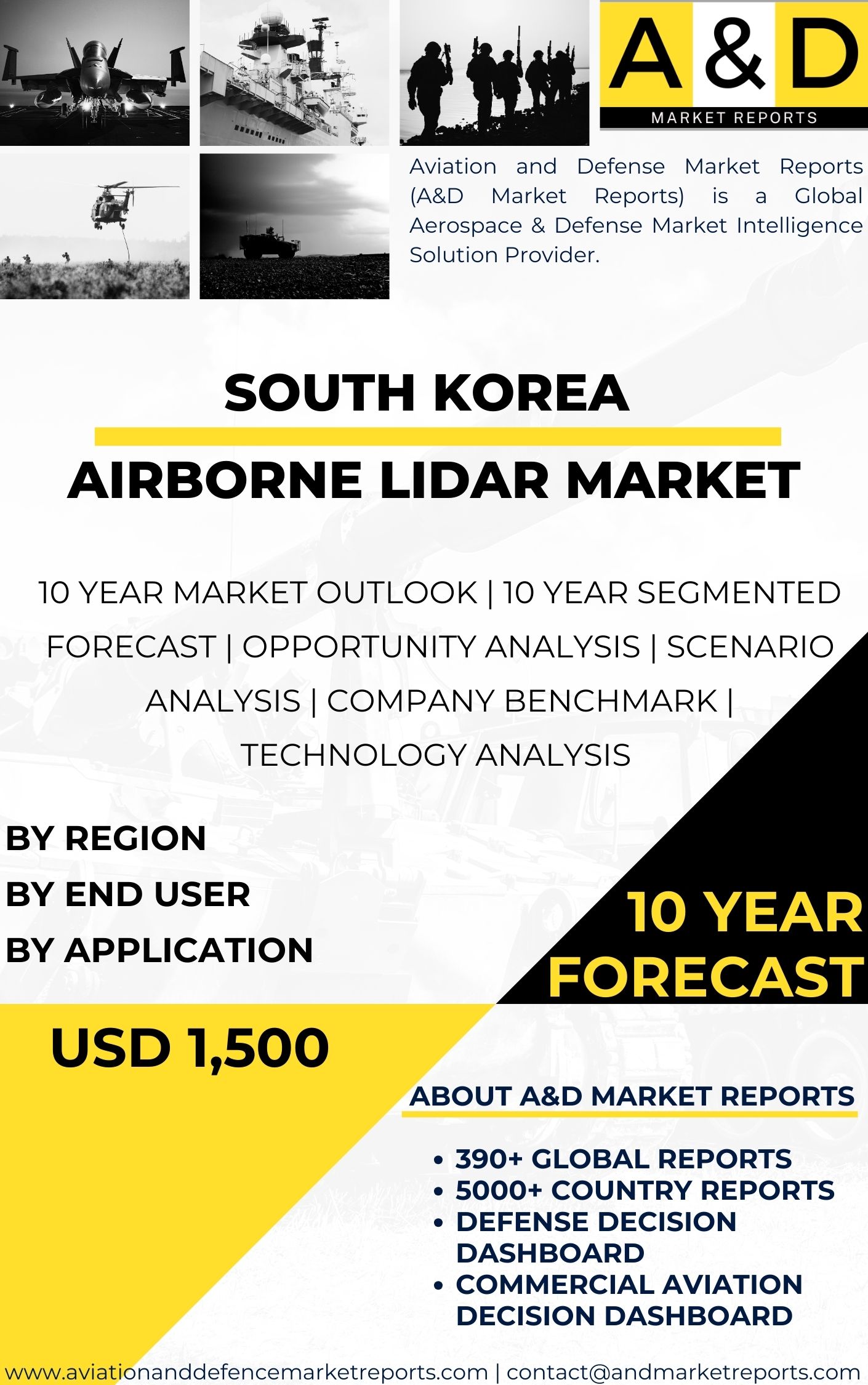
South Korea Airborne LiDAR Market

$1,500.00

Enquire Now
Category: Tags: , , , Report ID: ANDCKR0008

The South Korea Airborne LiDAR market has seen remarkable growth in recent years, driven by increasing demand for high-resolution geospatial data, advancements in LiDAR technology, and the country’s focus on infrastructure development and environmental monitoring. LiDAR (Light Detection and Ranging) is a remote sensing technology that uses laser pulses to measure distances and create precise three-dimensional models of the Earth’s surface. This article provides an in-depth analysis of the current state, growth drivers, challenges, key players, and future prospects of the South Korea Airborne LiDAR market.

Go To Global Report Page Track this market real time on DDD

Description

South Korea Airborne LiDAR Market Overview

The South Korea Airborne LiDAR market is growing steadily due to rising demand for accurate geospatial data. Airborne LiDAR supports mapping, planning, and monitoring activities across industries. The technology uses laser pulses to create detailed three-dimensional surface models. South Korea relies on these systems for development and environmental safety. As a result, market adoption continues to expand.

Development of the South Korea Airborne LiDAR Market

The South Korea Airborne LiDAR market has evolved with advances in remote sensing technology. Early use focused on mapping and surveying projects. Over time, system accuracy and data density improved. These improvements increased application scope. Today, LiDAR supports both public and private sector projects.

Applications in the South Korea Airborne LiDAR Market

Infrastructure and Urban Development

Infrastructure growth drives demand in the South Korea Airborne LiDAR market. Road and railway projects require precise elevation data. Urban planning depends on accurate terrain models. LiDAR helps identify obstacles and design safe routes. It also improves construction efficiency and safety.

Forestry and Environmental Monitoring

Forestry agencies use LiDAR to assess forest health. The technology measures canopy height and biomass accurately. This supports sustainable forest management. Environmental agencies use LiDAR for terrain monitoring. These insights help protect natural resources.

Agriculture and Land Management

Agriculture benefits from data provided by the South Korea Airborne LiDAR market. Farmers use elevation models for irrigation planning. LiDAR helps identify erosion-prone areas. It supports precision farming practices. This improves yield and resource use.

Disaster Management and Risk Assessment

Airborne LiDAR plays a key role in disaster planning. It supports flood modeling and landslide mapping. Emergency teams use LiDAR data for damage assessment. Accurate terrain data speeds response efforts. This improves public safety outcomes.

Technology Trends in the South Korea Airborne LiDAR Market

Technology upgrades strengthen the South Korea Airborne LiDAR market. New sensors offer higher point density. Improved software speeds data processing. These advancements reduce project time. They also increase data accuracy and reliability.

Challenges Facing the South Korea Airborne LiDAR Market

The South Korea Airborne LiDAR market faces several challenges. High system costs limit adoption by smaller firms. Regulatory approval for aerial surveys can delay projects. Data privacy concerns require strict compliance. Competition from established providers increases pressure.

Government Support and Industry Collaboration

Collaboration supports market growth in South Korea. Government agencies partner with private firms. These partnerships reduce financial risks. Research institutions support innovation and skill development. This creates a strong LiDAR ecosystem.

Future Outlook of the South Korea Airborne LiDAR Market

The future of the South Korea Airborne LiDAR market looks positive. Infrastructure and environmental projects will continue. Technology improvements will lower costs. Training programs will expand skilled talent. These factors will drive long-term growth.

Conclusion

The South Korea Airborne LiDAR market is expanding across multiple sectors. Infrastructure, agriculture, and disaster management drive demand. Technological progress improves efficiency and accuracy. Despite cost and regulatory challenges, opportunities remain strong. Continued investment will support sustainable market growth.
Table of content

Table Of Contents

1 Market Introduction

1.1 Market Introduction
1.2 Market Definition
1.3 Market Segmentation
1.4 10 Year Market Outlook

2 Market Technologies

3 Global Market Forecast

3.1 Global Market Forecast
3.2 By End User
3.3 By Application

4 APAC Market Trends & Forecast

4.1 Drivers, Restraints And Challenges
4.2 PEST
4.3 Market Forecast
4.3.1 Market Forecast By End User
4.3.2 Market Forecast By Application
4.4 Scenario Analysis
4.5 Key Companies& Profiling

5 South Korea Analysis

5.1 Current Levels Of Technology Maturation In This Market
5.2 Market Forecast
5.2.1 Market Forecast By End User
5.2.2 Market Forecast By Application
5.3 Scenario Analysis
5.4 Country Defense Budget (Historical and 10- year forecast)
5.5 Defense Budget Category Spending- 10- year forecast
5.6 Procurement Analysis
5.7 EXIM Data
5.8 Patents

6 Opportunity Matrix

6.1 By End User
6.2 By Application

7 Scenario Analysis

7.1 Scenario 1

7.1.1 By End User (Scenario-1)
7.1.2 By Application(Scenario-1)

7.2 Scenario 2

7.2.1 By End User (Scenario-2)
7.2.2 By Application(Scenario-2)

8 Company Benchmark

9 Strategic Conclusions

10 About Aviation And Defense Market Reports

Segments

By End User
By Application

List of Tables

Table1: Global Market Forecast, South Korea Airborne LiDAR Market
Table2: APAC Market Forecast, South Korea Airborne LiDAR Market
Table3: APAC Market Forecast, By End User
Table4: APAC Market Forecast, By Application
Table5: APAC, Scenario Analysis
Table6: South Korea Market Forecast, South Korea Airborne LiDAR Market
Table7: South Korea Market Forecast, By End User
Table8: South Korea Market Forecast, By Application
Table9: South Korea, Scenario Analysis
Table 10: South Korea Defense Budget 10 Year Forecast
Table 11: South Korea, Defense Budget Category Spending- 10- year forecast
Table 12: South Korea, Procurement Analysis
Table 13: South Korea, EXIM Data Analysis
Table 14: South Korea, Opportunity Analysis, By End User
Table 15: South Korea, Opportunity Analysis, By Application
Table 16: South Korea, Scenario Analysis, By End User
Table 17: South Korea, Scenario Analysis, By Application

List of Figures

Figure 1: Market Segmentation, South Korea Airborne LiDAR Market
Figure 2: Key Technology Analysis, South Korea Airborne LiDAR Market
Figure 3: Global Market Forecast, South Korea Airborne LiDAR Market
Figure 4: APAC, Market Forecast, South Korea Airborne LiDAR Market
Figure 5: APAC, Market Forecast, By End User
Figure 6: APAC, Market Forecast, By Application
Figure 7: APAC, Scenario Analysis
Figure 8: South Korea, Market Forecast, South Korea Airborne LiDAR Market
Figure 9: South Korea, Market Forecast, By End User
Figure 10: South Korea, Market Forecast, By Application
Figure 11: South Korea, Scenario Analysis
Figure 12: South Korea, Defense Budget 10 Year Forecast
Figure 13: South Korea, Defense Budget Category Spending- 10- year forecast
Figure 14: South Korea, Procurement Analysis
Figure 15: South Korea, EXIM Data Analysis
Figure 16: South Korea, Opportunity Analysis, By End User
Figure 17: South Korea, Opportunity Analysis, By Application
Figure 18: South Korea, Scenario Analysis, By End User
Figure 19: South Korea, Scenario Analysis, By Application
Figure 20: Company Benchmark