
Description
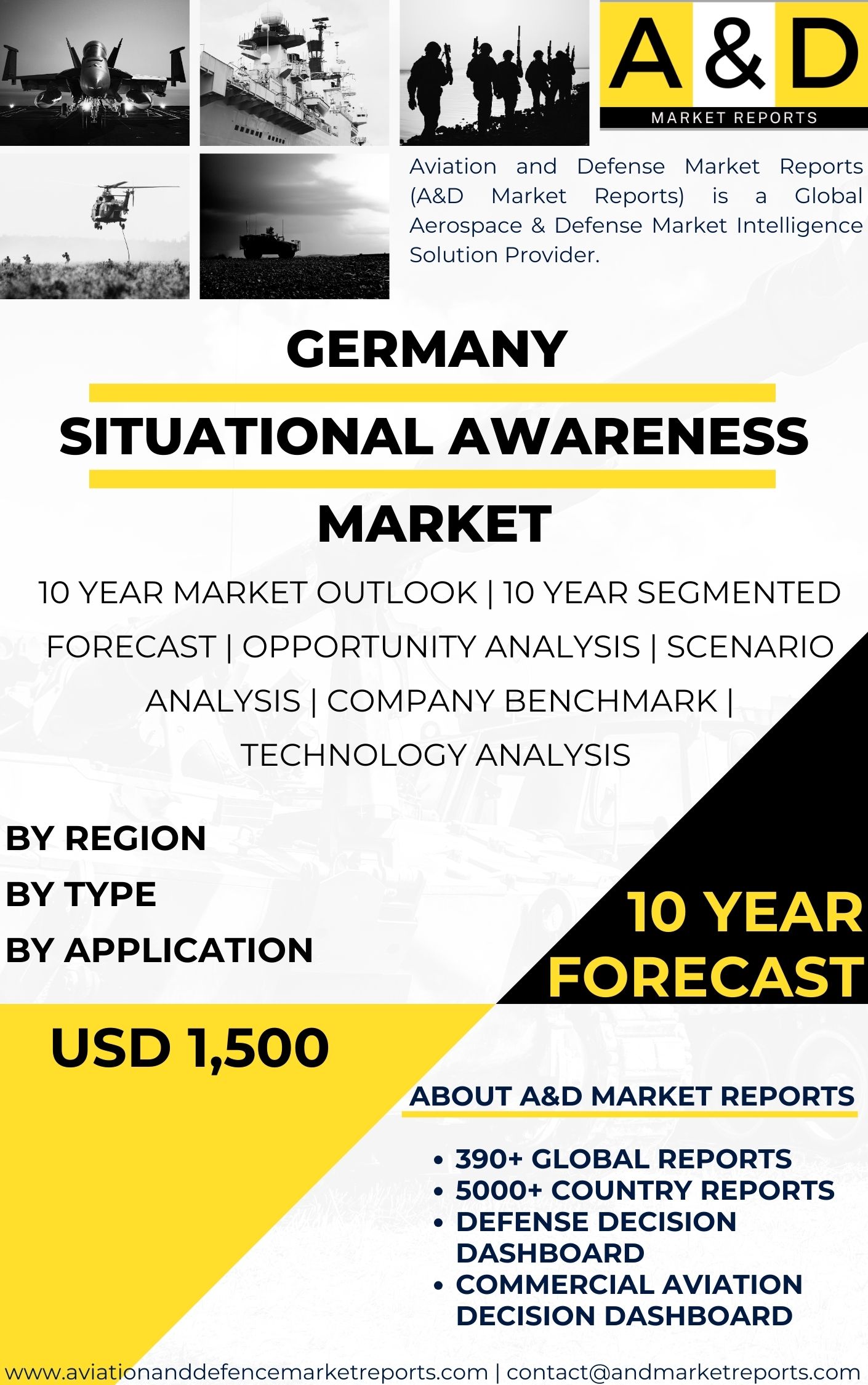
Situational Awareness market in Germany is experiencing robust growth driven by a rising demand for enhanced security, safety, and operational efficiency across multiple sectors. It encompasses technologies, systems, and software that provide real-time data and insights, enabling users to gain a comprehensive understanding of dynamic environments to make informed decisions. This market’s expansion is largely fueled by advancements in sensor technologies such as LiDAR, radar, and cameras, combined with the growing integration of artificial intelligence (AI), machine learning (ML), and the Internet of Things (IoT). These technologies enable more sophisticated data collection, processing, and predictive analysis, significantly enhancing situational awareness capabilities.
A key driver for the market is the increasing need for improved safety and security measures in sectors like defense and aerospace, transportation, public safety, industrial automation, and critical infrastructure. Defense applications include battlefield management and air traffic control, while transportation benefits from situational awareness systems for autonomous vehicles and smart traffic management. Industrial automation leverages predictive maintenance and process optimization, and public safety utilizes these systems for emergency response and crime prevention. The adoption of cloud-based platforms further facilitates data sharing and collaboration, supporting proactive risk management and decision-making in real time.
Government regulations play an important role in market growth, with authorities mandating enhanced security protocols in critical infrastructures and urban environments. These regulations also impose stringent cybersecurity and data privacy standards, prompting vendors to develop solutions with robust security features and compliance capabilities. Meanwhile, high initial investment costs and challenges related to data interoperability across diverse systems present obstacles for market penetration, especially in smaller enterprises.
The market is characterized by high competition among established industrial players like GE Grid Solutions, Honeywell, and Lockheed Martin, alongside emerging technology providers innovating in AI-driven analytics and IoT-enabled systems. Mergers and acquisitions are moderate but strategically important, as firms look to expand capabilities and geographic presence. Market participants are increasingly focused on developing integrated systems that combine multiple data sources such as weather data, surveillance feeds, social media inputs, and sensor outputs for richer situational insights.
Geographically, North America currently leads the market, supported by significant investments in defense, aerospace, and technology adoption. Asia-Pacific shows the fastest growth trajectory due to rapid industrialization, urbanization, and increasing infrastructure projects demanding improved security and automation solutions. Europe maintains a strong market position through a combination of mature technology infrastructure and stringent safety regulations.
Emerging trends highlight the growing role of AI and ML in improving predictive analytics and decision support, enabling organizations to anticipate threats and respond proactively. In healthcare, situational awareness software aids in managing patient data and emergency response, contributing to precision medicine and improved outcomes. Sustainability concerns are also influencing the market, with situational awareness solutions used to monitor energy usage, emissions, and environmental conditions to align with corporate social responsibility objectives.
The rise of IoT and connected devices significantly enriches the data ecosystem, fostering the development of smart cities and intelligent transportation systems. This integration allows for holistic environment monitoring and enhanced operational performance across transportation, manufacturing, logistics, and emergency services.
Overall, the Situational Awareness market is positioned for sustained and substantial growth, driven by a combination of technological innovation, regulatory pressures, and expanding application domains. Opportunities exist for deepening integration of AI, expanding cloud-based platforms, and addressing cybersecurity risks to better serve defense, public safety, industrial, and commercial sectors globally. The evolving landscape promises ongoing innovation and increasing adoption of comprehensive situational awareness solutions that enable timely, informed decision-making in complex and dynamic environments.