
Description
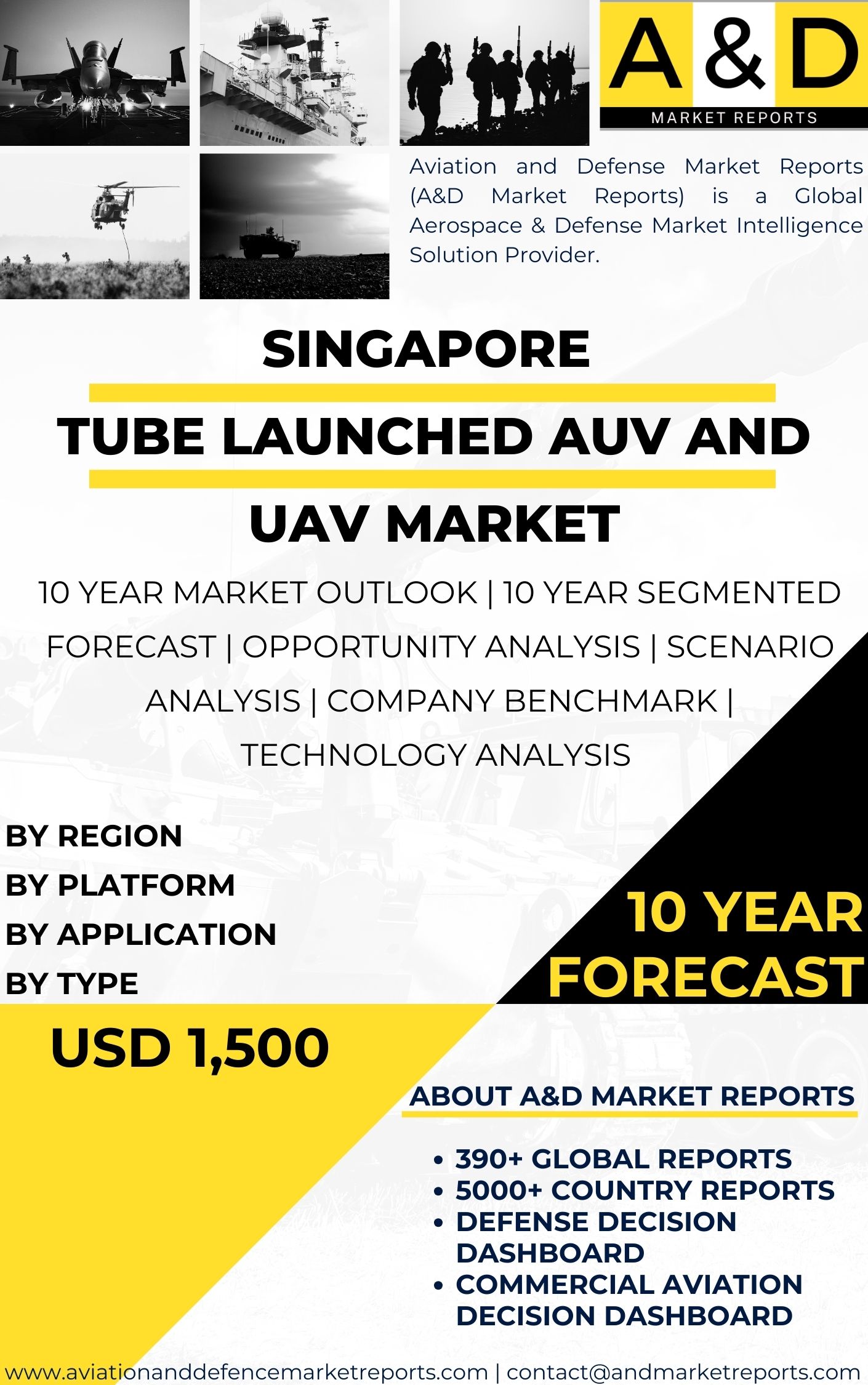
The market for tube-launched autonomous underwater vehicles (AUVs) and unmanned aerial vehicles (UAVs) in Singapore is growing due to the increasing demand for compact, versatile, and rapidly deployable unmanned systems that can operate in complex environments. These tube-launched systems are characterized by their ability to be launched from confined or mobile platforms such as submarines, armored vehicles, naval ships, or aircraft, allowing for stealthy and flexible deployments. The strategic advantage of this launch method is particularly significant in maritime and littoral zones around Singapore, where security concerns and regional maritime activities require discreet and efficient intelligence, surveillance, reconnaissance, and strike operations.
In underwater applications, tube-launched AUVs are highly valued for their capacity to be deployed covertly to carry out intelligence gathering, mine countermeasures, and detailed seabed mapping missions. Their compact size and stealth-oriented launch enable naval forces to operate in contested or sensitive waters with greater operational security. Advances in energy storage technology have extended mission durations, allowing these underwater vehicles to conduct longer, more data-intensive operations. On the other hand, the tube-launched UAVs offer a rapid, tactical aerial intelligence, surveillance, and reconnaissance (ISR) capability that can provide forces operating in Singapore?s airspace and adjacent areas with timely visual and signal intelligence without the need for bulky launch infrastructure. These UAVs’ modular designs facilitate mission-specific customization, enhancing their utility across various operational scenarios.
The integration of sophisticated technologies such as artificial intelligence, advanced sensing capabilities, secure communications, and adaptive autonomous navigation further enhances the effectiveness of these unmanned systems. AI-driven decision-making allows for real-time tactical adjustments based on environmental data and mission objectives, enabling more autonomous operations with reduced dependence on operator input. The vehicles? navigation systems are capable of maneuvering through complex underwater or aerial environments, avoiding obstacles and threats while adapting to changing conditions. These features are critical in Singapore?s defense landscape, where the need for flexible and discreet monitoring and defensive postures is paramount.
Singapore?s defense ecosystem benefits from a local and regional cluster of technology developers focusing on electrification, miniaturization, and propulsion systems that enhance the performance and endurance of tube-launched unmanned systems. The aviation and maritime sectors have also driven demand for these vehicles in commercial and civil applications like environmental monitoring, disaster management, and infrastructure inspection, thus widening the market scope beyond purely military use. The ability to launch unmanned vehicles from confined tubes also aligns well with Singapore?s strategic emphasis on leveraging high-tech, low-footprint assets for force projection and area denial in a complex geopolitical environment.
The market is further stimulated by increasing investments in research and development, with companies innovating in launch platform design, energy efficiency, sensor and payload integration, and multi-platform compatibility. Launching mechanisms are increasingly versatile, compatible with various existing platforms including naval torpedo tubes, containerized canisters, and even mobile land-based deployers, which broadens use cases and operational adaptability. Singaporean technology firms, often in collaboration with global partners, are also focusing on the development of enhanced secure communication links to maintain connectivity and control of unmanned systems in denied or contested environments.
The operational and strategic importance of tube-launched AUVs and UAVs in Singapore is underscored by the city-state?s role as a critical maritime hub with significant defense imperatives. The capability to rapidly deploy unmanned systems discreetly from multiple platforms supports layered defense strategies and intelligence collection across the air and undersea domains. This capability is increasingly vital as operational theaters become more multi-domain and less predictable, requiring rapid, scalable, and stealthy system deployments to maintain situational awareness and operational superiority.
Overall, the Singapore market for tube-launched AUVs and UAVs demonstrates robust growth driven by the dual military and civil demand, technological innovation, and strategic needs for enhanced surveillance, reconnaissance, and operational flexibility. The compactness, stealth, and modularity of these systems offer a significant tactical advantage, allowing for rapid mission-specific deployments with reduced logistical burden. These unmanned systems enhance Singapore?s overall defense posture by plugging capability gaps between large, expensive assets and front-line tactical forces, while also serving emerging commercial and environmental monitoring needs. The technological trajectory points towards smarter, quieter, and more autonomous tube-launched vehicles capable of meeting Singapore?s evolving security and operational requirements in complex maritime and aerial domains. This makes the tube-launched AUV and UAV market a critical and expanding component of Singapore?s broader unmanned systems and defense technology landscape.