
Description
Personal Air Mobility Market in Sweden: Market Overview
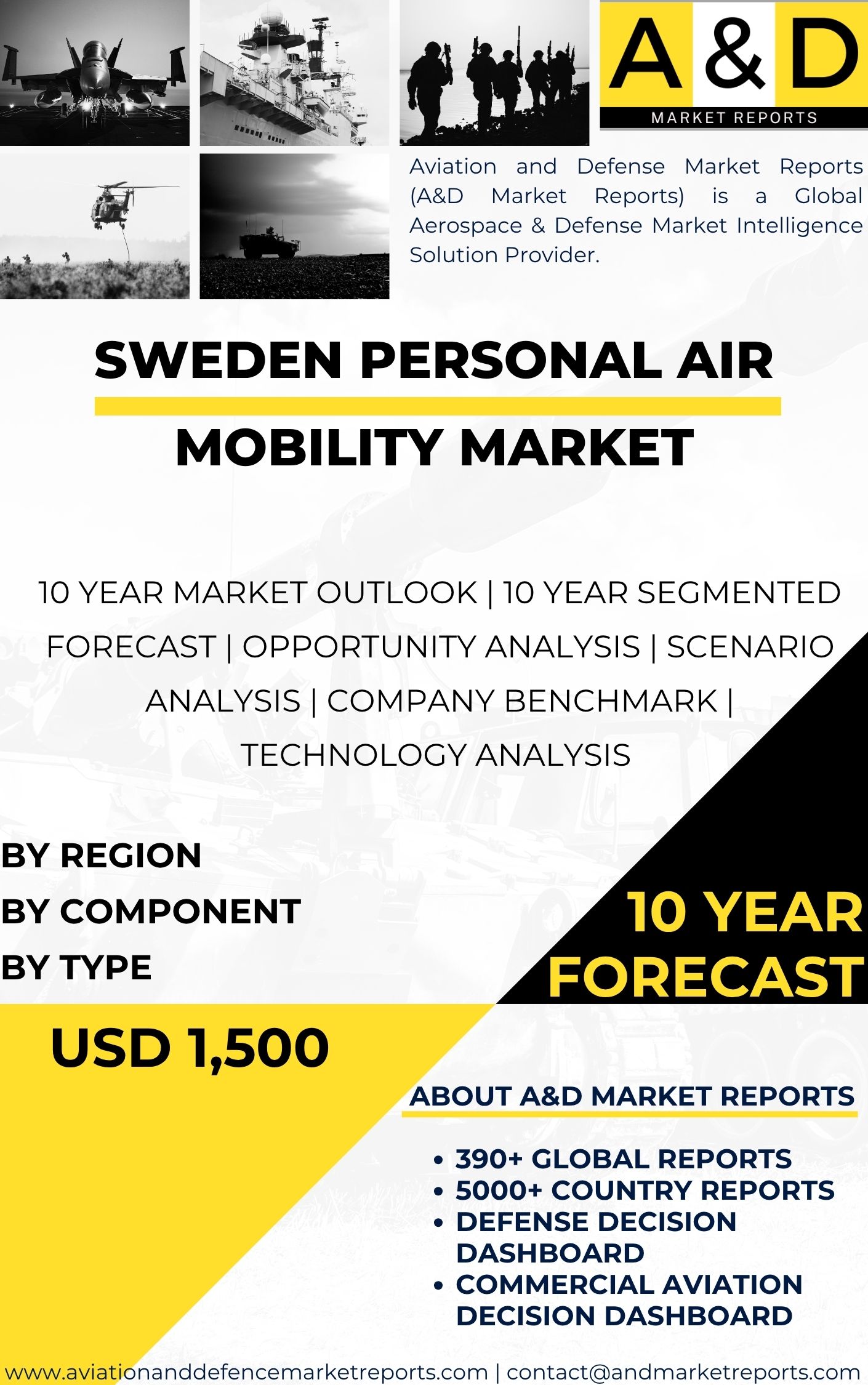
The personal air mobility market in Sweden is emerging as a fast-growing and innovative segment of the transportation sector. It is driven by urbanization, mobility challenges, and strong demand for efficient travel options. Sweden’s focus on sustainability and smart infrastructure supports the early adoption of personal air mobility solutions. These solutions aim to reduce congestion, cut travel time, and improve connectivity in urban and regional areas.
Personal Air Mobility Market in Sweden: Sustainability and Policy Support
Sustainability plays a central role in shaping the personal air mobility market in Sweden. Policymakers actively promote low-emission transport and clean energy solutions. As a result, electric vertical takeoff and landing aircraft align well with national climate targets. These platforms support zero-emission mobility and integrate with Sweden’s renewable energy ecosystem. Consequently, environmental priorities strongly accelerate market acceptance.
Personal Air Mobility Market in Sweden: Technology and Innovation Ecosystem
Sweden benefits from a highly advanced technology environment that supports personal air mobility development. Strong capabilities in aerospace engineering, automotive design, battery technology, and digital systems enable rapid innovation. Moreover, companies actively develop autonomous navigation, lightweight materials, and energy-efficient propulsion systems. At the same time, investments in vertiports, charging infrastructure, and urban air traffic systems improve operational readiness.
Personal Air Mobility Market in Sweden: Public Acceptance and Regulation
Public perception in Sweden remains largely positive toward urban air mobility concepts. Surveys indicate growing acceptance of flying vehicles for daily use. This openness helps regulators advance supportive policies more quickly. Authorities focus on safety, noise control, environmental impact, and data privacy. As a result, regulatory frameworks aim to balance innovation with public trust and urban planning needs.
Personal Air Mobility Market in Sweden: Industry Participation and Use Cases
The market features strong collaboration between startups, established aerospace firms, government bodies, and infrastructure developers. Together, these stakeholders drive platform development and service models. Companies design vehicles for multiple applications, including air taxis, emergency medical services, leisure travel, and cargo delivery. In addition, AI-enabled flight control and improved battery performance strengthen operational efficiency.
Personal Air Mobility Market in Sweden: Integration With Urban Transport
Sweden’s transport strategy emphasizes integration rather than replacement of existing systems. Personal air mobility solutions are designed to connect seamlessly with public transit and smart city platforms. This approach reduces road congestion and enhances access to remote regions. Multimodal hubs that link air vehicles with rail, buses, and shared mobility services further improve user convenience.
Market Challenges and Development Path
Despite strong momentum, the market faces challenges. High infrastructure costs, battery limitations, noise concerns, and scalability of autonomous systems remain key barriers. However, Sweden’s strong research ecosystem and government-backed pilot programs help address these issues. Continuous testing and innovation reduce technical risks over time.
Growth Outlook and Conclusion
The commercial outlook for the personal air mobility market in Sweden remains positive. Demand rises due to urban congestion, expanding cities, and interest in alternative mobility solutions. Supported by strong policy frameworks, technological expertise, and public acceptance, the market is expected to mature steadily. As infrastructure expands and regulations evolve, personal air mobility is likely to become a practical, clean, and efficient transport option across Swedish cities and regions.