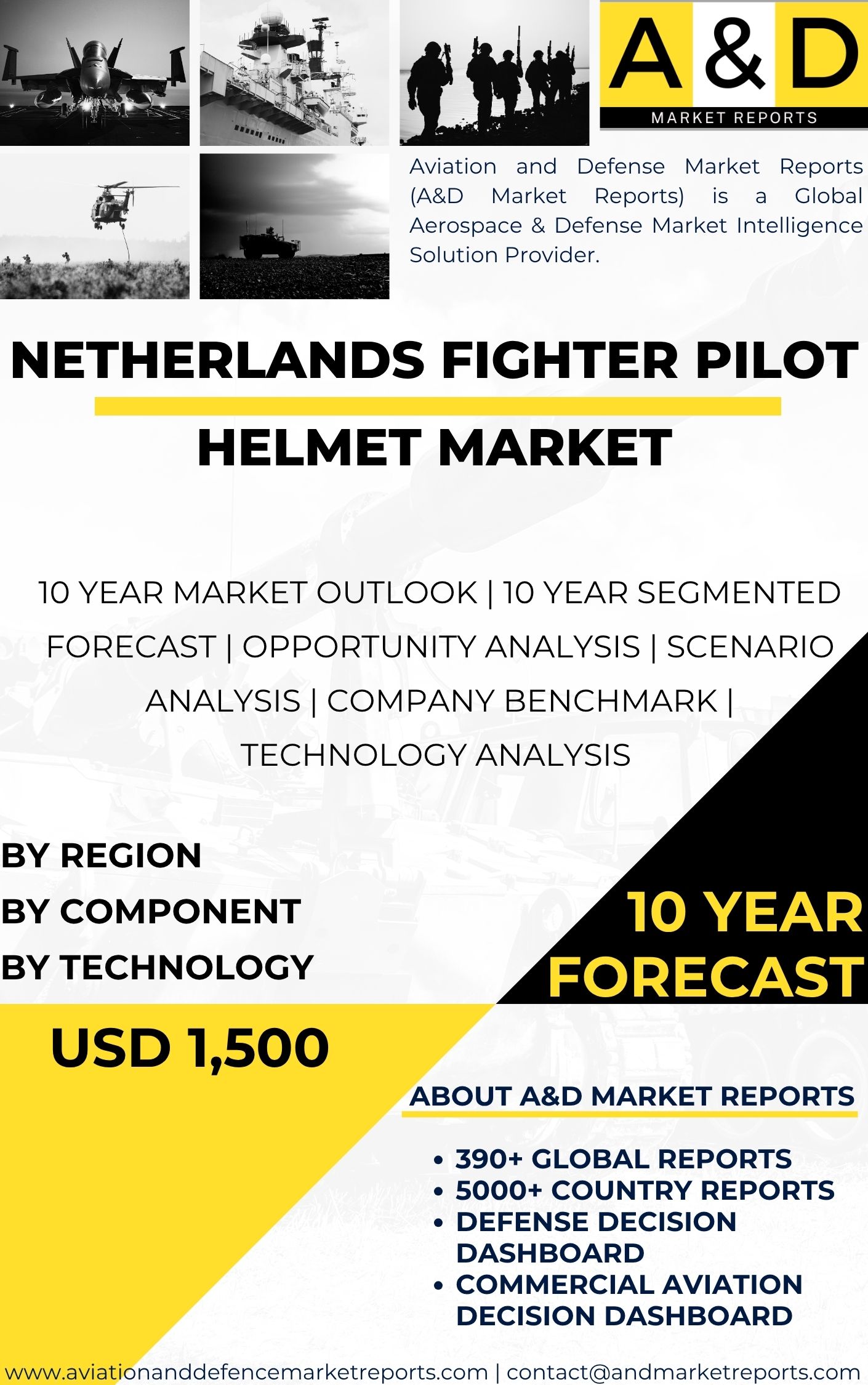
Netherlands Fighter Pilot Helmet Market

$1,500.00

Enquire Now

The Netherlands fighter pilot helmet market is a critical segment of the defense aviation industry, reflecting the importance of advanced pilot protection and situational awareness systems in modern air combat. Fighter pilot helmets are no longer simple protective gear; they have evolved into highly sophisticated systems that integrate advanced optics, augmented reality, and communications, turning them into essential tools for operational success. For the Royal Netherlands Air Force (RNLAF), which operates advanced platforms such as the F-35 Lightning II, the helmet is a vital enabler of mission effectiveness and survivability.

Go To Global Report Page Track this market real time on DDD

Description

The Netherlands fighter pilot helmet market is a critical segment of the defense aviation industry, reflecting the importance of advanced pilot protection and situational awareness systems in modern air combat. Fighter pilot helmets are no longer simple protective gear; they have evolved into highly sophisticated systems that integrate advanced optics, augmented reality, and communications, turning them into essential tools for operational success. For the Royal Netherlands Air Force (RNLAF), which operates advanced platforms such as the F-35 Lightning II, the helmet is a vital enabler of mission effectiveness and survivability.

The most prominent development in the Netherlands fighter pilot helmet market is the adoption of the F-35?s advanced Helmet-Mounted Display System (HMDS). Unlike traditional helmets, which required heads-up displays in the cockpit, the HMDS projects all flight and combat information directly onto the pilot?s visor. This gives Dutch fighter pilots unprecedented situational awareness, allowing them to monitor aircraft performance, navigation, targeting, and threat data without looking down at cockpit displays. The ability to ?see through? the aircraft using distributed aperture systems integrated into the helmet further enhances situational awareness, giving pilots an unmatched tactical advantage in both air-to-air and air-to-ground missions.

The Netherlands? investment in advanced helmet technology reflects its broader defense modernization priorities. Fighter pilot helmets are central to maximizing the operational potential of fifth-generation aircraft like the F-35. The helmets integrate not only flight data but also night vision, infrared imagery, and targeting systems, allowing pilots to conduct missions in all-weather conditions and across the full spectrum of combat scenarios. This integration underscores the growing role of helmets as advanced digital platforms rather than simple protective gear.

Technological innovation also drives continuous improvements in ergonomics and pilot comfort. Fighter pilots often operate under extreme conditions, including high G-forces and long mission durations. Helmets must balance advanced capabilities with reduced weight and optimized fit to minimize strain and fatigue. Dutch defense procurement emphasizes these ergonomic factors, ensuring that helmets are not only technologically advanced but also practical for extended operational use.

Challenges in the Netherlands fighter pilot helmet market include the high cost of advanced systems. Helmets like the F-35 HMDS cost hundreds of thousands of dollars each, reflecting their sophisticated technology. Procurement and maintenance require significant budgetary allocations, particularly as upgrades and new versions are developed. Additionally, ensuring compatibility with evolving aircraft systems and NATO interoperability remains a priority. Despite these challenges, the investment is justified by the operational advantages such helmets provide.

Looking ahead, the Netherlands fighter pilot helmet market will continue to evolve in line with technological advances and operational requirements. Future systems may incorporate even more advanced augmented reality, biometric monitoring, and AI-assisted decision tools, further enhancing pilot effectiveness and survivability. The Royal Netherlands Air Force?s participation in NATO operations ensures ongoing access to cutting-edge helmet technologies developed in collaboration with allied nations. For the Netherlands, fighter pilot helmets are not just protective equipment but vital enablers of combat effectiveness, ensuring pilots can fully exploit the capabilities of modern fighter aircraft in an increasingly complex air combat environment.
Table of content

Table Of Contents

1 Market Introduction

1.1 Market Introduction
1.2 Market Definition
1.3 Market Segmentation
1.4 10 Year Market Outlook

2 Market Technologies

3 Global Market Forecast

3.1 Global Market Forecast
3.2 By Technology
3.3 By Component

4 Europe Market Trends & Forecast

4.1 Drivers, Restraints And Challenges
4.2 PEST
4.3 Market Forecast
4.3.1 Market Forecast By Technology
4.3.2 Market Forecast By Component
4.4 Scenario Analysis
4.5 Key Companies& Profiling

5Netherlands Analysis

5.1 Current Levels Of Technology Maturation In This Market
5.2 Market Forecast
5.2.1 Market Forecast By Component
5.2.2 Market Forecast By Technology
5.3 Scenario Analysis
5.4 Country Defense Budget (Historical and 10- year forecast)
5.5 Defense Budget Category Spending- 10- year forecast
5.6 Procurement Analysis
5.7 EXIM Data
5.8 Patents

6 Opportunity Matrix

6.1 By Technology
6.2 By Component

7 Scenario Analysis

7.1 Scenario 1

7.1.1 By Technology (Scenario-1)
7.1.2 By Component (Scenario-1)

7.2 Scenario 2

7.2.1 By Technology (Scenario-2)
7.2.2 By Component (Scenario-2)

8 Company Benchmark

9 Strategic Conclusions

10 About Aviation And Defense Market Reports

Segments

By Component
By Technology

List of Tables

Table1: Global Market Forecast, Fighter Pilot Helmet Market
Table2: Europe Market Forecast, Fighter Pilot Helmet Market
Table3: Europe Market Forecast, By Component
Table4: Europe Market Forecast, By Technology
Table5: Europe, Scenario Analysis
Table6: Netherlands Market Forecast, Fighter Pilot Helmet Market
Table7: Netherlands Market Forecast, By Component
Table8: Netherlands Market Forecast, By Technology
Table9: Netherlands, Scenario Analysis
Table 10: Netherlands Defense Budget 10 Year Forecast
Table 11: Netherlands, Defense Budget Category Spending- 10- year forecast
Table 12: Netherlands, Procurement Analysis
Table 13: Netherlands, EXIM Data Analysis
Table 14: Netherlands, Opportunity Analysis, By Component
Table 15: Netherlands, Opportunity Analysis, By Technology
Table 16: Netherlands, Scenario Analysis, By Component
Table 17: Netherlands, Scenario Analysis, By Technology

List of Figures

Figure 1: Market Segmentation, Netherlands Fighter Pilot Helmet Market
Figure 2: Key Technology Analysis, Fighter Pilot Helmet Market
Figure 3: Global Market Forecast, Fighter Pilot Helmet Market
Figure 4: Europe, Market Forecast, Fighter Pilot Helmet Market
Figure 5: Europe, Market Forecast, By Component
Figure 6: Europe, Market Forecast, By Technology
Figure 7: Europe, Scenario Analysis
Figure 8: Netherlands, Market Forecast, Fighter Pilot Helmet Market
Figure 9: Netherlands, Market Forecast, By Component
Figure 10: Netherlands, Market Forecast, By Technology
Figure 11: Netherlands, Scenario Analysis
Figure 12: Netherlands, Defense Budget 10 Year Forecast
Figure 13: Netherlands, Defense Budget Category Spending- 10- year forecast
Figure 14: Netherlands, Procurement Analysis
Figure 15: Netherlands, EXIM Data Analysis
Figure 16: Netherlands, Opportunity Analysis, By Component
Figure 17: Netherlands, Opportunity Analysis, By Technology
Figure 18: Netherlands, Scenario Analysis, By Component
Figure 19: Netherlands, Scenario Analysis, By Technology
Figure 20: Company Benchmark

Aviation and Defense Market Reports


TPA | TIA | Consulting | Market Reports | Defense Decision Dashboard


Our Defense Report - Our Team Has Worked on More Than 250+ Individual Products / Markets