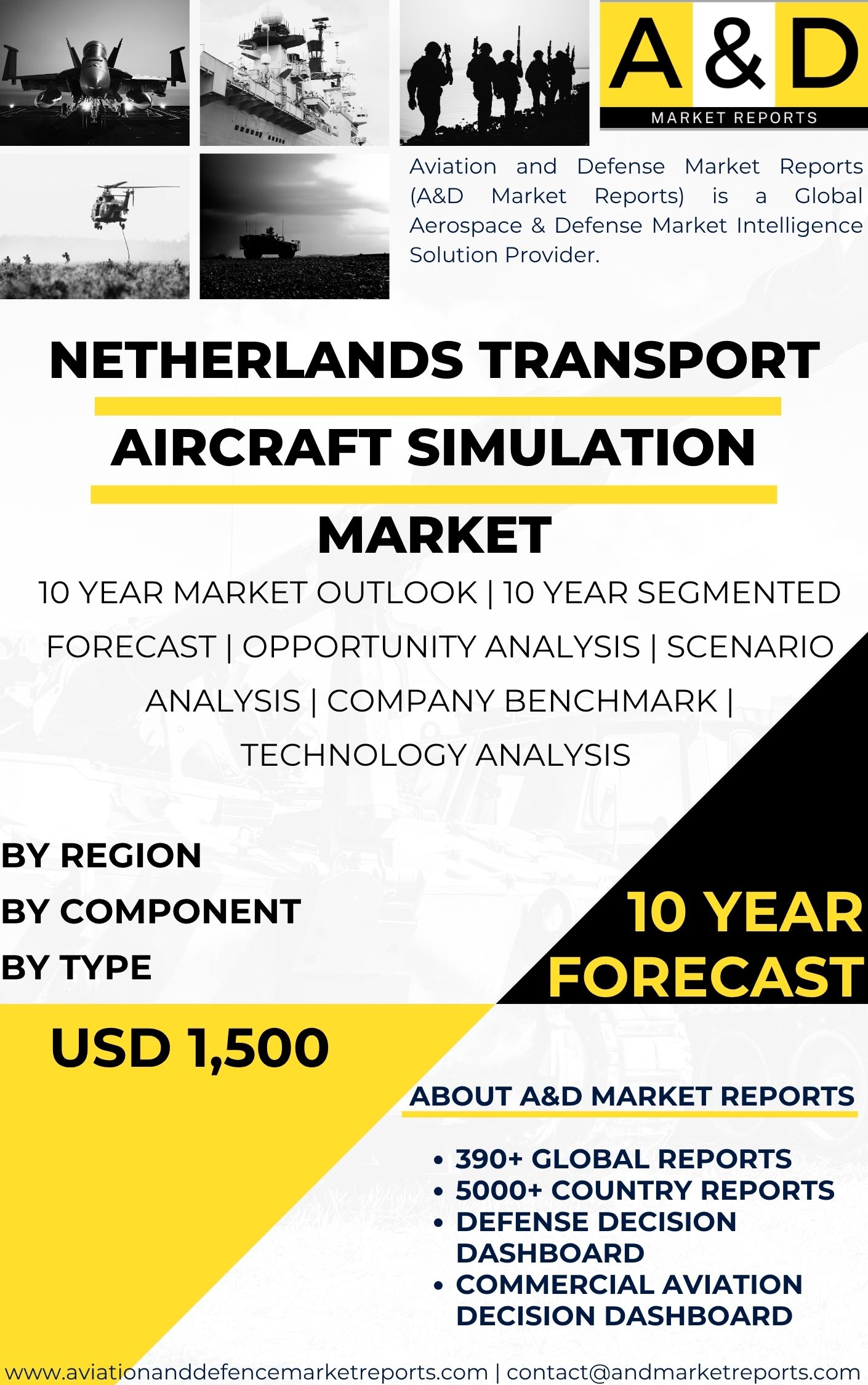
Netherlands Transport Aircraft Simulation Market

$1,500.00

Enquire Now

The Netherlands transport aircraft simulation market is an increasingly important area within the defense and civil aviation sectors, providing the tools necessary to train aircrews for a wide range of missions without the high costs and risks associated with live operations. Transport aircraft are critical to the Royal Netherlands Air Force (RNLAF) and NATO missions, as they support airlift, logistics, humanitarian assistance, medical evacuation, and troop deployments. Given the wide operational spectrum of these platforms, the need for advanced simulation technologies to ensure crew readiness and efficiency has grown significantly.

Go To Global Report Page Track this market real time on DDD

Description

The Netherlands transport aircraft simulation market is an increasingly important area within the defense and civil aviation sectors, providing the tools necessary to train aircrews for a wide range of missions without the high costs and risks associated with live operations. Transport aircraft are critical to the Royal Netherlands Air Force (RNLAF) and NATO missions, as they support airlift, logistics, humanitarian assistance, medical evacuation, and troop deployments. Given the wide operational spectrum of these platforms, the need for advanced simulation technologies to ensure crew readiness and efficiency has grown significantly.

Transport aircraft simulators replicate cockpit environments, flight dynamics, and mission systems to provide highly realistic training experiences. They allow pilots and loadmasters to practice tasks ranging from basic takeoffs and landings to complex mission profiles such as formation flying, aerial refueling coordination, and tactical approaches in contested environments. The Netherlands, with its participation in NATO rapid deployment forces and global humanitarian operations, benefits from simulators that enable training for both military and civil missions under a variety of conditions.

The advantages of simulation for transport aircraft are considerable. Live training in large aircraft such as the C-130 Hercules or the A330 Multi Role Tanker Transport (MRTT) is costly due to fuel, maintenance, and operating expenses. Simulators significantly reduce these costs while also lowering aircraft wear and extending service life. Moreover, simulators provide a safe environment to practice emergency procedures, including engine failures, hydraulic malfunctions, or hostile threats, which cannot be realistically rehearsed in live operations.

Technological advancements are transforming this market in the Netherlands. High-resolution visual systems, artificial intelligence-driven scenarios, and advanced motion systems enhance the realism of training. Integration with mission systems such as navigation, radar, communication networks, and cargo handling tools ensures that crews gain experience with the same equipment used in real missions. Networked simulators also allow joint and multinational exercises, reflecting the Netherlands? commitment to NATO interoperability and coalition operations.

Cost-effectiveness and adaptability are driving procurement. Transport aircraft simulators can be updated with new software to reflect evolving threats, equipment upgrades, or changes in mission doctrine. This flexibility ensures long-term relevance without requiring frequent investment in entirely new systems. At the same time, sustainability goals encourage the shift to synthetic training, as it reduces fuel consumption and environmental impact.

Challenges for the market include maintaining realism and fidelity, especially for multi-role transport aircraft used in diverse operational environments. Developing and maintaining simulators that can handle the full range of mission profiles requires substantial investment. Additionally, the rapid pace of technological change means that simulation systems must be continuously upgraded to remain effective, which can place strain on defense budgets.

Looking ahead, the Netherlands transport aircraft simulation market is expected to grow as synthetic training becomes more central to aircrew preparation. Future systems will likely incorporate more advanced virtual and augmented reality technologies, cloud-based training architectures, and AI-driven adaptive training tailored to individual and crew performance. By investing in these capabilities, the Netherlands ensures that its transport aircrews remain proficient, cost-effective, and ready to conduct critical missions in both national defense and international operations.
Table of content

Table Of Contents

1 Market Introduction

1.1 Market Introduction
1.2 Market Definition
1.3 Market Segmentation
1.4 10 Year Market Outlook

2 Market Technologies

3 Global Market Forecast

3.1 Global Market Forecast
3.2 By Type
3.3 By Component

4 Europe Market Trends & Forecast

4.1 Drivers, Restraints And Challenges
4.2 PEST
4.3 Market Forecast
4.3.1 Market Forecast By Type
4.3.2 Market Forecast By Component
4.4 Scenario Analysis
4.5 Key Companies& Profiling

5Netherlands Analysis

5.1 Current Levels Of Technology Maturation In This Market
5.2 Market Forecast
5.2.1 Market Forecast By Component
5.2.2 Market Forecast By Type
5.3 Scenario Analysis
5.4 Country Defense Budget (Historical and 10- year forecast)
5.5 Defense Budget Category Spending- 10- year forecast
5.6 Procurement Analysis
5.7 EXIM Data
5.8 Patents

6 Opportunity Matrix

6.1 By Type
6.2 By Component

7 Scenario Analysis

7.1 Scenario 1

7.1.1 By Type (Scenario-1)
7.1.2 By Component (Scenario-1)

7.2 Scenario 2

7.2.1 By Type (Scenario-2)
7.2.2 By Component (Scenario-2)

8 Company Benchmark

9 Strategic Conclusions

10 About Aviation And Defense Market Reports

Segments

By Type
By Component

List of Tables

Table1: Global Market Forecast, Transport Aircraft Simulation Market
Table2: Europe Market Forecast, Transport Aircraft Simulation Market
Table3: Europe Market Forecast, By Type
Table4: Europe Market Forecast, By Component
Table5: Europe, Scenario Analysis
Table6: Netherlands Market Forecast, Transport Aircraft Simulation Market
Table7: Netherlands Market Forecast, By Type
Table8: Netherlands Market Forecast, By Component
Table9: Netherlands, Scenario Analysis
Table 10: Netherlands Defense Budget 10 Year Forecast
Table 11: Netherlands, Defense Budget Category Spending- 10- year forecast
Table 12: Netherlands, Procurement Analysis
Table 13: Netherlands, EXIM Data Analysis
Table 14: Netherlands, Opportunity Analysis, By Type
Table 15: Netherlands, Opportunity Analysis, By Component
Table 16: Netherlands, Scenario Analysis, By Type
Table 17: Netherlands, Scenario Analysis, By Component

List of Figures

Figure 1: Market Segmentation, Netherlands Transport Aircraft Simulation Market
Figure 2: Key Technology Analysis, Transport Aircraft Simulation Market
Figure 3: Global Market Forecast, Transport Aircraft Simulation Market
Figure 4: Europe, Market Forecast, Transport Aircraft Simulation Market
Figure 5: Europe, Market Forecast, By Type
Figure 6: Europe, Market Forecast, By Component
Figure 7: Europe, Scenario Analysis
Figure 8: Netherlands, Market Forecast, Transport Aircraft Simulation Market
Figure 9: Netherlands, Market Forecast, By Type
Figure 10: Netherlands, Market Forecast, By Component
Figure 11: Netherlands, Scenario Analysis
Figure 12: Netherlands, Defense Budget 10 Year Forecast
Figure 13: Netherlands, Defense Budget Category Spending- 10- year forecast
Figure 14: Netherlands, Procurement Analysis
Figure 15: Netherlands, EXIM Data Analysis
Figure 16: Netherlands, Opportunity Analysis, By Type
Figure 17: Netherlands, Opportunity Analysis, By Component
Figure 18: Netherlands, Scenario Analysis, By Type
Figure 19: Netherlands, Scenario Analysis, By Component
Figure 20: Company Benchmark

Aviation and Defense Market Reports


TPA | TIA | Consulting | Market Reports | Defense Decision Dashboard


Our Defense Report - Our Team Has Worked on More Than 250+ Individual Products / Markets