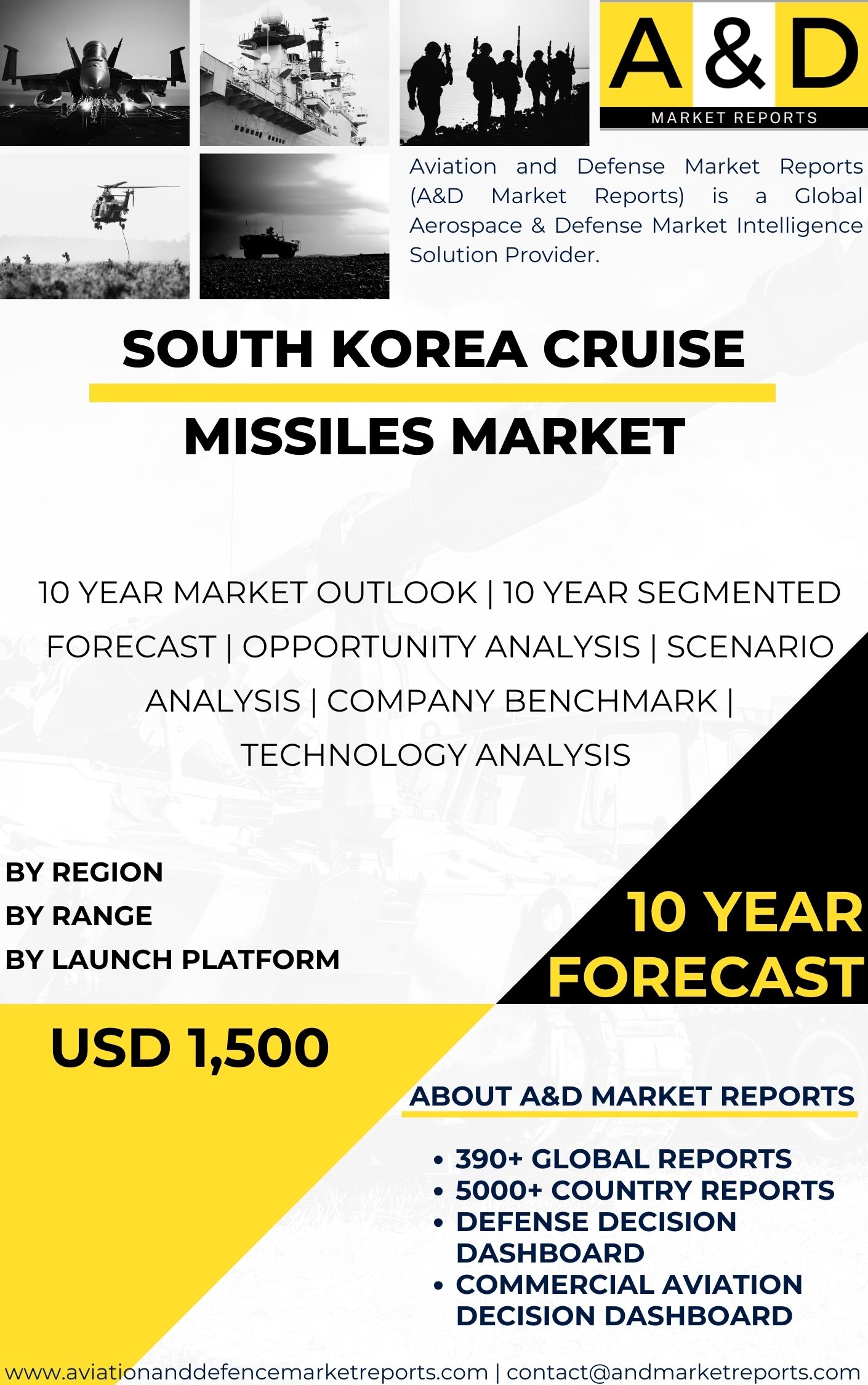
South Korea Cruise Missiles Market

$1,500.00

Enquire Now

The cruise missiles market in South Korea is characterized by rapid technological development, heightened defense spending, and an urgent strategic focus in response to regional security challenges and evolving military doctrines. South Korea’s pursuit of advanced cruise missile capabilities has been significantly influenced by both indigenous research and international collaboration, particularly as the country seeks to deter potential adversaries and ensure critical strike precision in any future conflict scenario. Historically, South Korea’s initial cruise missile arsenal traced its lineage to foreign technology?such as the American Harpoon and SLAM-ER systems, as well as European models?before the nation fully committed to indigenous development programs. This transition was spurred by both an ambition for defense self-sufficiency and operational needs that demanded tailored solutions for unique geographic and strategic threats on the Korean peninsula. South Korea’s Haesong, Cheon Ryong, and Hyunmoo cruise missile families exemplify this strategy, offering the country options for sea-, land-, and air-based deployment, with ranges suitable for both anti-ship and land-attack roles.

Go To Global Report Page Track this market real time on DDD

Description

Cruise Missiles Market in South Korea: Overview

The cruise missiles market in South Korea is expanding steadily due to rising defense needs and rapid technology development. Regional security threats continue to shape military planning and investment priorities.

South Korea focuses on precision strike capability and deterrence. Cruise missiles play a critical role in this strategy. Strong government funding and long-term defense planning support market growth.

Strategic Drivers of the Cruise Missiles Market in South Korea

Regional Security Environment

Security risks on the Korean Peninsula remain high. North Korea’s missile activity increases the need for advanced strike systems. Cruise missiles provide precision, flexibility, and survivability.

The military views cruise missiles as essential for both deterrence and response missions.

Shift Toward Indigenous Capabilities

South Korea initially relied on foreign missile systems. These included platforms such as Harpoon and SLAM-ER. Over time, the country moved toward domestic development.

This shift supports defense self-reliance and allows systems to match local terrain and threat profiles.

Cruise Missile Development Programs in South Korea

Indigenous Cruise Missile Families

South Korea has developed several cruise missile families. These include Haesong, Cheon Ryong, and Hyunmoo systems. Each supports sea-, land-, or air-launched operations.

These missiles serve both anti-ship and land-attack roles. Their ranges meet regional operational needs.

Extended Range and Precision Improvements

Newer cruise missiles offer longer range and higher accuracy. Some land-attack variants now reach up to 1,500 kilometers. Improved guidance systems enhance strike precision.

Stealth features and advanced propulsion help missiles survive dense threat environments.

Foreign Systems and Technology Integration

South Korea also integrates selected foreign missiles. A key example is the Taurus KEPD350. This system equips aircraft such as the F-15K.

The missile strengthens the ability to strike hardened and underground targets. Foreign systems often complement domestic designs.

Cruise Missiles Market Size and Growth Outlook

The cruise missiles market in South Korea was valued at about USD 0.9 billion in 2024. Forecasts suggest growth to nearly USD 1.5 billion by 2033.

Growth drivers include:

  • Replacement of aging missile systems

  • Ongoing force modernization

  • Increased research and development spending

Market expansion reflects sustained defense investment.

Competitive Landscape of the Cruise Missiles Market in South Korea

Key Domestic Players

Local defense firms play a major role in the market. LIG Nex1 and Hanwha lead missile research and production. Government contracts provide long-term stability.

These firms continue to improve missile range, accuracy, and survivability.

International Collaboration

Foreign partnerships support technology transfer and system integration. Imported missiles are often adapted to local needs. This approach balances independence with capability enhancement.

Policy and Regulatory Support

Missile development policies have evolved over time. Agreements with the United States gradually eased earlier restrictions on range and payload.

These changes allowed South Korea to develop longer-range precision systems. Successful test launches followed, along with scaled production.

Political consensus strongly supports advanced missile development.

Future Outlook of the Cruise Missiles Market in South Korea

The cruise missiles market in South Korea remains strategically important. Continued modernization will drive further investment.

Advances in guidance, stealth, and propulsion will shape future systems. Strong government backing ensures long-term market stability.

Cruise missiles will remain a key pillar of South Korea’s defense posture in the years ahead.

Table of content

Table Of Contents

1 Market Introduction

1.1 Market Introduction
1.2 Market Definition
1.3 Market Segmentation
1.4 10 Year Market Outlook

2 Market Technologies

3 Global Market Forecast

3.1 Global Market Forecast
3.2 By Launch Platform
3.3 By Range

4 APAC Market Trends & Forecast

4.1 Drivers, Restraints And Challenges
4.2 PEST
4.3 Market Forecast
4.3.1 Market Forecast By Launch Platform
4.3.2 Market Forecast By Fitment
4.4 Scenario Analysis
4.5 Key Companies& Profiling

5 South Korea Analysis

5.1 Current Levels Of Technology Maturation In This Market
5.2 Market Forecast
5.2.1 Market Forecast By Launch Platform
5.2.2 Market Forecast By Fitment
5.3 Scenario Analysis
5.4 Country Defense Budget (Historical and 10- year forecast)
5.5 Defense Budget Category Spending- 10- year forecast
5.6 Procurement Analysis
5.7 EXIM Data
5.8 Patents

6 Opportunity Matrix

6.1 By Launch Platform
6.2 By Range

7 Scenario Analysis

7.1 Scenario 1

7.1.1 By Launch Platform (Scenario-1)
7.1.2 By Range (Scenario-1)

7.2 Scenario 2

7.2.1 By Launch Platform (Scenario-2)
7.2.2 By Range (Scenario-2)

8 Company Benchmark

9 Strategic Conclusions

10 About Aviation And Defense Market Reports

Segments

By Launch Platform
By Range

List of Tables

Table1: Global Market Forecast, Cruise Missiles Market
Table2: APAC Market Forecast, Cruise Missiles Market
Table3: APAC Market Forecast, By Launch Platform
Table4: APAC Market Forecast, By Range
Table5: APAC, Scenario Analysis
Table6: South Korea Market Forecast, Cruise Missiles Market
Table7: South Korea Market Forecast, By Launch Platform
Table8: South Korea Market Forecast, By Range
Table9: South Korea, Scenario Analysis
Table 10: South Korea Defense Budget 10 Year Forecast
Table 11: South Korea, Defense Budget Category Spending- 10- year forecast
Table 12: South Korea, Procurement Analysis
Table 13: South Korea, EXIM Data Analysis
Table 14: South Korea, Opportunity Analysis, By Launch Platform
Table 15: South Korea, Opportunity Analysis, By Range
Table 16: South Korea, Scenario Analysis, By Launch Platform
Table 17: South Korea, Scenario Analysis, By Range

List of Figures

Figure 1: Market Segmentation, South Korea Cruise Missiles Market
Figure 2: Key Technology Analysis, Cruise Missiles Market
Figure 3: Global Market Forecast, Cruise Missiles Market
Figure 4: APAC, Market Forecast, Cruise Missiles Market
Figure 5: APAC, Market Forecast, By Launch Platform
Figure 6: APAC, Market Forecast, By Range
Figure 7: APAC, Scenario Analysis
Figure 8: South Korea, Market Forecast, Cruise Missiles Market
Figure 9: South Korea, Market Forecast, By Launch Platform
Figure 10: South Korea, Market Forecast, By Range
Figure 11: South Korea, Scenario Analysis
Figure 12: South Korea, Defense Budget 10 Year Forecast
Figure 13: South Korea, Defense Budget Category Spending- 10- year forecast
Figure 14: South Korea, Procurement Analysis
Figure 15: South Korea, EXIM Data Analysis
Figure 16: South Korea, Opportunity Analysis, By Launch Platform
Figure 17: South Korea, Opportunity Analysis, By Range
Figure 18: South Korea, Scenario Analysis, By Launch Platform
Figure 19: South Korea, Scenario Analysis, By Range
Figure 20: Company Benchmark

Aviation and Defense Market Reports


TPA | TIA | Consulting | Market Reports | Defense Decision Dashboard


Our Defense Report - Our Team Has Worked on More Than 250+ Individual Products / Markets