
Description
Market Overview and Strategic Significance
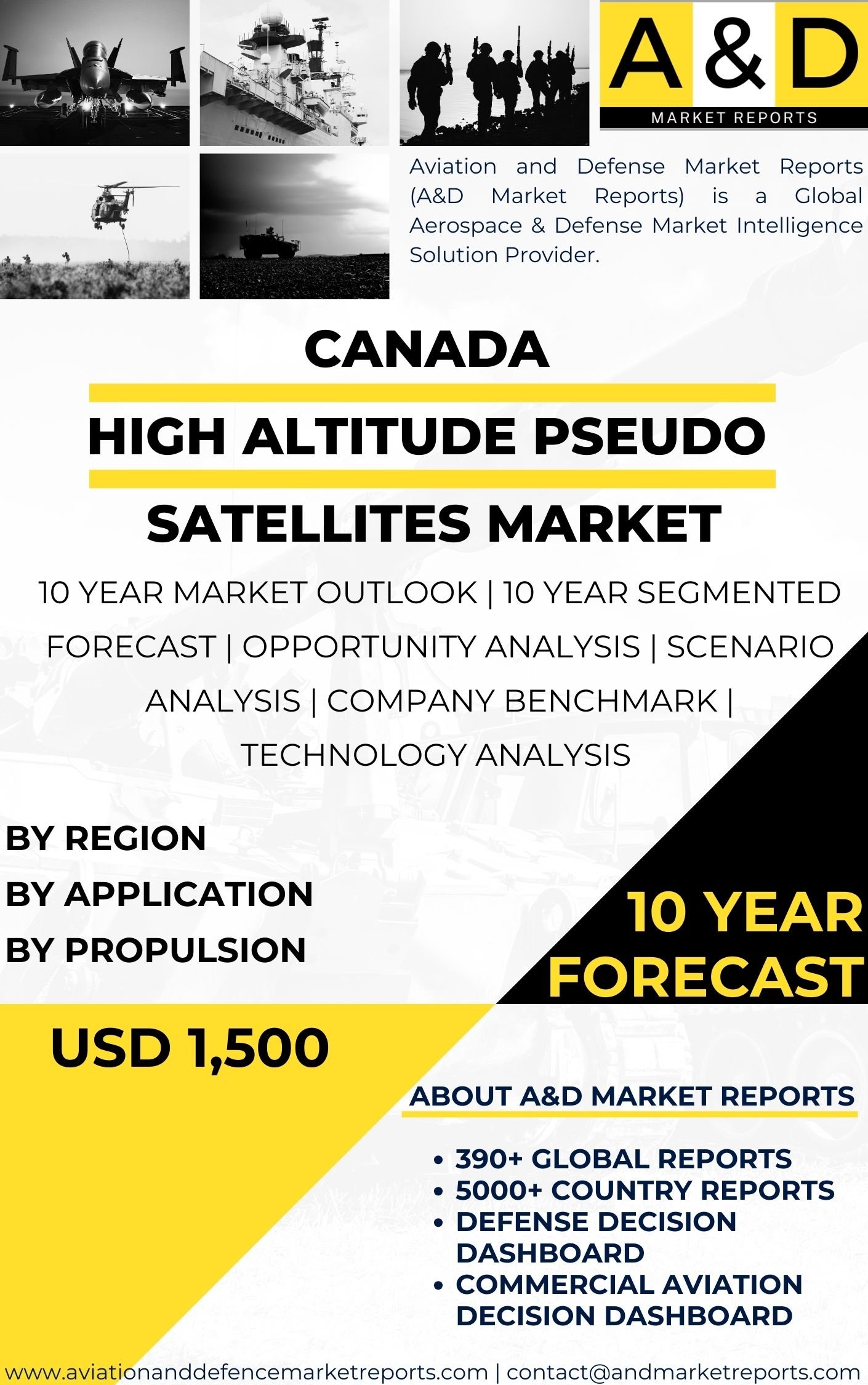
The Canada High Altitude Pseudo represents a rapidly advancing segment of aerospace and defense innovation. These unmanned, solar-powered platforms operate in the stratosphere for extended durations, often remaining airborne for weeks or months. Because they function above conventional air traffic yet below orbital satellites, they bridge the gap between terrestrial and space-based systems. HAPS platforms provide persistent coverage over designated regions without the high launch costs associated with traditional satellites. In addition, they offer flexible redeployment and mission reconfiguration capabilities. Therefore, this market is becoming increasingly important within Canada’s surveillance and communications strategy.
Industry Structure and Key Participants
The market includes aerospace manufacturers, technology startups, and defense research organizations collaborating on advanced high-altitude systems. Companies such as Airbus have pioneered solar-powered stratospheric platforms for long-endurance missions. Similarly, BAE Systems contributes expertise in autonomous systems and advanced aerospace integration. These organizations partner with avionics suppliers, solar technology firms, and AI developers. Moreover, government-backed research programs accelerate endurance and payload optimization initiatives. As a result, the ecosystem combines innovation with operational scalability.
Core Technologies and Platform Characteristics
HAPS platforms rely heavily on advanced photovoltaic cells, high-efficiency energy storage systems, and ultra-lightweight composite airframes. Solar arrays generate power during daylight hours, while batteries sustain operations overnight. Autonomous flight control systems enable precise station-keeping and route adjustments. Payload versatility supports surveillance sensors, communication relays, and environmental monitoring equipment. Additionally, AI-driven flight management enhances endurance and reliability. Consequently, technological refinement directly impacts operational persistence and cost efficiency.
Demand Drivers and Application Segments
Growing demand for persistent intelligence, surveillance, and reconnaissance capabilities drives investment in HAPS systems. Military forces value their ability to provide continuous situational awareness without satellite dependency. Disaster monitoring, environmental observation, and communication augmentation also represent key civilian and dual-use applications. Because HAPS platforms can be deployed more rapidly than satellites, they support time-sensitive missions. Furthermore, layered communication networks benefit from stratospheric relay nodes. Therefore, both defense and commercial customers recognize their strategic utility.
Regulation, Supply Chain, and Future Outlook
Regulatory oversight requires coordination between aerospace authorities and defense agencies to ensure safe operation in controlled airspace. In Canada, alignment with defense requirements is overseen by the Department of National Defence to ensure mission compatibility and airspace compliance. Supply chains depend on specialized solar cells, lightweight composites, advanced avionics, and propulsion components. Technological progress continues in photovoltaic efficiency, energy density, and AI-based autonomy. However, challenges remain in certification processes, payload integration, and competition with emerging satellite constellations. Overall, the High Altitude Pseudo Satellites market is reshaping aerial surveillance and communication paradigms, offering cost-effective, persistent capabilities that complement traditional air and space systems.