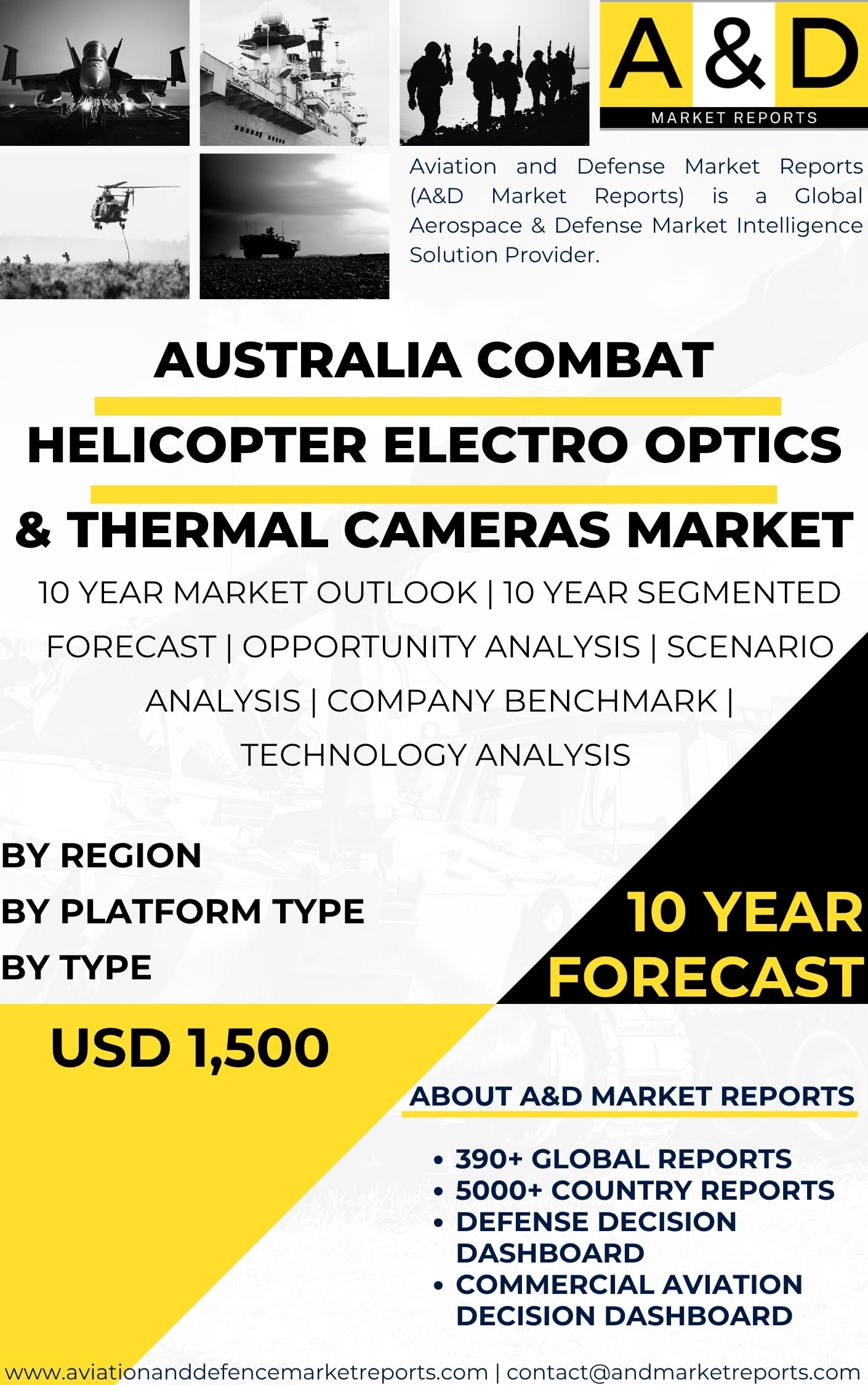
Australia Combat Helicopter Electro Optics & Thermal Cameras

$1,500.00

Enquire Now

The market for combat helicopter electro optics and thermal cameras in Australia is shaped by the country?s continuous focus on strengthening its advanced defense capabilities and integrating modern technologies into its aviation platforms. As combat helicopters remain a significant element of Australia?s defense strategy, the demand for sophisticated optical and imaging systems is driven by the need to enhance operational effectiveness, situational awareness, and precision targeting in both conventional and asymmetric conflicts. Electro optic and thermal camera systems serve as vital force multipliers, enabling helicopter crews to operate effectively in diverse mission environments under varying conditions, including low light, poor visibility, and dynamic battlefield scenarios. These technologies are not only applied in combat engagements but also in reconnaissance, surveillance, search and rescue, and counter-insurgency operations, highlighting their multi-mission relevance.

Go To Global Report Page Track this market real time on DDD

Description

The market for combat helicopter electro optics and thermal cameras in Australia is shaped by the country?s continuous focus on strengthening its advanced defense capabilities and integrating modern technologies into its aviation platforms. As combat helicopters remain a significant element of Australia?s defense strategy, the demand for sophisticated optical and imaging systems is driven by the need to enhance operational effectiveness, situational awareness, and precision targeting in both conventional and asymmetric conflicts. Electro optic and thermal camera systems serve as vital force multipliers, enabling helicopter crews to operate effectively in diverse mission environments under varying conditions, including low light, poor visibility, and dynamic battlefield scenarios. These technologies are not only applied in combat engagements but also in reconnaissance, surveillance, search and rescue, and counter-insurgency operations, highlighting their multi-mission relevance.

Australian defense procurement policies prioritize advanced subsystems that extend platform versatility and survivability, making electro optics and thermal imaging technologies key areas of investment. The defense establishment places strong emphasis on upgrading existing rotorcraft fleets with modular sensor packages that include electro optic cameras, infrared systems, laser rangefinders, and target designators. Such enhancements support interoperability with allied systems and reinforce joint operational effectiveness. In parallel, defense modernization programs encourage the adoption of next-generation imaging platforms that integrate artificial intelligence and real-time data processing, allowing helicopter crews to assess threats more rapidly and act on actionable intelligence with minimal latency. The strategic importance of these systems is further reinforced by Australia?s emphasis on maintaining deterrence capabilities and rapid response preparedness in its surrounding maritime and terrestrial regions.

Domestic and international defense suppliers play an important role in shaping the procurement and integration of these technologies within Australia. Established global defense companies with strong portfolios in electro optics and thermal systems have formed industrial partnerships to provide high-performance imaging platforms suited to Australia?s unique defense landscape. At the same time, local Australian defense technology firms are increasingly participating in the supply chain by supporting system integration, platform customization, and maintenance. This approach fosters indigenous capability development while reducing reliance on external sources for long-term operational sustainability. Such collaborations ensure that the Australian defense force has access to both cutting-edge technologies and localized expertise in system upgrades and lifecycle support.

From an operational standpoint, the application of electro optics and thermal cameras in combat helicopters is integral to enhancing tactical reach, precision strike ability, and survivability in hostile environments. These systems enable target acquisition at standoff distances, ensuring helicopters can engage while minimizing exposure to enemy fire. They are equally crucial in identifying hidden or camouflaged threats, monitoring activity in urban terrains, and conducting maritime operations across vast regions where aerial surveillance is critical. Advanced thermal sensors allow pilots and gunners to navigate and target effectively during night operations, while electro optic cameras provide high-resolution imagery for intelligence gathering. Together, these technologies form the backbone of comprehensive mission execution, making them indispensable assets on the modern battlefield.

Australia?s defense industry also aligns the adoption of electro optics and thermal imaging with broader trends in digital transformation and integrated battle management. With the growing importance of network-centric warfare, data collected through imaging systems on helicopters can be seamlessly shared with other air, land, and naval assets, supporting cohesive command and control. This interoperability improves coordinated responses, enhances situational awareness across domains, and strengthens the overall effectiveness of joint operations. Demand for imaging systems with embedded digital connectivity creates opportunities for suppliers to innovate and deliver multi-functional solutions that can be scaled and adapted to different mission scenarios.

Market dynamics are influenced by Australia?s regional security environment, which underscores the need for constant vigilance and readiness. Electro optics and thermal cameras installed on combat helicopters ensure that defense forces retain a technological advantage by providing accurate detection, enhanced mobility, and greater decision-making clarity in unpredictable operational contexts. Investments in these areas signal Australia?s broader intention to maintain regional stability and contribute to collective defense initiatives with allies. As these technologies evolve, there is a growing focus on miniaturization, lighter weight designs, improved thermal sensitivity, and higher image fidelity, which all contribute to broader mission flexibility and longer endurance for helicopter operations.

The market outlook is therefore shaped by the dual forces of operational necessity and technological innovation. Combat helicopter platforms in Australia require versatile optical and thermal systems that not only improve tactical performance but also align with future modernization pathways emphasizing digital integration and sustainability. With continuous collaboration between defense agencies, international suppliers, and domestic industry partners, electro optics and thermal camera technologies are set to remain a central pillar in enhancing Australia?s defense aviation capability. As Australia pursues modernization while preparing for evolving security challenges, the demand for these systems will persist, ensuring they remain at the core of air combat readiness, intelligence gathering, and regional deterrence strategies.

Table of content

Table Of Contents

1 Market Introduction

1.1 Market Introduction
1.2 Market Definition
1.3 Market Segmentation
1.4 10 Year Market Outlook

2 Market Technologies

3 Global Market Forecast

3.1 Global Market Forecast
3.2 By Platform
3.3 By Type

4 APAC Market Trends & Forecast

4.1 Drivers, Restraints And Challenges
4.2 PEST
4.3 Market Forecast
4.3.1 Market Forecast By Platform
4.3.2 Market Forecast By Type
4.4 Scenario Analysis
4.5 Key Companies& Profiling

5 Australia Analysis

5.1 Current Levels Of Technology Maturation In This Market
5.2 Market Forecast
5.2.1 Market Forecast By Type
5.2.2 Market Forecast By Platform
5.3 Scenario Analysis
5.4 Country Defense Budget (Historical and 10- year forecast)
5.5 Defense Budget Category Spending- 10- year forecast
5.6 Procurement Analysis
5.7 EXIM Data
5.8 Patents

6 Opportunity Matrix

6.1 By Platform
6.2 By Type

7 Scenario Analysis

7.1 Scenario 1

7.1.1 By Platform (Scenario-1)
7.1.2 By Type (Scenario-1)

7.2 Scenario 2

7.2.1 By Platform (Scenario-2)
7.2.2 By Type (Scenario-2)

8 Company Benchmark

9 Strategic Conclusions

10 About Aviation And Defense Market Reports

Segments

By Type
By Platform Type

List of Tables

Table1: Global Market Forecast, Combat Helicopter Electro Optics & Thermal Cameras
Table2: APAC Market Forecast, Combat Helicopter Electro Optics & Thermal Cameras
Table3: APAC Market Forecast, By Type
Table4: APAC Market Forecast, By Platform Type
Table5: APAC, Scenario Analysis
Table6: Australia Market Forecast, Combat Helicopter Electro Optics & Thermal Cameras
Table7: Australia Market Forecast, By Type
Table8: Australia Market Forecast, By Platform Type
Table9: Australia, Scenario Analysis
Table 10: Australia Defense Budget 10 Year Forecast
Table 11: Australia, Defense Budget Category Spending- 10- year forecast
Table 12: Australia, Procurement Analysis
Table 13: Australia, EXIM Data Analysis
Table 14: Australia, Opportunity Analysis, By Type
Table 15: Australia, Opportunity Analysis, By Platform Type
Table 16: Australia, Scenario Analysis, By Type
Table 17: Australia, Scenario Analysis, By Platform Type

List of Figures

Figure 1: Market Segmentation, Australia Combat Helicopter Electro Optics & Thermal Cameras
Figure 2: Key Technology Analysis, Combat Helicopter Electro Optics & Thermal Cameras
Figure 3: Global Market Forecast, Combat Helicopter Electro Optics & Thermal Cameras
Figure 4: APAC, Market Forecast, Combat Helicopter Electro Optics & Thermal Cameras
Figure 5: APAC, Market Forecast, By Type
Figure 6: APAC, Market Forecast, By Platform Type
Figure 7: APAC, Scenario Analysis
Figure 8: Australia, Market Forecast, Combat Helicopter Electro Optics & Thermal Cameras
Figure 9: Australia, Market Forecast, By Type
Figure 10: Australia, Market Forecast, By Platform Type
Figure 11: Australia, Scenario Analysis
Figure 12: Australia, Defense Budget 10 Year Forecast
Figure 13: Australia, Defense Budget Category Spending- 10- year forecast
Figure 14: Australia, Procurement Analysis
Figure 15: Australia, EXIM Data Analysis
Figure 16: Australia, Opportunity Analysis, By Type
Figure 17: Australia, Opportunity Analysis, By Platform Type
Figure 18: Australia, Scenario Analysis, By Type
Figure 19: Australia, Scenario Analysis, By Platform Type
Figure 20: Company Benchmark