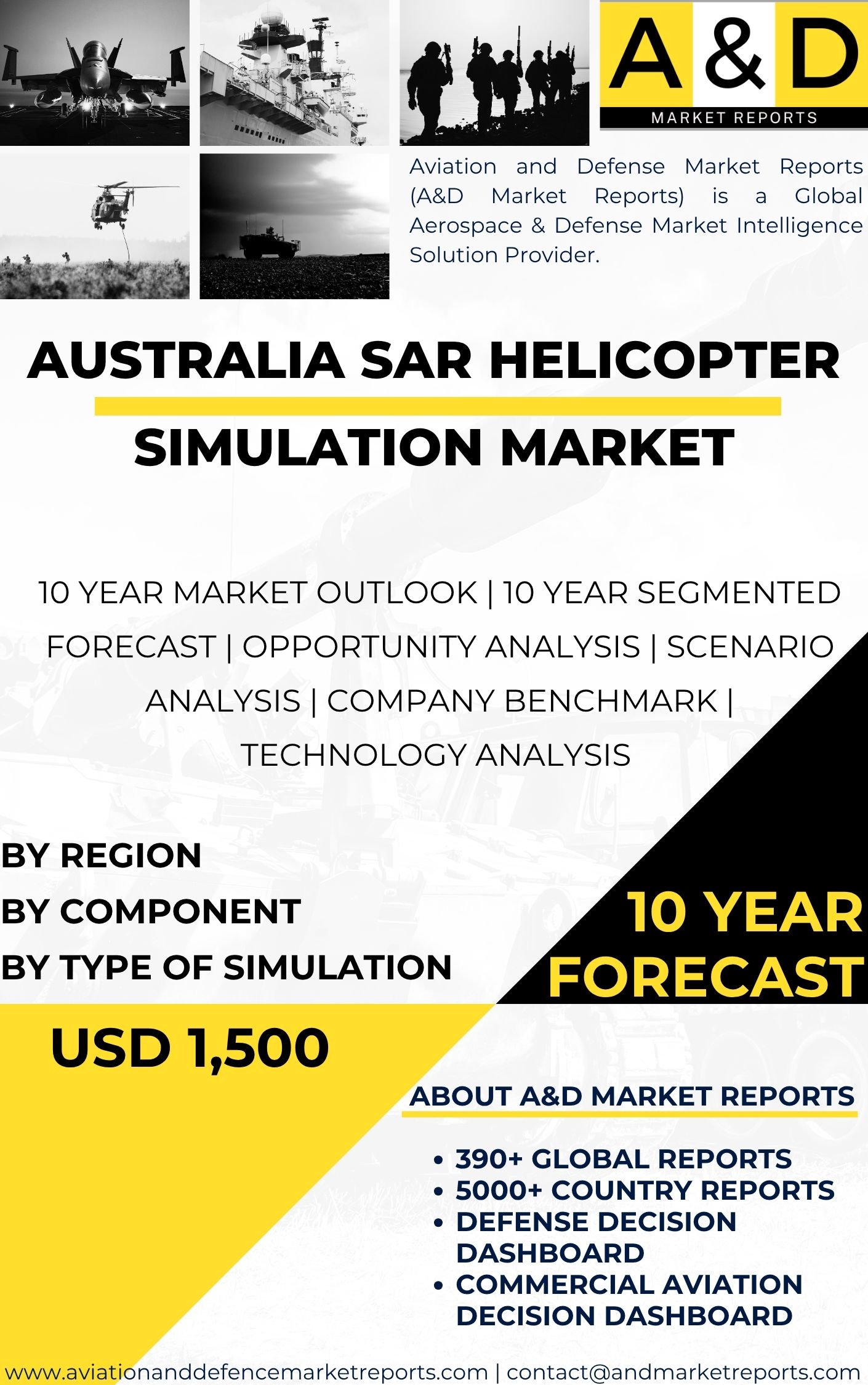
Australia SAR Helicopter Simulation Market

$1,500.00

Enquire Now

The Search and Rescue (SAR) helicopter simulation market in Australia is a specialized segment within the aviation training industry that plays a crucial role in preparing pilots for the demanding and often life-critical scenarios encountered in SAR missions. This market is driven by the necessity to enhance pilot skills, boost operational safety, and improve mission success rates in difficult environments. Simulators provide a controlled and risk-free environment where pilots can practice complex maneuvers, emergency responses, and operational procedures without the need for actual helicopter flights, which can be costly, risky, and weather-dependent.

Go To Global Report Page Track this market real time on DDD

Description

The Search and Rescue (SAR) helicopter simulation market in Australia is a specialized segment within the aviation training industry that plays a crucial role in preparing pilots for the demanding and often life-critical scenarios encountered in SAR missions. This market is driven by the necessity to enhance pilot skills, boost operational safety, and improve mission success rates in difficult environments. Simulators provide a controlled and risk-free environment where pilots can practice complex maneuvers, emergency responses, and operational procedures without the need for actual helicopter flights, which can be costly, risky, and weather-dependent.

Technological advancements have significantly influenced this market, making simulations more realistic and effective through the integration of high-fidelity visual systems, virtual reality, and advanced avionics replicating the exact cockpit environment and flight dynamics of SAR helicopters. These improvements allow pilots to experience a wide variety of scenarios such as night operations, adverse weather conditions, maritime rescues, and terrain navigation with precision and safety. The ability to rehearse these scenarios repeatedly ensures that pilots develop the necessary reflexes, situational awareness, and decision-making skills vital for real missions.

Australia?s unique geography and vast, often inaccessible coastal and inland terrains create a heightened demand for highly skilled SAR helicopter crews. Situations such as maritime emergencies, natural disasters, and remote area rescues require helicopters equipped for quick deployment and complex mission profiles. Thus, the simulation market must cater to these specific operational needs with training programs that encompass the diverse roles of SAR helicopters, including search, rescue, medical evacuation, and disaster response. The multi-role capabilities of these aircraft necessitate simulators that can provide an immersive experience covering all mission facets.

Government agencies and defense forces in Australia are significant drivers of this market. Investments in upgrading SAR capabilities, including pilot training infrastructure, reflect the critical importance of rapid and effective emergency response capabilities. Regulatory bodies emphasize adherence to stringent training standards, which increasingly incorporate simulator-based certifications as part of pilot qualification processes. This regulatory framework ensures that personnel operating SAR helicopters are trained to the highest safety and operational effectiveness standards without incurring the risks and costs associated with live flight training.

Cost efficiency is another influential factor guiding the adoption of SAR helicopter simulators. Traditional flight training incurs substantial expenses related to fuel, maintenance, and helicopter wear and tear, while simulators offer a more economical alternative. This is particularly valuable in training for rare but potentially high-risk scenarios, which cannot be safely or practically conducted frequently in real flight. By reducing operational costs, simulators make it feasible for organizations to increase the scope and frequency of training, thereby enhancing overall readiness.

The SAR helicopter simulation market in Australia also benefits from advancements in communication and data integration technologies. Modern simulators can connect with real-time data systems, enabling coordinated training with other rescue assets such as ground teams, maritime vessels, and aerial drones. This interoperability enhances the realism of training exercises and prepares SAR crews for the complex teamwork required during multi-agency emergency operations.

Challenges within the market exist, primarily related to budget constraints and the high initial costs of advanced simulator systems. However, ongoing collaborations between government, defense, and private sector companies continue to foster innovation and development, helping to introduce more accessible and versatile simulation products tailored to Australia?s SAR operational environments.

Overall, the SAR helicopter simulation market in Australia is characterized by a strong emphasis on technological sophistication, operational relevance, cost efficiency, and regulatory compliance. These factors collectively drive the steady growth and evolution of simulation solutions that enhance pilot training quality and readiness, crucial for executing demanding search and rescue missions effectively across Australia?s challenging terrains and coastal areas. This market is poised to expand as demand for advanced training systems and capabilities grows in tandem with the strategic importance of robust SAR operations.

Table of content

Table Of Contents

1 Market Introduction

1.1 Market Introduction
1.2 Market Definition
1.3 Market Segmentation
1.4 10 Year Market Outlook

2 Market Technologies

3 Global Market Forecast

3.1 Global Market Forecast
3.2 By Component
3.3 By Type of Simulation

4 APAC Market Trends & Forecast

4.1 Drivers, Restraints And Challenges
4.2 PEST
4.3 Market Forecast
4.3.1 Market Forecast By Component
4.3.2 Market Forecast By Type of Simulation
4.4 Scenario Analysis
4.5 Key Companies& Profiling

5 Australia Analysis

5.1 Current Levels Of Technology Maturation In This Market
5.2 Market Forecast
5.2.1 Market Forecast By Component
5.2.2 Market Forecast By Type of Simulation
5.3 Scenario Analysis
5.4 Country Defense Budget (Historical and 10- year forecast)
5.5 Defense Budget Category Spending- 10- year forecast
5.6 Procurement Analysis
5.7 EXIM Data
5.8 Patents

6 Opportunity Matrix

6.1 By Component
6.2 By Type of Simulation

7 Scenario Analysis

7.1 Scenario 1

7.1.1 By Component (Scenario-1)
7.1.2 By Type of Simulation (Scenario-1)

7.2 Scenario 2

7.2.1 By Component (Scenario-2)
7.2.2 By Type of Simulation (Scenario-2)

8 Company Benchmark

9 Strategic Conclusions

10 About Aviation And Defense Market Reports

Segments

By Component
By Type of Simulation

List of Tables

Table1: Global Market Forecast, SAR Helicopter Simulation Market
Table2: APAC Market Forecast, SAR Helicopter Simulation Market
Table3: APAC Market Forecast, By Component
Table4: APAC Market Forecast, By Type of Simulation
Table5: APAC, Scenario Analysis
Table6: Australia Market Forecast, SAR Helicopter Simulation Market
Table7: Australia Market Forecast, By Component
Table8: Australia Market Forecast, By Type of Simulation
Table9: Australia, Scenario Analysis
Table 10: Australia Defense Budget 10 Year Forecast
Table 11: Australia, Defense Budget Category Spending- 10- year forecast
Table 12: Australia, Procurement Analysis
Table 13: Australia, EXIM Data Analysis
Table 14: Australia, Opportunity Analysis, By Component
Table 15: Australia, Opportunity Analysis, By Type of Simulation
Table 16: Australia, Scenario Analysis, By Component
Table 17: Australia, Scenario Analysis, By Type of Simulation

List of Figures

Figure 1: Market Segmentation, Australia SAR Helicopter Simulation Market
Figure 2: Key Technology Analysis, SAR Helicopter Simulation Market
Figure 3: Global Market Forecast, SAR Helicopter Simulation Market
Figure 4: APAC, Market Forecast, SAR Helicopter Simulation Market
Figure 5: APAC, Market Forecast, By Component
Figure 6: APAC, Market Forecast, By Type of Simulation
Figure 7: APAC, Scenario Analysis
Figure 8: Australia, Market Forecast, SAR Helicopter Simulation Market
Figure 9: Australia, Market Forecast, By Component
Figure 10: Australia, Market Forecast, By Type of Simulation
Figure 11: Australia, Scenario Analysis
Figure 12: Australia, Defense Budget 10 Year Forecast
Figure 13: Australia, Defense Budget Category Spending- 10- year forecast
Figure 14: Australia, Procurement Analysis
Figure 15: Australia, EXIM Data Analysis
Figure 16: Australia, Opportunity Analysis, By Component
Figure 17: Australia, Opportunity Analysis, By Type of Simulation
Figure 18: Australia, Scenario Analysis, By Component
Figure 19: Australia, Scenario Analysis, By Type of Simulation
Figure 20: Company Benchmark