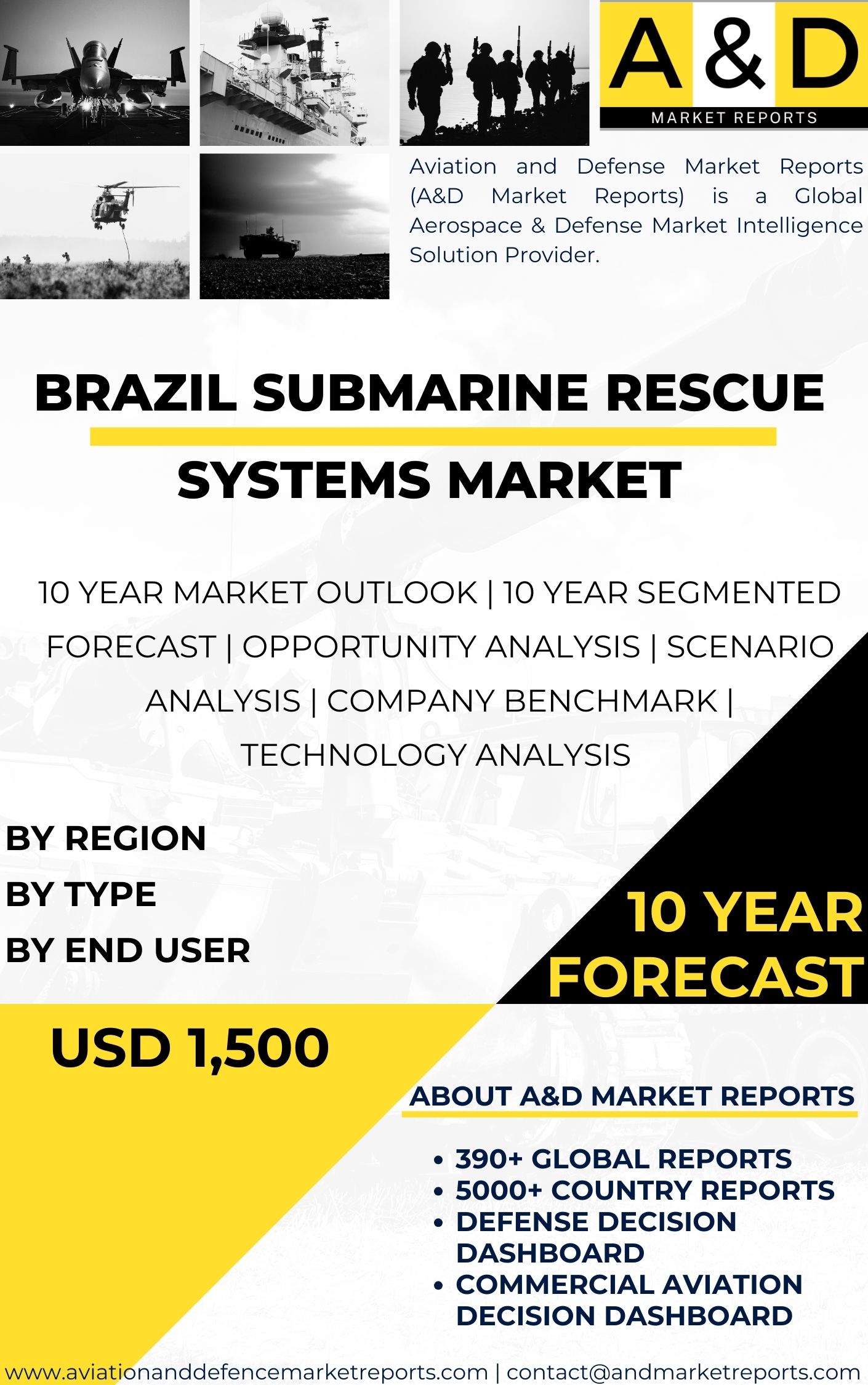
Brazil Submarine Rescue Systems Market

$1,500.00

Enquire Now

The Brazil Submarine Rescue Systems Market holds significant importance for the country’s naval capabilities, as submarine rescue systems are critical for safeguarding the lives of submariners and maintaining the readiness of the submarine fleet. Submarine rescue systems are specialized equipment designed to provide timely and effective assistance in the event of a submarine emergency, such as a disabled or stranded submarine with crew members in distress. As Brazil seeks to bolster its naval forces and enhance its maritime security, the market for submarine rescue systems has gained prominence. This article provides a comprehensive analysis of the Brazil Submarine Rescue Systems Market, covering its current state, key drivers, challenges, applications, technological advancements, and growth prospects.

Go To Global Report Page Track this market real time on DDD

Description

Brazil’s Submarine Rescue Infrastructure and International Collaboration

Brazil submarine rescue systems market is anchored by its evolving infrastructure, including hyperbaric facilities, escape training towers, and dedicated support vessels, which underpin the Brazilian Navy’s commitment to crew safety amid the Prosub program’s expansion. These assets, combined with active participation in multinational exercises, enhance operational readiness and foster global interoperability, positioning Brazil as a collaborative leader in South American maritime security.

Hyperbaric Chambers and Escape Training Facilities

The Brazilian Navy maintains a network of hyperbaric chambers across naval hospitals and bases, capable of treating decompression illness for multiple personnel simultaneously. A central hyperbaric complex at the Rio de Janeiro Submarine Base supports equipment testing at great depths and simulates saturated diving operations. Complementing this are two escape training towers: a 20m-deep facility at the Niterói Submarine Base for Tupi-class crews and a 5m-deep tower at the Itaguaí Base for Riachuelo-class submarines, ensuring submariners are proficient in emergency ascents up to 180m with internal resources or 300m with external support. These facilities, integrated into the Navy’s Diving School—the only one in Brazil training deep divers for military and civilian applications—bolster self-reliance while supporting oil industry needs.

NSS Guillobel: The New Submarine Rescue Ship

Commissioned in recent years to replace the decommissioned NSS Felinto Perry (K-11), the NSS Guillobel serves as Brazil’s primary submarine rescue vessel. Equipped with a Type 2 Dynamic Positioning System and a diving bell/hyperbaric complex for saturated dives to 180m (extendable to 300m), it enables rapid intervention for disabled submarines (DISSUBs). The ship facilitates pressurized rescues and on-board treatment, though full Transfer Under Pressure (TUP) capabilities are under development. This asset enhances Brazil’s response time in the South Atlantic, critical for protecting its expanding Riachuelo-class fleet under Prosub.

Prosub Integration and Indigenous Developments

As part of the Submarine Development Program (Prosub), Brazil is prioritizing rescue systems to support its four new Scorpène-derived Riachuelo-class submarines (S-40 to S-43) and the forthcoming nuclear-powered Álvaro Alberto. While no dedicated Submarine Rescue Vehicle (SRV) has been procured yet, discussions emphasize compatibility with NATO-standard systems like the SRV-F Mk3 (capable of 500m+ depths and 50-person capacity per dive) or OceanWorks’ RORV/SRV hybrids for untethered operations. Indigenous efforts focus on hyperbaric enhancements and potential SRV adaptations.

International Exercises and Regional Cooperation

Brazil actively engages in multinational submarine rescue drills to refine procedures and interoperability. Notable participations include Exercise IBSAMAR (with India and South Africa), focusing on anti-submarine warfare, search-and-rescue, and joint operations; and Black Sea / Caribbean iterations of Dynamic Monarch under ISMERLO, involving NATO allies like the US, UK, and France for DSRV mating simulations up to 610m. Recent involvement in Pacific Reach 2025 and potential collaborations via the NATO Submarine Rescue System (NSRS)—shared by France, Norway, and the UK—underscore Brazil’s role in hemispheric exercises, such as those with Russia, Turkey, Chile, and Ecuador simulating Type 214 rescues. These efforts, absent major US participation in some, highlight Brazil’s bridge-building in non-NATO forums.

In summary, Brazil’s submarine rescue ecosystem—bolstered by the NSS Guillobel, Prosub-aligned training, and robust international engagements—addresses the safety imperatives of its growing fleet while contributing to global standards, these investments ensure crew confidence and regional stability, paving the way for advanced SRV acquisitions by 2030.
Table of content

Table Of Contents

1 Market Introduction

1.1 Market Introduction
1.2 Market Definition
1.3 Market Segmentation
1.4 10 Year Market Outlook

2 Market Technologies

3 Global Market Forecast

3.1 Global Market Forecast
3.2 By Type
3.3 By End User

4 South AmericaMarket Trends & Forecast

4.1 Drivers, Restraints And Challenges
4.2 PEST
4.3 Market Forecast
4.3.1 Market Forecast By Type
4.3.2 Market Forecast By End User
4.4 Scenario Analysis
4.5 Key Companies& Profiling

5 Brazil Analysis

5.1 Current Levels Of Technology Maturation In This Market
5.2 Market Forecast
5.2.1 Market Forecast By Type
5.2.2 Market Forecast By End User
5.3 Scenario Analysis
5.4 Country Defense Budget (Historical and 10- year forecast)
5.5 Defense Budget Category Spending- 10- year forecast
5.6 Procurement Analysis
5.7 EXIM Data
5.8 Patents

6 Opportunity Matrix

6.1 By Type
6.2 By End User

7 Scenario Analysis

7.1 Scenario 1

7.1.1 By Type (Scenario-1)
7.1.2 By End User(Scenario-1)

7.2 Scenario 2

7.2.1 By Type (Scenario-2)
7.2.2 By End User(Scenario-2)

8 Company Benchmark

9 Strategic Conclusions

10 About Aviation And Defense Market Reports

Segments

By Type
By End User

List of Tables

Table1: Global Market Forecast, Brazil Submarine Rescue Systems Market
Table2: South America Market Forecast, Brazil Submarine Rescue Systems Market
Table3: South America Market Forecast, By Type
Table4: South America Market Forecast, By End User
Table5: South America, Scenario Analysis
Table6: Brazil Market Forecast, Brazil Submarine Rescue Systems Market
Table7: Brazil Market Forecast, By Type
Table8: Brazil Market Forecast, By End User
Table9: Brazil, Scenario Analysis
Table 10: Brazil Defense Budget 10 Year Forecast
Table 11: Brazil, Defense Budget Category Spending- 10- year forecast
Table 12: Brazil, Procurement Analysis
Table 13: Brazil, EXIM Data Analysis
Table 14: Brazil, Opportunity Analysis, By Type
Table 15: Brazil, Opportunity Analysis, By End User
Table 16: Brazil, Scenario Analysis, By Type
Table 17: Brazil, Scenario Analysis, By End User

List of Figures

Figure 1: Market Segmentation, Brazil Submarine Rescue Systems Market
Figure 2: Key Technology Analysis, Brazil Submarine Rescue Systems Market
Figure 3: Global Market Forecast, Brazil Submarine Rescue Systems Market
Figure 4: South America, Market Forecast, Brazil Submarine Rescue Systems Market
Figure 5: South America, Market Forecast, By Type
Figure 6: South America, Market Forecast, By End User
Figure 7: South America, Scenario Analysis
Figure 8: Brazil, Market Forecast, Brazil Submarine Rescue Systems Market
Figure 9: Brazil, Market Forecast, By Type
Figure 10: Brazil, Market Forecast, By End User
Figure 11: Brazil, Scenario Analysis
Figure 12: Brazil, Defense Budget 10 Year Forecast
Figure 13: Brazil, Defense Budget Category Spending- 10- year forecast
Figure 14: Brazil, Procurement Analysis
Figure 15: Brazil, EXIM Data Analysis
Figure 16: Brazil, Opportunity Analysis, By Type
Figure 17: Brazil, Opportunity Analysis, By End User
Figure 18: Brazil, Scenario Analysis, By Type
Figure 19: Brazil, Scenario Analysis, By End User
Figure 20: Company Benchmark