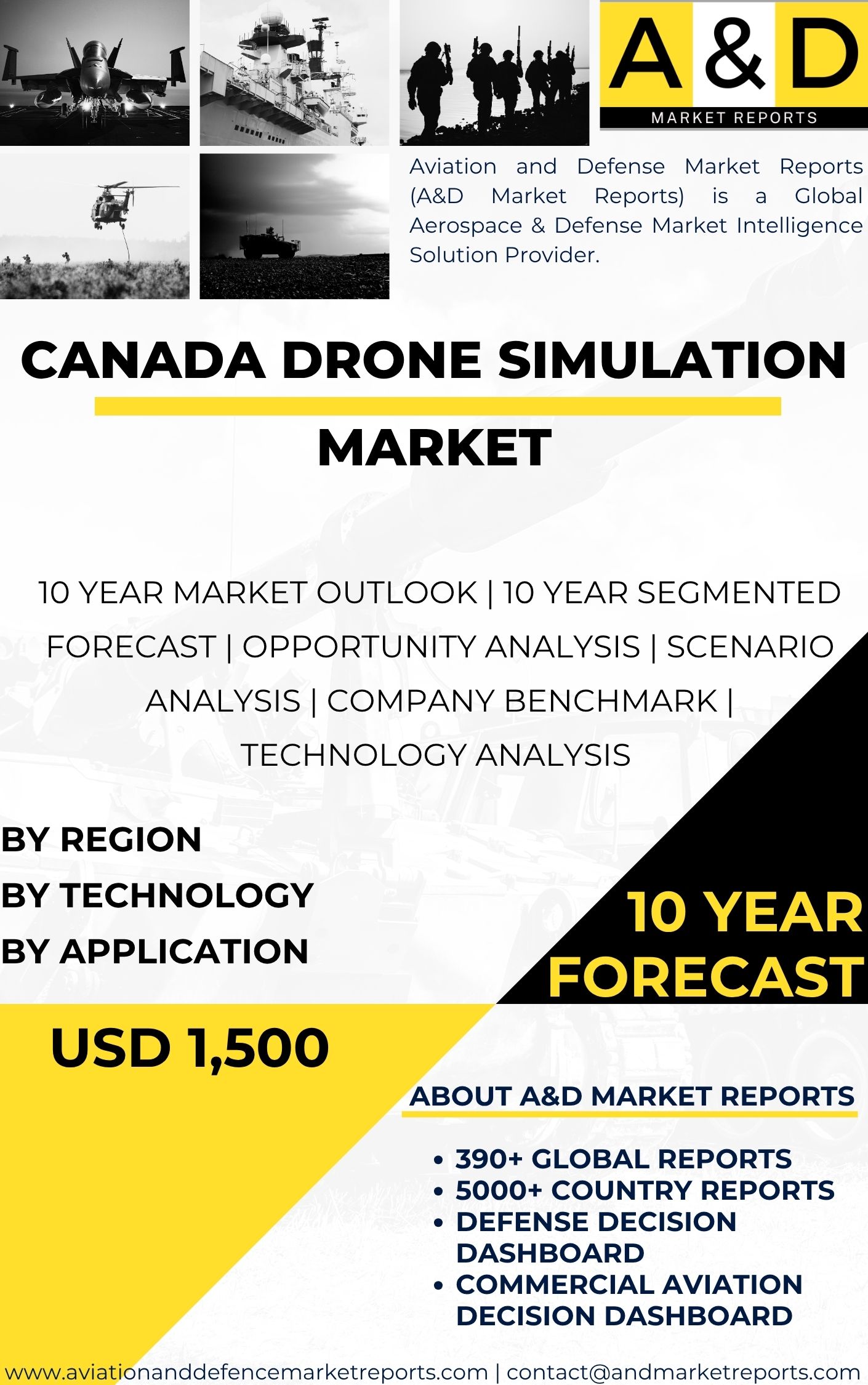
Canada Drone Simulation Market

$1,500.00

Enquire Now
Category: Tag: Report ID: ANDCCA0163

The Drone Simulation market in the Canada plays a critical role in the training, development, and testing of unmanned aerial systems operations across military and civilian sectors. This market comprises an ecosystem of simulation software developers, hardware manufacturers, and integrators delivering platforms that emulate drone flight performance, sensor operations, mission planning, and environmental challenges. Key features include customizable scenario creation, real-time data feedback, networked operations for multi-drone coordination, and interfaces designed for training operators, testing autonomous navigation algorithms, and validating payload configurations. Segmentations include fixed-wing, rotary-wing, and hybrid drone simulation platforms servicing defense, public safety, agricultural, and commercial drone stakeholders.

Go To Global Report Page Track this market real time on DDD

Description

Market Overview and Strategic Relevance

The Canada Drone Simulation Market  forms the invisible runway where unmanned systems learn to fly before ever touching the sky. It supports training, development, mission rehearsal, and system validation for both military and civilian drone operations. Because unmanned aerial systems now conduct reconnaissance, logistics delivery, surveillance, and environmental monitoring, structured simulation has become essential. These platforms recreate flight physics, payload behavior, and operational constraints in controlled digital environments. In addition, simulation reduces risk, accelerates skill acquisition, and lowers operational costs. Therefore, this market stands at the intersection of safety, innovation, and operational readiness.

Industry Structure and Key Participants

The ecosystem includes simulation software developers, hardware manufacturers, aerospace integrators, and AI specialists. Companies such as CAE Inc. contribute advanced training and modeling expertise, while L3Harris Technologies supports integrated mission simulation environments. These firms collaborate with drone manufacturers and defense agencies to ensure fidelity and regulatory alignment. Startups also play a significant role in autonomous navigation modeling and sensor emulation. This layered structure blends aerospace engineering with immersive digital technology. As a result, innovation cycles remain fast and adaptive.

Core Technologies and Platform Capabilities

Drone simulators replicate fixed-wing, rotary-wing, and hybrid UAV flight characteristics with high precision. Customizable mission scenarios allow operators to train across diverse terrains and threat conditions. Real-time performance feedback enhances operator decision-making and system tuning. Networked simulation enables multi-drone coordination and swarm behavior rehearsal. Artificial intelligence modules test autonomous flight algorithms and obstacle avoidance logic. Consequently, simulation platforms function as both training grounds and development laboratories.

Market Drivers and Application Segments

The rapid expansion of drone applications drives demand for structured and scalable training environments. Military forces require realistic mission rehearsal for reconnaissance and tactical coordination. Public safety agencies depend on simulation to prepare for emergency response scenarios. Commercial sectors including agriculture and infrastructure inspection use simulators to refine operational efficiency. Because live testing can be costly and regulated, simulation offers a practical alternative. Therefore, demand spans defense, public safety, aerospace development, and commercial drone enterprises.

Regulation, Supply Chain, and Future Outlook

Regulatory oversight emphasizes compliance with aviation safety standards and operator certification frameworks. In Canada, coordination with the Department of National Defence supports defense-specific training requirements, while civil applications align with national aviation authorities. Supply chains integrate high-performance computing systems, advanced graphics processors, sensor emulation hardware, and modular software toolkits. Technological progress increasingly incorporates virtual and augmented reality interfaces for immersive operator experiences. Cloud-based distributed simulation further enables collaborative multi-location training. Overall, the Drone Simulation market strengthens the safe integration of unmanned systems into complex airspace, shaping a skilled workforce and advancing autonomous aviation capabilities across Canada.
Table of content

Table Of Contents

1 Market Introduction

1.1 Market Introduction
1.2 Market Definition
1.3 Market Segmentation
1.4 10 Year Market Outlook

2 Market Technologies

3 Global Market Forecast

3.1 Global Market Forecast
3.2 By Technology
3.3 By Application

4 North America Market Trends & Forecast

4.1 Drivers, Restraints And Challenges
4.2 PEST
4.3 Market Forecast
4.3.1 Market Forecast By Technology
4.3.2 Market Forecast By Application
4.4 Scenario Analysis
4.5 Key Companies& Profiling

5 Canada Analysis

5.1 Current Levels Of Technology Maturation In This Market
5.2 Market Forecast
5.2.1 Market Forecast By Technology
5.2.2 Market Forecast By Application
5.3 Scenario Analysis
5.4 Country Defense Budget (Historical and 10- year forecast)
5.5 Defense Budget Category Spending- 10- year forecast
5.6 Procurement Analysis
5.7 EXIM Data
5.8 Patents

6 Opportunity Matrix

6.1 By Technology
6.2 By Application

7 Scenario Analysis

7.1 Scenario 1

7.1.1 By Technology (Scenario-1)
7.1.2 By Application (Scenario-1)

7.2 Scenario 2

7.2.1 By Technology (Scenario-2)
7.2.2 By Application (Scenario-2)

8 Company Benchmark

9 Strategic Conclusions

10 About Aviation And Defense Market Reports

Segments

By Technology
By Application

List of Tables

Table1: Global Market Forecast, Drone Simulation Market
Table2: Market Forecast, Drone Simulation Market
Table3: Market Forecast, By Technology
Table4: Market Forecast, By Application
Table5: , Scenario Analysis
Table6: Market Forecast, Drone Simulation Market
Table7: Market Forecast, By Technology
Table8: Market Forecast, By Application
Table9: , Scenario Analysis
Table 10: Defense Budget 10 Year Forecast
Table 11: , Defense Budget Category Spending- 10- year forecast
Table 12: , Procurement Analysis
Table 13: , EXIM Data Analysis
Table 14: , Opportunity Analysis, By Technology
Table 15: , Opportunity Analysis, By Application
Table 16: , Scenario Analysis, By Technology
Table 17: , Scenario Analysis, By Application

List of Figures

Figure 1: Market Segmentation, Canada Drone Simulation Market
Figure 2: Key Technology Analysis, Drone Simulation Market
Figure 3: Global Market Forecast, Drone Simulation Market
Figure 4: North America, Market Forecast, Drone Simulation Market
Figure 5: North America, Market Forecast, By Technology
Figure 6: North America, Market Forecast, By Application
Figure 7: North America, Scenario Analysis
Figure 8: Canada, Market Forecast, Drone Simulation Market
Figure 9: Canada, Market Forecast, By Technology
Figure 10: Canada, Market Forecast, By Application
Figure 11: Canada, Scenario Analysis
Figure 12: Canada, Defense Budget 10 Year Forecast
Figure 13: Canada, Defense Budget Category Spending- 10- year forecast
Figure 14: Canada, Procurement Analysis
Figure 15: Canada, EXIM Data Analysis
Figure 16: Canada, Opportunity Analysis, By Technology
Figure 17: Canada, Opportunity Analysis, By Application
Figure 18: Canada, Scenario Analysis, By Technology
Figure 19: Canada, Scenario Analysis, By Application
Figure 20: Company Benchmark

Aviation and Defense Market Reports


TPA | TIA | Consulting | Market Reports | Defense Decision Dashboard


Our Defense Report - Our Team Has Worked on More Than 250+ Individual Products / Markets