Canada Personal Air Mobility Market

$1,500.00

Enquire Now

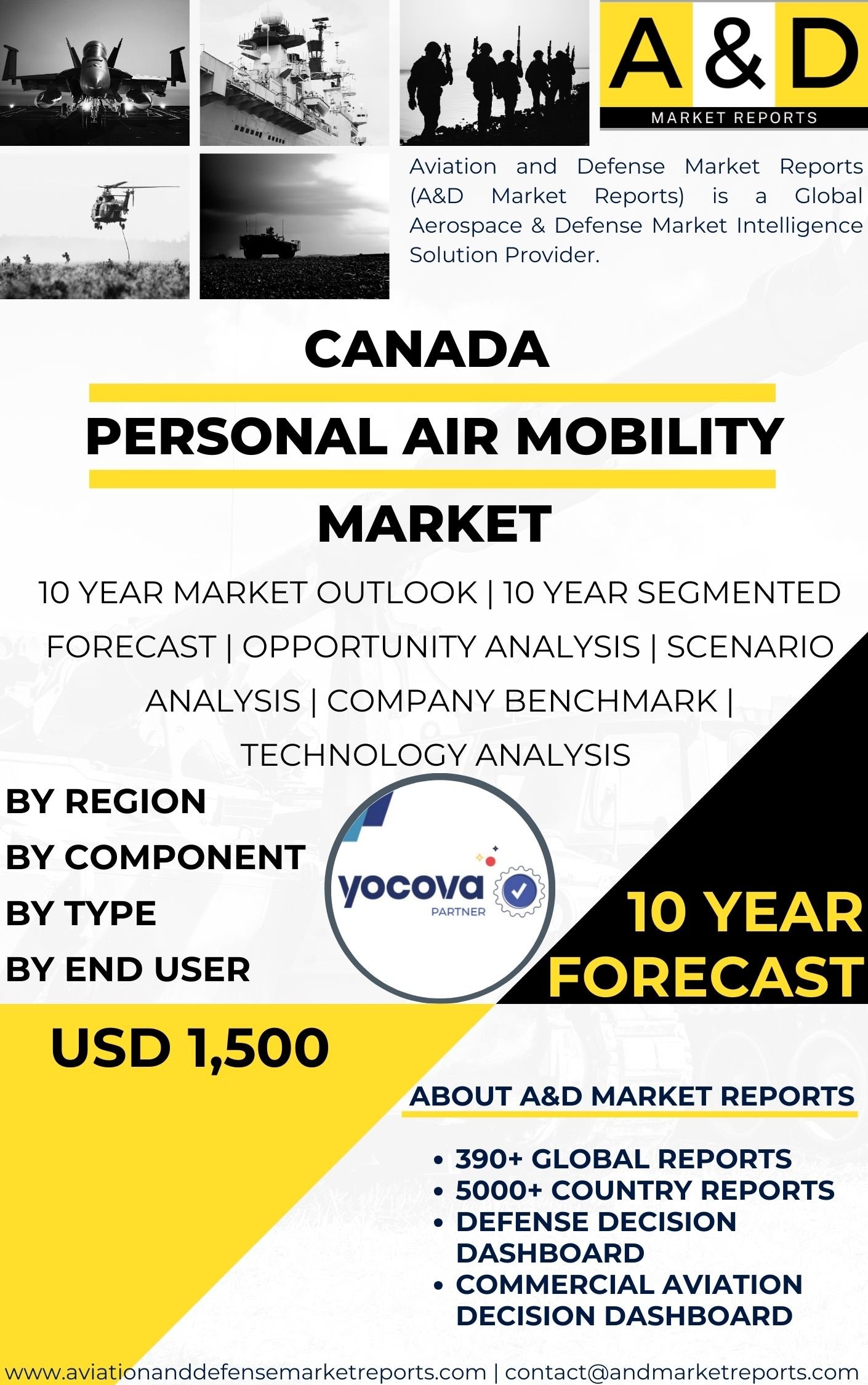
The personal air mobility market in the Canada is emerging as a transformative sector within the broader urban air mobility and advanced aerospace framework, aiming to redefine short-range airborne transportation through compact, electric, and often autonomous vertical takeoff and landing (VTOL) vehicles. The market comprises pioneering aerospace startups, established aviation manufacturers, technology developers, and infrastructure planners working collaboratively to deliver scalable, safe, and sustainable personal air mobility solutions. The market?s structure is characterized by intense innovation in propulsion, battery technology, lightweight materials, and autonomous flight control, supported by a nascent regulatory environment evolving to accommodate these new vehicle classes. Key characteristics include compact design optimized for urban environments, zero or low emissions, reduced noise profiles, and enhanced safety features aimed at widespread public adoption. Trends driving market growth include increasing urban congestion, technological readiness of electric propulsion, and growing interest in decentralized and efficient transport systems. Leading players emphasize developing vehicles with varying passenger capacities, integrating seamless digital user interfaces, and advancing air traffic management solutions that enable safe urban operation. Customers range from private consumers to corporate fleets and government agencies exploring novel transport paradigms. Typical applications envision a blend of personal, commuter, and on-demand ride-sharing models that augment traditional ground transport systems. The regulatory landscape remains fluid but progressing, involving federal aviation authorities, local governments, and standards organizations focused on airworthiness, safety certification, and operational regulations. Supply chains face challenges related to sourcing advanced composites, batteries, and electronic components, with a strong focus on reliability and scalability. Technological advances include breakthroughs in battery energy density, software-driven autonomous navigation, and advanced communication and sensing systems to ensure operational safety. Unique features of the U.S. personal air mobility market include strong government support for innovation, vibrant ecosystem of startups and research institutions, and a large, diverse urban population receptive to transformative mobility solutions.

Go To Global Report Page Track this market real time on DDD

Description

Market Overview and Strategic Vision

The Canada Personal Air Mobility Market is emerging as a transformative segment within urban air mobility. It focuses on compact electric vertical takeoff and landing aircraft designed for short-range travel. Because cities face rising congestion, stakeholders seek faster and more flexible transport options. In addition, electric propulsion aligns with sustainability goals and emission reduction targets. These vehicles aim to redefine how people move within metropolitan regions. Therefore, the sector holds strong long-term strategic potential.

Industry Structure and Key Participants

The market includes aerospace startups, established aviation manufacturers, and technology developers. Companies such as Joby Aviation and Archer Aviation lead innovation in electric VTOL aircraft. At the same time, major aerospace firms like Boeing explore advanced air mobility platforms. These organizations collaborate with infrastructure planners and software developers. As a result, the ecosystem combines manufacturing expertise with digital innovation. This coordinated structure accelerates prototype development and certification progress.

Technology Foundations and Design Characteristics

Personal air mobility vehicles rely on electric propulsion, advanced batteries, and lightweight composite materials. Because efficiency and range remain critical, developers prioritize improvements in battery energy density. Moreover, autonomous flight control systems enhance safety and operational reliability. Designers also focus on low noise output to support urban deployment. Compact airframes allow operations from small vertiports or rooftops. Consequently, technology integration drives both performance and public acceptance.

Demand Drivers and Use Cases

Urban congestion strongly motivates interest in personal air mobility solutions. In addition, growing acceptance of electric vehicles increases consumer openness to aerial alternatives. Potential customers include private users, corporate fleets, and government agencies. Typical use cases involve commuter travel, on-demand ride sharing, and emergency response support. Because these services reduce travel time, they complement existing ground transport networks. Therefore, market adoption may expand as infrastructure matures.

Regulation, Supply Chain, and Future Outlook

Regulatory authorities continue shaping certification standards for electric VTOL aircraft. Agencies such as Federal Aviation Administration work to establish airworthiness and operational guidelines. Meanwhile, supply chains must secure advanced composites, batteries, and avionics systems. Developers also integrate autonomous navigation software and advanced sensing technologies. Furthermore, government innovation programs and research institutions support early-stage growth. As technological readiness improves, the personal air mobility market in Canada is positioned to expand through sustainable design and digital air traffic integration.
Table of content

Table Of Contents

1 Market Introduction

1.1 Market Introduction
1.2 Market Definition
1.3 Market Segmentation
1.4 10 Year Market Outlook

2 Market Technologies

3 Global Market Forecast

3.1 Global Market Forecast
3.2 By Type
3.3 By Component

4 North America Market Trends & Forecast

4.1 Drivers, Restraints And Challenges
4.2 PEST
4.3 Market Forecast
4.3.1 Market Forecast By Type
4.3.2 Market Forecast By Component
4.4 Scenario Analysis
4.5 Key Companies& Profiling

5 Canada Analysis

5.1 Current Levels Of Technology Maturation In This Market
5.2 Market Forecast
5.2.1 Market Forecast By Component
5.2.2 Market Forecast By Type
5.3 Scenario Analysis
5.4 Country Defense Budget (Historical and 10- year forecast)
5.5 Defense Budget Category Spending- 10- year forecast
5.6 Procurement Analysis
5.7 EXIM Data
5.8 Patents

6 Opportunity Matrix

6.1 By Type
6.2 By Component

7 Scenario Analysis

7.1 Scenario 1

7.1.1 By Type (Scenario-1)
7.1.2 By Component (Scenario-1)

7.2 Scenario 2

7.2.1 By Type (Scenario-2)
7.2.2 By Component (Scenario-2)

8 Company Benchmark

9 Strategic Conclusions

10 About Aviation And Defense Market Reports

Segments

By Component
By Type

List of Tables

Table1: Global Market Forecast, Personal Air Mobility Market
Table2: Market Forecast, Personal Air Mobility Market
Table3: Market Forecast, By Component
Table4: Market Forecast, By Type
Table5: , Scenario Analysis
Table6: Market Forecast, Personal Air Mobility Market
Table7: Market Forecast, By Component
Table8: Market Forecast, By Type
Table9: , Scenario Analysis
Table 10: Defense Budget 10 Year Forecast
Table 11: , Defense Budget Category Spending- 10- year forecast
Table 12: , Procurement Analysis
Table 13: , EXIM Data Analysis
Table 14: , Opportunity Analysis, By Component
Table 15: , Opportunity Analysis, By Type
Table 16: , Scenario Analysis, By Component
Table 17: , Scenario Analysis, By Type

List of Figures

Figure 1: Market Segmentation, Canada Personal Air Mobility Market
Figure 2: Key Technology Analysis, Personal Air Mobility Market
Figure 3: Global Market Forecast, Personal Air Mobility Market
Figure 4: North America, Market Forecast, Personal Air Mobility Market
Figure 5: North America, Market Forecast, By Component
Figure 6: North America, Market Forecast, By Type
Figure 7: North America, Scenario Analysis
Figure 8: Canada, Market Forecast, Personal Air Mobility Market
Figure 9: Canada, Market Forecast, By Component
Figure 10: Canada, Market Forecast, By Type
Figure 11: Canada, Scenario Analysis
Figure 12: Canada, Defense Budget 10 Year Forecast
Figure 13: Canada, Defense Budget Category Spending- 10- year forecast
Figure 14: Canada, Procurement Analysis
Figure 15: Canada, EXIM Data Analysis
Figure 16: Canada, Opportunity Analysis, By Component
Figure 17: Canada, Opportunity Analysis, By Type
Figure 18: Canada, Scenario Analysis, By Component
Figure 19: Canada, Scenario Analysis, By Type
Figure 20: Company Benchmark

Aviation and Defense Market Reports


TPA | TIA | Consulting | Market Reports | Defense Decision Dashboard


Our Defense Report - Our Team Has Worked on More Than 250+ Individual Products / Markets