
Description
Surface Material Testing Overview in Canada
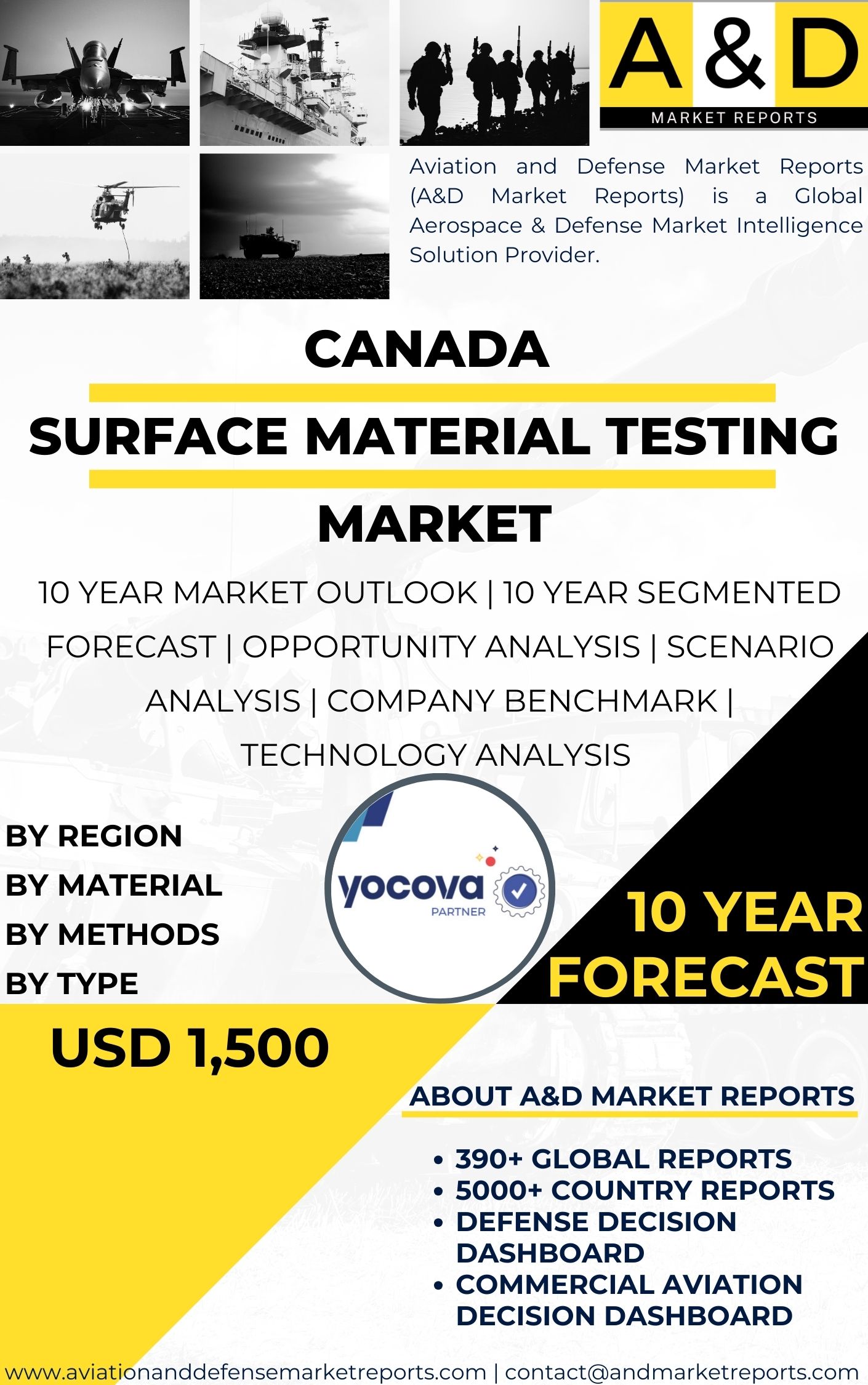
Canada Surface material testing aerospace and defense sectors plays a critical role in ensuring material integrity, durability, and operational safety. Aerospace platforms operate in extreme conditions that include mechanical stress, corrosion, temperature variation, and environmental exposure. Therefore, engineers apply rigorous testing methodologies to validate surface performance before deployment. These evaluations protect aircraft, spacecraft, missiles, and defense systems from premature degradation. As operational demands intensify, surface validation becomes increasingly important across design, production, and maintenance stages.
Material Types and Core Testing Objectives
Surface testing covers metals, composites, polymers, ceramics, coatings, and advanced alloys used in aerospace structures. Each material type requires specific evaluation techniques to measure performance characteristics. Engineers assess surface roughness, hardness, coating adhesion, corrosion resistance, wear behavior, and microstructural consistency. These properties directly influence aerodynamic efficiency, structural fatigue resistance, and service life. Consequently, accurate surface characterization supports both lightweight design strategies and long-term durability goals.
Non-Destructive Testing Techniques
Non-destructive testing methods form the backbone of surface evaluation processes. These techniques allow engineers to detect defects without harming components. Common methods include ultrasonic testing, radiographic inspection, eddy current analysis, magnetic particle testing, and liquid penetrant inspection. For example, fluorescent penetrant inspection reveals microscopic cracks under ultraviolet light. Similarly, eddy current testing identifies conductivity variations that indicate flaws in metallic surfaces. Because safety remains paramount in aerospace systems, NDT ensures early detection of cracks, corrosion, delamination, and coating defects.
Mechanical and Tribological Testing Methods
Mechanical testing techniques provide quantitative measurements of surface durability and structural resistance. Hardness testing and nanoindentation determine localized strength and elasticity at micro scales. Adhesion testing verifies that protective coatings withstand thermal cycling and mechanical stress. In addition, tribological evaluations measure friction and wear performance under simulated operating conditions. These assessments prove essential for turbine blades, landing gear components, and exposed structural surfaces. Therefore, mechanical validation enhances reliability and extends component lifespan.
Thermal Analysis and Environmental Performance
Thermal testing evaluates how materials respond to temperature fluctuations and extreme heat exposure. Techniques such as Differential Scanning Calorimetry, Thermogravimetric Analysis, and Dynamic Mechanical Analysis characterize phase transitions and decomposition limits. These insights help engineers select materials that remain stable during high-altitude flight or engine operation. Furthermore, thermal cycling simulations reveal expansion behavior and coating resilience. As aerospace systems encounter wide temperature ranges, thermal analysis ensures consistent material performance.
Microstructural and Chemical Characterization
Microstructural analysis provides deeper insight into surface morphology and internal composition. Tools such as scanning electron microscopy and X-ray diffraction reveal grain structure, chemical distribution, and phase composition. Energy-dispersive spectroscopy further identifies elemental variations within coatings and alloys. These techniques allow engineers to diagnose failure mechanisms and optimize manufacturing processes. Consequently, detailed microstructural evaluation strengthens quality assurance and supports advanced material development.
Regulatory Standards and Certification
Surface material testing operates within strict regulatory frameworks that enforce accuracy and repeatability. Aerospace standards from ASTM, SAE, MIL-STD, and NADCAP define testing protocols and documentation requirements. Compliance with these standards ensures reproducible and scientifically valid results. Moreover, certification processes support safety assurance and international acceptance of aerospace components. Because defense applications demand uncompromising reliability, adherence to standards remains a fundamental market driver.
Economic and Environmental Impact
Surface testing reduces the risk of in-service failures and lowers long-term maintenance costs. By identifying weaknesses early, manufacturers avoid costly recalls and warranty claims. In addition, optimized materials enable weight reduction without sacrificing strength, which improves fuel efficiency. Environmentally, advanced surface validation supports the development of corrosion-resistant and sustainable coatings. Therefore, surface testing contributes to both operational efficiency and reduced environmental impact.
Conclusion
Surface material testing in Canada’s aerospace and defense industry represents a comprehensive and interdisciplinary field. It integrates physical, mechanical, chemical, and microstructural analysis to safeguard performance and safety. As aerospace systems adopt lighter materials and operate under more demanding conditions, testing methodologies continue to advance. Consequently, surface validation remains essential to achieving reliability, durability, and technological leadership in modern aerospace and defense engineering,