
Description
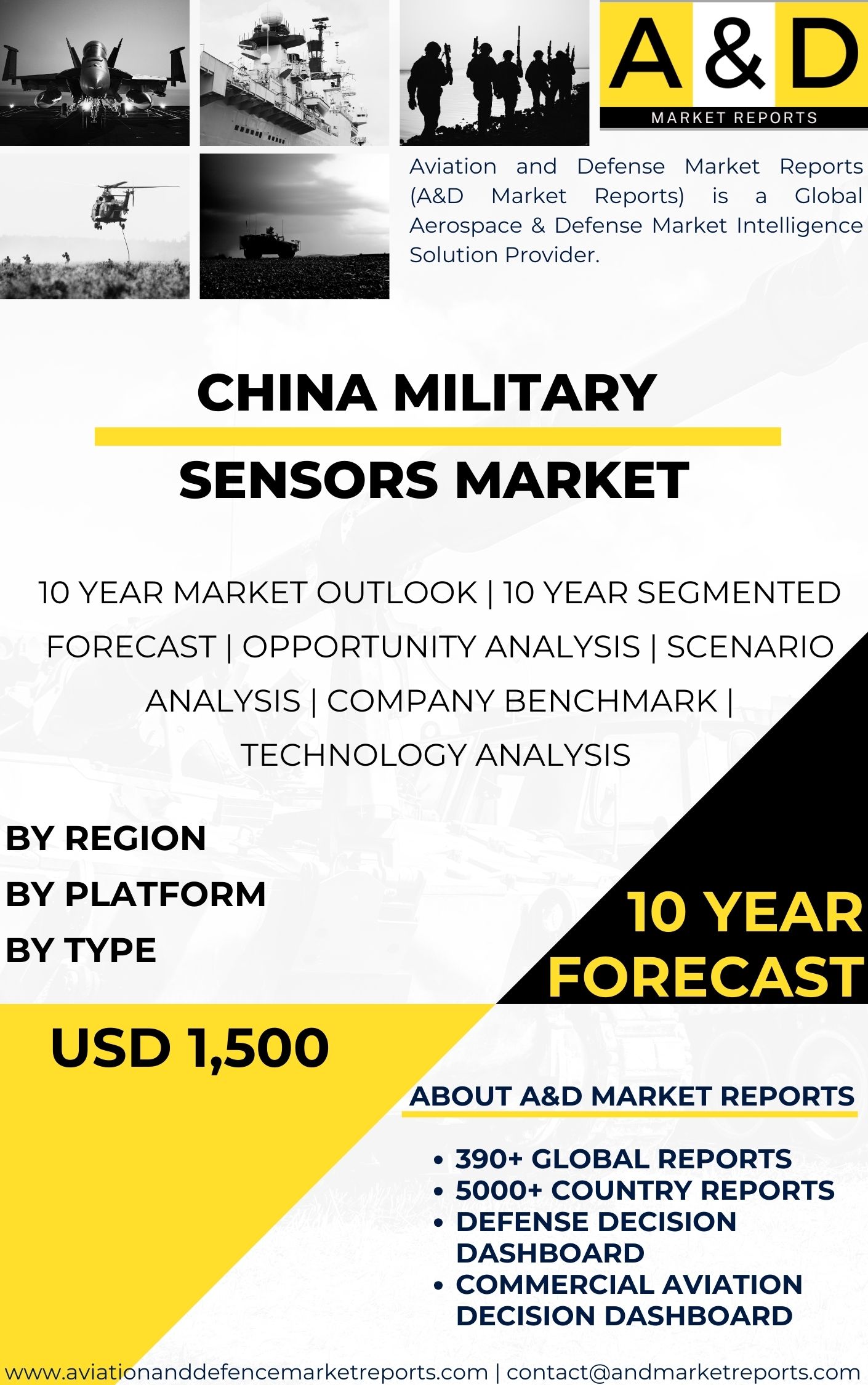
Overview of China Military Sensors Market
The China Military Sensors Market is a critical and rapidly expanding sector within the country’s defense industry. Military sensors are essential for enhancing situational awareness, intelligence gathering, target detection, and tracking in modern military operations. These systems include radar, electro-optical sensors, acoustic sensors, magnetic sensors, and chemical and biological detection systems. China’s focus on military modernization, information dominance, and advanced warfare capabilities has strongly driven the development of this market. Growing demand for precise, real-time battlefield intelligence is accelerating sensor innovation across all defense platforms.
Government Investment and Technological Development
China has significantly increased investment in research and development to build advanced indigenous military sensor technologies. The government recognizes that superior sensor capabilities are critical for operational readiness, early threat detection, and mission success. As a result, strong emphasis is placed on developing high-performance radar systems, infrared imaging sensors, multi-spectral sensors, and advanced detection platforms. Collaboration between defense institutions, universities, and private enterprises is further accelerating innovation and enabling rapid deployment of next-generation sensor systems.
Technological Self-Sufficiency as a Growth Driver
A major driver of the China Military Sensors Market is the push for technological self-sufficiency and reduced dependence on foreign suppliers. China is actively strengthening its domestic defense industrial base by investing in core technologies such as semiconductor sensors, signal processing systems, and advanced electronics. Domestic companies are working closely with research institutes to develop high-precision, mission-specific sensors tailored for military applications. This approach enhances national security while improving China’s competitiveness in the global defense sensor market.
Rising Demand for Advanced Sensor Capabilities
China’s expanding military operations and modernization programs are increasing demand for advanced sensor systems. Modern defense platforms require sensors capable of delivering accurate, real-time data for surveillance, reconnaissance, target identification, and threat monitoring. These systems must perform reliably in complex environments, including land, sea, air, and space domains. Chinese defense companies are focusing on improving sensor accuracy, detection range, resolution, and integration with other battlefield systems to enhance overall operational effectiveness.
Strong Defense Industrial and Technological Base
China benefits from a strong and well-established defense and electronics industrial ecosystem. Companies specializing in radar technology, microelectronics, optics, signal processing, and data analytics are key contributors to this market. This industrial base supports large-scale production, rapid prototyping, and continuous innovation in sensor technologies. The availability of skilled engineers and integrated supply chains further strengthens China’s ability to develop advanced, high-performance military sensor systems.
Integration of Advanced Technologies
The China Military Sensors Market is increasingly driven by the integration of advanced technologies such as artificial intelligence, machine learning, and data fusion systems. These technologies significantly improve the speed and accuracy of data interpretation, enabling faster decision-making on the battlefield. AI-powered sensors can identify targets more efficiently, reduce false alarms, and enhance automated threat detection. Integration with network-centric systems also improves real-time information sharing across military platforms.
Strategic Importance in Modern Warfare
Military sensors play a vital role in China’s broader strategy for information warfare and network-centric operations. These systems are essential for intelligence gathering, surveillance, reconnaissance, and precision targeting. By integrating sensor networks with command, control, and communication systems, China enhances its ability to conduct coordinated and multi-domain operations. This strengthens its capabilities in asymmetric warfare and improves overall battlefield awareness and response speed.
Challenges in Quality, Performance, and Innovation
Despite strong growth, the market faces challenges related to quality assurance, reliability, and performance consistency. Military sensors must meet extremely high standards for accuracy and durability under harsh operational conditions. Continuous research and development investment is required to improve sensor sensitivity, resolution, and environmental adaptability. Ensuring consistency across large-scale production also remains a key challenge for domestic manufacturers.
Technological Limitations and Cost Pressures
Adapting to evolving battlefield requirements presents additional challenges, including the need for smaller, lighter, more energy-efficient, and higher-performance sensors. Balancing advanced capabilities with cost-effectiveness is a key concern for manufacturers. Chinese companies must continuously innovate to meet rising performance expectations while maintaining affordability and scalability for mass deployment across military platforms.
Conclusion and Future Outlook
The China Military Sensors Market is expected to experience continued strong growth driven by military modernization, technological innovation, and government support. Advancements in AI, semiconductor technologies, and multi-domain integration will further enhance sensor capabilities. China’s strong industrial base and focus on self-reliance position it as a major global competitor in this sector. However, addressing challenges related to quality, performance optimization, and international collaboration will be essential for sustained long-term growth and global competitiveness.