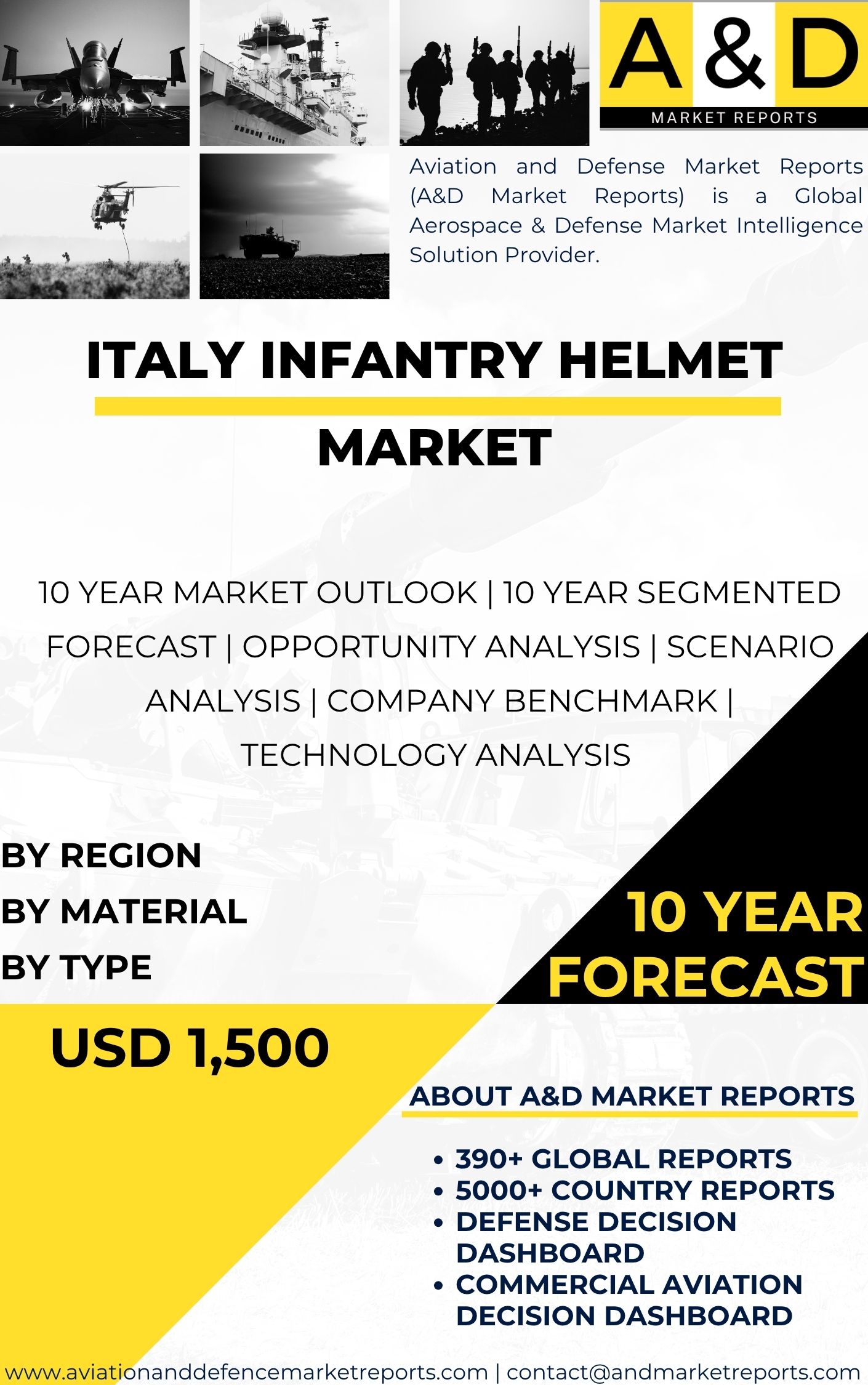
Italy Infantry Helmet Market

$1,500.00

Enquire Now
Category: Tag: Report ID: ANDCIT0184

Italy?s infantry helmet market is a sophisticated and strategically important segment of the nation?s defense and personal protection industry, driven by the requirement to protect dismounted soldiers against a spectrum of battlefield threats while maximizing comfort, situational awareness and mission effectiveness. Infantry helmets have evolved far beyond basic ballistic protection; modern systems are integrated platforms that combine ballistic shells, modular applique armor, suspension systems, communication headsets, night vision and sensor mounts, and enhanced stabilization features. In Italy, domestic defense contractors and specialized manufacturers supply helmets for the Italian Army, special operations forces, law enforcement agencies and export customers, focusing on meeting NATO ballistic standards, ergonomics, modularity and lifecycle support. Protection levels vary according to mission?standard combat helmets prioritize ballistic and fragmentation protection for small-arms and shell fragments, while special operations helmets balance protection with weight savings and accommodate advanced sensor payloads. The market?s technical trajectory is shaped by material science innovations, helmet ergonomics, integration of electronics and modular add-ons that allow single-platform adaptability across mission sets.

Go To Global Report Page Track this market real time on DDD

Description

Italy?s infantry helmet market is a sophisticated and strategically important segment of the nation?s defense and personal protection industry, driven by the requirement to protect dismounted soldiers against a spectrum of battlefield threats while maximizing comfort, situational awareness and mission effectiveness. Infantry helmets have evolved far beyond basic ballistic protection; modern systems are integrated platforms that combine ballistic shells, modular applique armor, suspension systems, communication headsets, night vision and sensor mounts, and enhanced stabilization features. In Italy, domestic defense contractors and specialized manufacturers supply helmets for the Italian Army, special operations forces, law enforcement agencies and export customers, focusing on meeting NATO ballistic standards, ergonomics, modularity and lifecycle support. Protection levels vary according to mission?standard combat helmets prioritize ballistic and fragmentation protection for small-arms and shell fragments, while special operations helmets balance protection with weight savings and accommodate advanced sensor payloads. The market?s technical trajectory is shaped by material science innovations, helmet ergonomics, integration of electronics and modular add-ons that allow single-platform adaptability across mission sets.

Materials technology is a central driver in Italy?s infantry helmet market. High-performance fibers such as ultra-high-molecular-weight polyethylene (UHMWPE), advanced aramid fibers (e.g., Twaron, Kevlar) and composite laminates provide improved ballistic performance at reduced weights. Manufacturers apply optimized layups and bonding techniques to manage trade-offs between blunt-force trauma mitigation, fragmentation resistance and weight. Additive manufacturing and advanced molding processes enable complex internal geometries for suspension systems and integration points while ensuring consistent protective performance. Surface coatings and treatments contribute to environmental resistance, reducing degradation from UV, salt, humidity and temperature extremes?important considerations for Italy?s Mediterranean and expeditionary deployments.

Integration capability has become a defining attribute of modern helmets. Rail systems, standard mounting interfaces and night-vision mounts allow rapid attachment of electro-optical sensors, helmet-mounted displays and communications headsets. Built-in cable routing, buffeting reduction features and compatibility with respiratory equipment and protective eyewear enhance usability in combined-arms operations and NBC (nuclear, biological, chemical) environments. Communications integration is especially important; modern infantry operations depend on real-time voice and data exchange. Helmets designed for seamless incorporation of headsets, bone-conduction audio or integrated microphones improve command-and-control and decrease reaction times, particularly for squad leaders and vehicle crew.

Ergonomics and human factors are critical market attributes that influence procurement. Prolonged wear demands adjustable suspension systems, padding material choices that reduce pressure points, and balance to prevent neck strain during long missions or when wearing night-vision or augmented reality devices. Ventilation and thermal management are also important in hot climates to reduce heat stress and maintain cognitive performance. Italy?s helmet suppliers invest in anthropometric research to design liners and retention systems that fit diverse user populations while ensuring stability during high-mobility actions and parachute or fast-rope ingress.

Standards compliance, testing and certification underpin market credibility. Helmets must meet stringent ballistic tests, blunt impact standards, retention system strength and flame resistance thresholds. Certification processes and independent testing regimes provide procurement authorities with assurance of performance, while lifecycle support including spare parts, replacement liners and refurbishment extend service life and reduce total ownership costs. Italy?s defense procurement often favors suppliers that can provide comprehensive support packages including training, field repairs and logistical sustainment.

The market also faces evolving threat considerations that shape design priorities. Asymmetric threats, urban combat and the prevalence of fragmentation devices prompt focus on modular side and rear ballistic add-ons, while growing concerns about blast and concussive effects drive research into energy-absorbing liners and suspension systems that mitigate traumatic brain injury risk. Electronic countermeasures and signature management are further considerations in some specialized helmets, particularly for forces operating in high-threat electronic warfare environments.

Export potential is an important economic dimension. Italian manufacturers that combine certified ballistic performance, ergonomic design and integrated electronics can compete in global markets, particularly among NATO and EU partners seeking interoperable protective systems. Export strategies often bundle helmets with training, maintenance and certification support to enhance appeal. Environmental and sustainability trends also influence production; life-cycle assessments, recyclable liner materials and lower-impact manufacturing processes are becoming part of buyer preferences, particularly for large procurement volumes.

Looking ahead, Italy?s infantry helmet market will continue evolving toward lighter, more integrated platforms that enhance soldier lethality and survivability without compromising mobility or comfort. Advances in smart materials, embedded sensors (for biometrics or environmental sensing), augmented reality displays and improved blast-mitigation liners will incrementally reshape helmet capabilities. Suppliers that can marry rigorous ballistic protection with modular electronics integration, ergonomic excellence and sustainable manufacturing processes will be best positioned to meet the diverse operational needs of Italy?s armed forces and international customers.

Table of content

Table Of Contents

1 Market Introduction

1.1 Market Introduction
1.2 Market Definition
1.3 Market Segmentation
1.4 10 Year Market Outlook

2 Market Technologies

3 Global Market Forecast

3.1 Global Market Forecast
3.2 By Type
3.3 By Material

4 Europe Market Trends & Forecast

4.1 Drivers, Restraints And Challenges
4.2 PEST
4.3 Market Forecast
4.3.1 Market Forecast By Type
4.3.2 Market Forecast By Material
4.4 Scenario Analysis
4.5 Key Companies& Profiling

5 Italy Analysis

5.1 Current Levels Of Technology Maturation In This Market
5.2 Market Forecast
5.2.1 Market Forecast By Type
5.2.2 Market Forecast By Material
5.3 Scenario Analysis
5.4 Country Defense Budget (Historical and 10- year forecast)
5.5 Defense Budget Category Spending- 10- year forecast
5.6 Procurement Analysis
5.7 EXIM Data
5.8 Patents

6 Opportunity Matrix

6.1 By Type
6.2 By Material

7 Scenario Analysis

7.1 Scenario 1

7.1.1 By Type (Scenario-1)
7.1.2 By Material (Scenario-1)

7.2 Scenario 2

7.2.1 By Type (Scenario-2)
7.2.2 By Material (Scenario-2)

8 Company Benchmark

9 Strategic Conclusions

10 About Aviation And Defense Market Reports

Segments

By Type
By Material

List of Tables

Table1: Global Market Forecast, Infantry Helmet Market
Table2: Europe Market Forecast, Infantry Helmet Market
Table3: Europe Market Forecast, By Type
Table4: Europe Market Forecast, By Material
Table5: Europe, Scenario Analysis
Table6: Italy Market Forecast, Infantry Helmet Market
Table7: Italy Market Forecast, By Type
Table8: Italy Market Forecast, By Material
Table9: Italy, Scenario Analysis
Table 10: Italy Defense Budget 10 Year Forecast
Table 11: Italy, Defense Budget Category Spending- 10- year forecast
Table 12: Italy, Procurement Analysis
Table 13: Italy, EXIM Data Analysis
Table 14: Italy, Opportunity Analysis, By Type
Table 15: Italy, Opportunity Analysis, By Material
Table 16: Italy, Scenario Analysis, By Type
Table 17: Italy, Scenario Analysis, By Material

List of Figures

Figure 1: Market Segmentation, Italy Infantry Helmet Market
Figure 2: Key Technology Analysis, Infantry Helmet Market
Figure 3: Global Market Forecast, Infantry Helmet Market
Figure 4: Europe, Market Forecast, Infantry Helmet Market
Figure 5: Europe, Market Forecast, By Type
Figure 6: Europe, Market Forecast, By Material
Figure 7: Europe, Scenario Analysis
Figure 8: Italy, Market Forecast, Infantry Helmet Market
Figure 9: Italy, Market Forecast, By Type
Figure 10: Italy, Market Forecast, By Material
Figure 11: Italy, Scenario Analysis
Figure 12: Italy, Defense Budget 10 Year Forecast
Figure 13: Italy, Defense Budget Category Spending- 10- year forecast
Figure 14: Italy, Procurement Analysis
Figure 15: Italy, EXIM Data Analysis
Figure 16: Italy, Opportunity Analysis, By Type
Figure 17: Italy, Opportunity Analysis, By Material
Figure 18: Italy, Scenario Analysis, By Type
Figure 19: Italy, Scenario Analysis, By Material
Figure 20: Company Benchmark

Aviation and Defense Market Reports


TPA | TIA | Consulting | Market Reports | Defense Decision Dashboard


Our Defense Report - Our Team Has Worked on More Than 250+ Individual Products / Markets