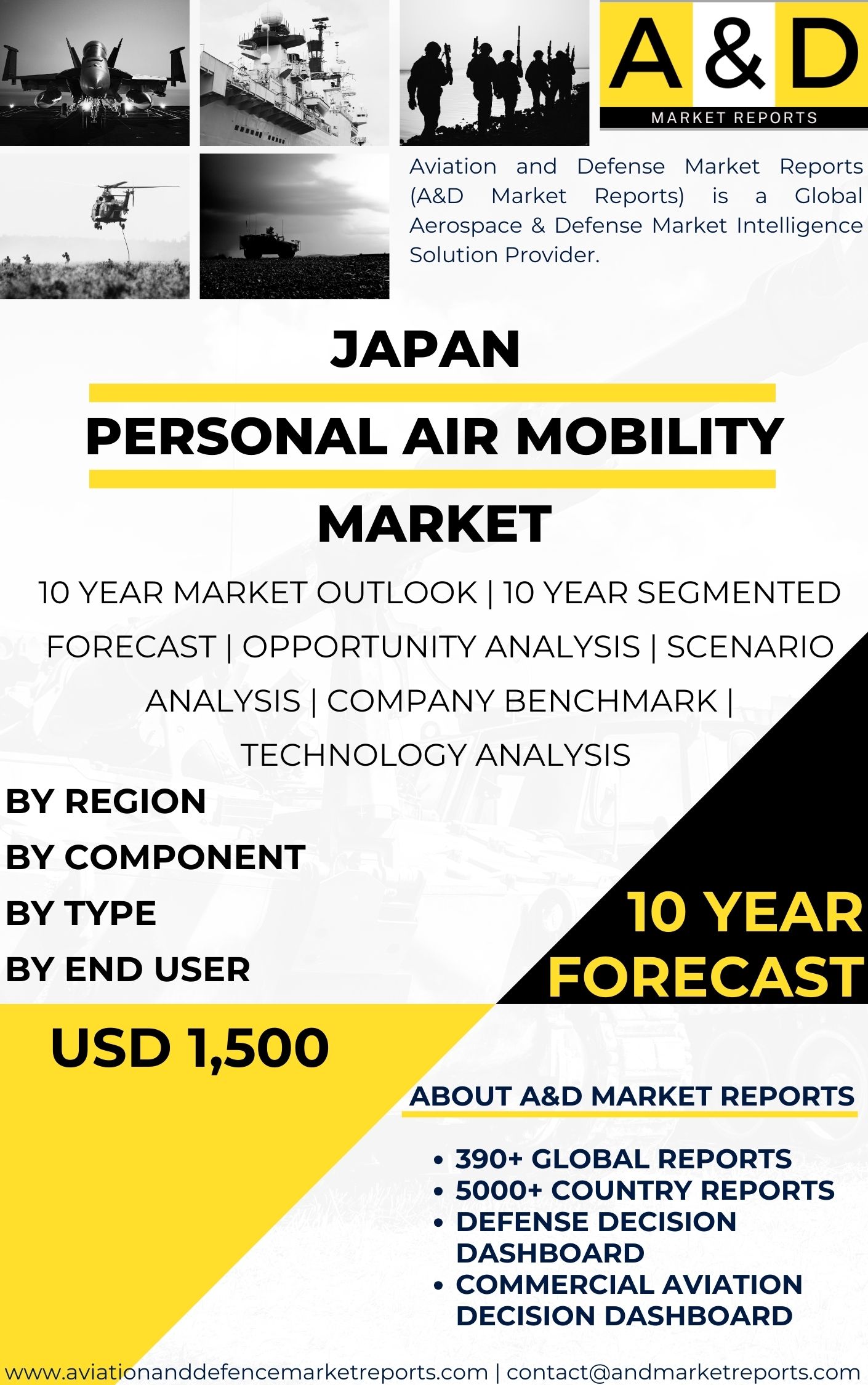
Japan Personal Air Mobility Market

$1,500.00

Enquire Now

The personal air mobility market in Japan is developing rapidly as a transformative solution to urban transportation challenges in the country. This market revolves primarily around electric vertical takeoff and landing vehicles, known as eVTOLs, which promise to alleviate ground traffic congestion and reduce travel times dramatically compared to traditional road transport. These aircraft are designed to operate in and around urban centers, leveraging advanced electric propulsion systems that make them quieter, more efficient, and environment-friendly. The promise of these vehicles is a new mode of transportation that is faster, less dependent on ground infrastructure, and capable of integrating with existing urban transport networks.

Go To Global Report Page Track this market real time on DDD

Description

The personal air mobility market in Japan is developing rapidly as a transformative solution to urban transportation challenges in the country. This market revolves primarily around electric vertical takeoff and landing vehicles, known as eVTOLs, which promise to alleviate ground traffic congestion and reduce travel times dramatically compared to traditional road transport. These aircraft are designed to operate in and around urban centers, leveraging advanced electric propulsion systems that make them quieter, more efficient, and environment-friendly. The promise of these vehicles is a new mode of transportation that is faster, less dependent on ground infrastructure, and capable of integrating with existing urban transport networks.

Japan is uniquely positioned as a significant market for personal air mobility due to its dense urban population, aging infrastructure, and the technological prowess of its industries. The government, through its Ministry of Land, Infrastructure, Transport and Tourism, actively supports the development and rollout of advanced air mobility solutions. This includes the creation of regulatory frameworks tailored to accommodate this new form of transport and safety standards that ensure public trust and confidence. Collaboration between public institutions and private sector stakeholders is strong, encompassing manufacturers, technology companies, and urban planners, all working toward the social implementation of flying cars and related technologies.

The market is energized by partnerships between Japanese corporations and global innovators. For example, collaborations involving major airlines, aircraft manufacturers, and technology firms aim to accelerate the deployment of air taxi services. These air taxis, typically pilot-operated at first, will provide point-to-point urban travel options, allowing passengers to bypass congested highways. The vehicles generally support small groups of passengers, offering speeds significantly higher than urban ground transport and emitting zero operational emissions, contributing to Japan?s environmental and sustainability goals.

Key infrastructure development is critical to enabling this market. Vertiports, which are designated takeoff and landing locations for eVTOLs, are being planned and constructed in strategic urban and suburban locations. These vertiports are designed to integrate seamlessly with existing public transport hubs, creating a multi-modal transport ecosystem that enhances convenience for users. Efforts are also underway to develop support ecosystems including pilot training centers and aircraft maintenance facilities, all of which are vital to supporting the expected growth in operations.

The personal air mobility market in Japan is also influenced by cultural and economic factors. Japanese consumers are increasingly open to innovative mobility solutions that offer convenience, efficiency, and an enhanced travel experience. The promise of reliable, safe, and quick air travel within metropolitan areas has generated interest and enthusiasm among potential users. At the same time, Japan?s robust industrial base and technological innovation ecosystem offer fertile ground for developing advanced air mobility technologies, from battery systems to autonomous flight technology, which may see gradual integration alongside piloted air taxis.

Challenges remain in this evolving market. Concerns about noise, safety, and air traffic management in crowded urban airspace are significant considerations. Regulatory bodies are actively working to address these concerns by developing stringent standards and integrating new types of aircraft into Japan?s existing air navigation systems. Moreover, the high cost of developing and scaling these advanced technologies means initial adoption may be limited to wealthier consumers or premium urban routes, with broader accessibility dependent on future operational cost reductions.

The trajectory of personal air mobility in Japan is also shaped by government initiatives aimed at promoting smart cities and sustainable infrastructure. Japan is pushing forward with visions that include flying cars becoming a routine part of urban mobility, supported by comprehensive traffic management systems that incorporate AI and digital control to safely coordinate aerial vehicles alongside traditional air traffic. Public-private collaborations continue to expand, bringing new companies and investors into the fold, thereby accelerating innovation and implementation.

Overall, the personal air mobility market in Japan stands at the intersection of cutting-edge technology, visionary urban planning, and dynamic market demand. It offers a glimpse into the future of urban transport, promising to redefine how people move within and between cities by combining speed, accessibility, and ecological responsibility. This vibrant market is actively evolving and holds potential to become a cornerstone of Japan?s transportation infrastructure, helping to alleviate longstanding challenges and create new opportunities for mobility, travel convenience, and environmental sustainability. The advancement of this market will likely continue at a steady pace as regulatory frameworks mature, technological barriers diminish, and public acceptance grows, setting the stage for Japan as a global leader in personal and urban air mobility.

Table of content

Table Of Contents

1 Market Introduction

1.1 Market Introduction
1.2 Market Definition
1.3 Market Segmentation
1.4 10 Year Market Outlook

2 Market Technologies

3 Global Market Forecast

3.1 Global Market Forecast
3.2 By Type
3.3 By Component

4 APAC Market Trends & Forecast

4.1 Drivers, Restraints And Challenges
4.2 PEST
4.3 Market Forecast
4.3.1 Market Forecast By Type
4.3.2 Market Forecast By Component
4.4 Scenario Analysis
4.5 Key Companies& Profiling

5 Japan Analysis

5.1 Current Levels Of Technology Maturation In This Market
5.2 Market Forecast
5.2.1 Market Forecast By Component
5.2.2 Market Forecast By Type
5.3 Scenario Analysis
5.4 Country Defense Budget (Historical and 10- year forecast)
5.5 Defense Budget Category Spending- 10- year forecast
5.6 Procurement Analysis
5.7 EXIM Data
5.8 Patents

6 Opportunity Matrix

6.1 By Type
6.2 By Component

7 Scenario Analysis

7.1 Scenario 1

7.1.1 By Type (Scenario-1)
7.1.2 By Component (Scenario-1)

7.2 Scenario 2

7.2.1 By Type (Scenario-2)
7.2.2 By Component (Scenario-2)

8 Company Benchmark

9 Strategic Conclusions

10 About Aviation And Defense Market Reports

Segments

By Component
By Type

List of Tables

Table1: Global Market Forecast, Personal Air Mobility Market
Table2: APAC Market Forecast, Personal Air Mobility Market
Table3: APAC Market Forecast, By Component
Table4: APAC Market Forecast, By Type
Table5: APAC, Scenario Analysis
Table6: Japan Market Forecast, Personal Air Mobility Market
Table7: Japan Market Forecast, By Component
Table8: Japan Market Forecast, By Type
Table9: Japan, Scenario Analysis
Table 10: Japan Defense Budget 10 Year Forecast
Table 11: Japan, Defense Budget Category Spending- 10- year forecast
Table 12: Japan, Procurement Analysis
Table 13: Japan, EXIM Data Analysis
Table 14: Japan, Opportunity Analysis, By Component
Table 15: Japan, Opportunity Analysis, By Type
Table 16: Japan, Scenario Analysis, By Component
Table 17: Japan, Scenario Analysis, By Type

List of Figures

Figure 1: Market Segmentation, Japan Personal Air Mobility Market
Figure 2: Key Technology Analysis, Personal Air Mobility Market
Figure 3: Global Market Forecast, Personal Air Mobility Market
Figure 4: APAC, Market Forecast, Personal Air Mobility Market
Figure 5: APAC, Market Forecast, By Component
Figure 6: APAC, Market Forecast, By Type
Figure 7: APAC, Scenario Analysis
Figure 8: Japan, Market Forecast, Personal Air Mobility Market
Figure 9: Japan, Market Forecast, By Component
Figure 10: Japan, Market Forecast, By Type
Figure 11: Japan, Scenario Analysis
Figure 12: Japan, Defense Budget 10 Year Forecast
Figure 13: Japan, Defense Budget Category Spending- 10- year forecast
Figure 14: Japan, Procurement Analysis
Figure 15: Japan, EXIM Data Analysis
Figure 16: Japan, Opportunity Analysis, By Component
Figure 17: Japan, Opportunity Analysis, By Type
Figure 18: Japan, Scenario Analysis, By Component
Figure 19: Japan, Scenario Analysis, By Type
Figure 20: Company Benchmark

Aviation and Defense Market Reports


TPA | TIA | Consulting | Market Reports | Defense Decision Dashboard


Our Defense Report - Our Team Has Worked on More Than 250+ Individual Products / Markets