Netherlands Aerodynamics Testing and Simulation

$1,500.00

Enquire Now

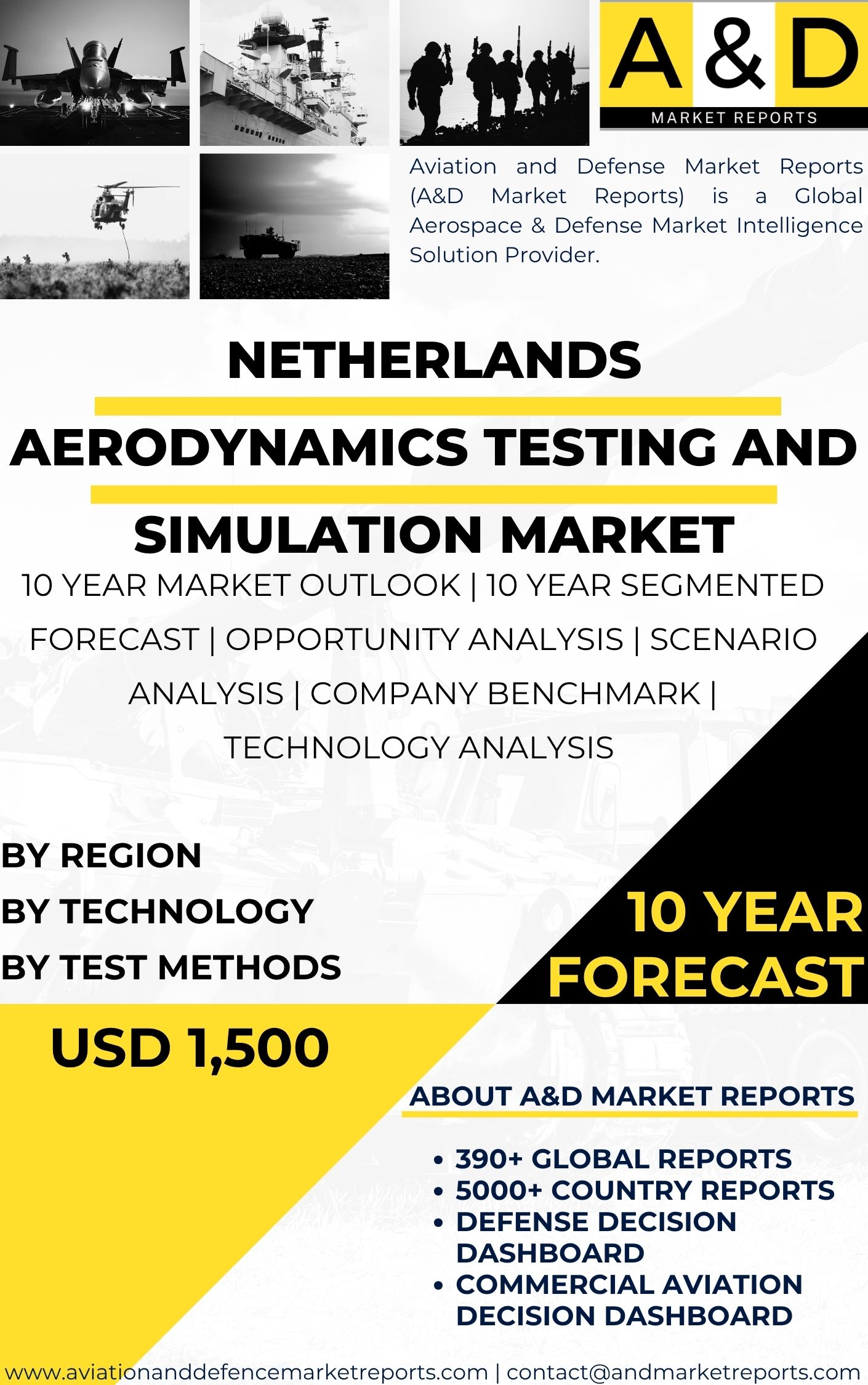
The Netherlands aerodynamics testing and simulation market is a crucial component of the country?s aerospace and defense industry, supporting the design, development, and optimization of aircraft, UAVs, missiles, and other high-performance platforms. Aerodynamics testing evaluates how air flows around structures, affecting lift, drag, stability, control, and fuel efficiency. In defense applications, precise aerodynamic performance is critical for fighter aircraft, helicopters, unmanned aerial systems, and precision-guided munitions. The Netherlands leverages advanced testing and simulation tools to enhance operational capabilities, maintain safety standards, and ensure interoperability with NATO and allied systems.

Go To Global Report Page Track this market real time on DDD

Description

The Netherlands aerodynamics testing and simulation market is a crucial component of the country?s aerospace and defense industry, supporting the design, development, and optimization of aircraft, UAVs, missiles, and other high-performance platforms. Aerodynamics testing evaluates how air flows around structures, affecting lift, drag, stability, control, and fuel efficiency. In defense applications, precise aerodynamic performance is critical for fighter aircraft, helicopters, unmanned aerial systems, and precision-guided munitions. The Netherlands leverages advanced testing and simulation tools to enhance operational capabilities, maintain safety standards, and ensure interoperability with NATO and allied systems.

Aerodynamics testing involves wind tunnel experiments, computational fluid dynamics (CFD), and flight testing. Wind tunnels provide controlled conditions to study airflow over aircraft surfaces, measure pressure distributions, and identify aerodynamic instabilities. CFD simulations use high-performance computing to model airflow and predict aerodynamic performance under a variety of operational conditions, enabling design optimization before physical prototypes are built. Dutch aerospace firms employ these methods to reduce design risks, improve efficiency, and shorten development timelines for both defense and civil aircraft platforms.

The market is driven by increasing complexity in aircraft and UAV designs, including the use of advanced composites, blended wing-body configurations, stealth shaping, and high-speed aerodynamic surfaces. Modern platforms also incorporate adaptive control surfaces and morphing technologies, requiring detailed aerodynamic validation. Aerodynamics testing ensures these features perform reliably under various conditions, including high-speed maneuvers, turbulence, and extreme weather.

Technological advancements are transforming the aerodynamics testing and simulation market. High-fidelity wind tunnels, advanced sensors, real-time data acquisition, and AI-driven simulations provide precise insights into flow dynamics, stability margins, and structural loads. Digital twin technologies allow engineers to simulate thousands of flight hours, reducing the need for costly physical testing while providing predictive analysis for design improvements. For the Netherlands, these capabilities support both national defense modernization programs and collaborative NATO projects.

Operational efficiency and cost reduction are significant benefits. Simulation reduces the number of physical prototypes required, lowers material and labor costs, and accelerates development cycles. Aerodynamics testing also mitigates the risk of in-service failures, enhancing safety and extending platform lifecycles. Dutch defense forces benefit from improved aircraft performance, reduced fuel consumption, and optimized mission readiness through precise aerodynamic validation.

Challenges include high capital investment in wind tunnels and simulation infrastructure, the need for skilled aeronautical engineers, and the continuous evolution of aircraft and UAV designs. Additionally, integrating experimental data with computational models requires sophisticated software and expertise. The adoption of new materials, hybrid propulsion, and autonomous systems further complicates aerodynamic validation.

Looking ahead, the Netherlands aerodynamics testing and simulation market is expected to grow with increased UAV adoption, modernization of fighter and transport aircraft, and advances in missile and space systems. Future trends will likely include AI-driven design optimization, enhanced digital twins, and the integration of multi-physics simulations to analyze aerodynamics alongside structural, thermal, and control system interactions. Investments in aerodynamics testing and simulation will ensure Dutch aerospace and defense platforms remain high-performing, safe, and capable in diverse operational environments.
Table of content

Table Of Contents

1 Market Introduction

1.1 Market Introduction
1.2 Market Definition
1.3 Market Segmentation
1.4 10 Year Market Outlook

2 Market Technologies

3 Global Market Forecast

3.1 Global Market Forecast
3.2 By Test Methods
3.3 By Technology

4 Europe Market Trends & Forecast

4.1 Drivers, Restraints And Challenges
4.2 PEST
4.3 Market Forecast
4.3.1 Market Forecast By Test Methods
4.3.2 Market Forecast By Technology
4.4 Scenario Analysis
4.5 Key Companies& Profiling

5Netherlands Analysis

5.1 Current Levels Of Technology Maturation In This Market
5.2 Market Forecast
5.2.1 Market Forecast By Test Methods
5.2.2 Market Forecast By Technology
5.3 Scenario Analysis
5.4 Country Defense Budget (Historical and 10- year forecast)
5.5 Defense Budget Category Spending- 10- year forecast
5.6 Procurement Analysis
5.7 EXIM Data
5.8 Patents

6 Opportunity Matrix

6.1 By Test Methods
6.2 By Technology

7 Scenario Analysis

7.1 Scenario 1

7.1.1 By Test Methods (Scenario-1)
7.1.2 By Technology (Scenario-1)

7.2 Scenario 2

7.2.1 By Test Methods (Scenario-2)
7.2.2 By Technology (Scenario-2)

8 Company Benchmark

9 Strategic Conclusions

10 About Aviation And Defense Market Reports

Segments

By Test Methods
By Technology

List of Tables

Table1: Global Market Forecast, Aerodynamics Testing and Simulation
Table2: Europe Market Forecast, Aerodynamics Testing and Simulation
Table3: Europe Market Forecast, By Test Methods
Table4: Europe Market Forecast, By Technology
Table5: Europe, Scenario Analysis
Table6: Netherlands Market Forecast, Aerodynamics Testing and Simulation
Table7: Netherlands Market Forecast, By Test Methods
Table8: Netherlands Market Forecast, By Technology
Table9: Netherlands, Scenario Analysis
Table 10: Netherlands Defense Budget 10 Year Forecast
Table 11: Netherlands, Defense Budget Category Spending- 10- year forecast
Table 12: Netherlands, Procurement Analysis
Table 13: Netherlands, EXIM Data Analysis
Table 14: Netherlands, Opportunity Analysis, By Test Methods
Table 15: Netherlands, Opportunity Analysis, By Technology
Table 16: Netherlands, Scenario Analysis, By Test Methods
Table 17: Netherlands, Scenario Analysis, By Technology

List of Figures

Figure 1: Market Segmentation, Netherlands Aerodynamics Testing and Simulation
Figure 2: Key Technology Analysis, Aerodynamics Testing and Simulation
Figure 3: Global Market Forecast, Aerodynamics Testing and Simulation
Figure 4: Europe, Market Forecast, Aerodynamics Testing and Simulation
Figure 5: Europe, Market Forecast, By Test Methods
Figure 6: Europe, Market Forecast, By Technology
Figure 7: Europe, Scenario Analysis
Figure 8: Netherlands, Market Forecast, Aerodynamics Testing and Simulation
Figure 9: Netherlands, Market Forecast, By Test Methods
Figure 10: Netherlands, Market Forecast, By Technology
Figure 11: Netherlands, Scenario Analysis
Figure 12: Netherlands, Defense Budget 10 Year Forecast
Figure 13: Netherlands, Defense Budget Category Spending- 10- year forecast
Figure 14: Netherlands, Procurement Analysis
Figure 15: Netherlands, EXIM Data Analysis
Figure 16: Netherlands, Opportunity Analysis, By Test Methods
Figure 17: Netherlands, Opportunity Analysis, By Technology
Figure 18: Netherlands, Scenario Analysis, By Test Methods
Figure 19: Netherlands, Scenario Analysis, By Technology
Figure 20: Company Benchmark