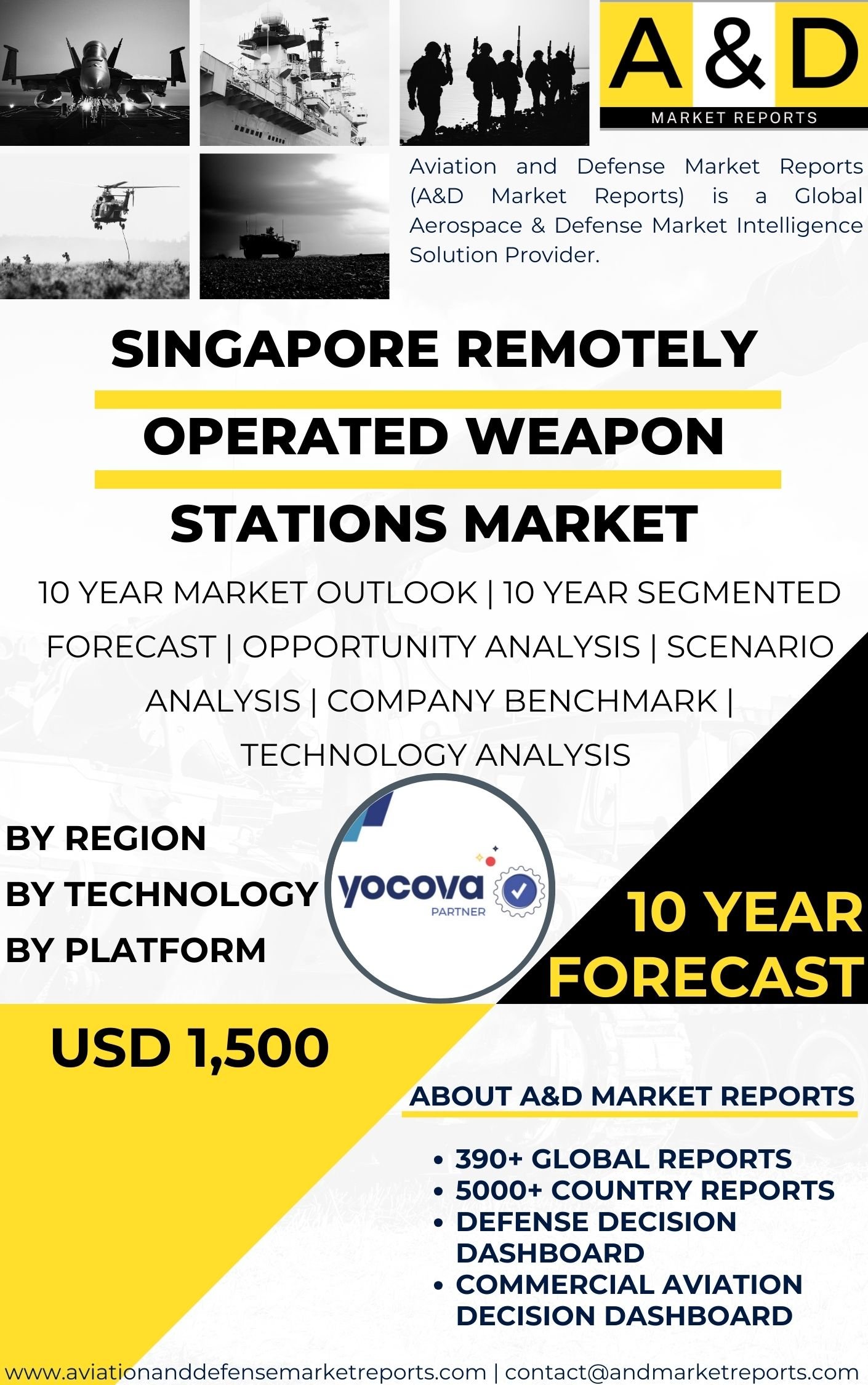
Singapore Remotely Operated Weapon Stations Market

$1,500.00

Enquire Now

The remotely operated weapon stations (ROWS) market in Singapore is a critical element of the country’s defense industry, reflecting its commitment to maintaining a modern and capable military force. ROWS are advanced weapon systems that enable operators to remotely control and fire weapons from a protected location, enhancing the effectiveness and survivability of ground-based military platforms. As a small but technologically advanced nation with strategic security interests, Singapore recognizes the importance of adopting ROWS to enhance its defense capabilities and ensure it remains agile and effective in the face of evolving security challenges.

Go To Global Report Page Track this market real time on DDD

Description

Singapore Remotely Operated Weapon Stations Market is a vital part of the country’s defense modernization strategy. It reflects Singapore’s commitment to maintaining a capable and technologically advanced military. ROWS enable operators to control and fire weapons from protected locations, improving accuracy, safety, and mission effectiveness. As a small but advanced nation with significant security interests, Singapore views ROWS as essential for strengthening its defense capabilities and maintaining agility against modern threats.

Singapore Remotely Operated Weapon Stations Market Dynamics of the ROWS

The ROWS market in Singapore is shaped by strong domestic development and active international collaboration. The Singapore Armed Forces (SAF) consistently invests in advanced ROWS technologies to enhance combat readiness. Furthermore, partnerships with leading global defense firms and research institutions allow Singapore to access new expertise, accelerate innovation, and maintain high operational standards.

Singapore Remotely Operated Weapon Stations Market Key Drivers of the ROWS Growth

Modern warfare has evolved, with threats becoming more asymmetric and technology-driven. As a result, the SAF emphasizes precision, automation, and protection — all areas where ROWS play a critical role. These systems reduce troop exposure, improve response times, and support rapid deployment in diverse operational environments.

Singapore’s continuous investment in research and development (R&D) strengthens its indigenous ROWS capabilities. By focusing on customization, the nation develops systems tailored to its security needs, optimizing performance across ground, naval, and aerial platforms.

Technological Innovation and Defense Collaboration

Singapore’s defense ecosystem prioritizes innovation and collaboration. Through R&D partnerships with global defense companies, local firms gain access to cutting-edge technologies such as AI-assisted targeting, automated threat detection, and data analytics. Consequently, Singapore remains at the forefront of defense technology innovation in Southeast Asia.

Additionally, the integration of ROWS with other smart defense systems enhances interoperability and command efficiency, giving the SAF a decisive operational edge.

Applications Across Singapore’s Armed Forces

The adoption of ROWS extends beyond ground forces.

The Republic of Singapore Navy equips its patrol vessels with remotely operated stations to strengthen maritime defense and precision targeting.

The Republic of Singapore Air Force uses ROWS on Unmanned Aerial Vehicles (UAVs) and unmanned helicopters, improving surveillance, reconnaissance, and response capabilities.

Singapore’s strategic maritime location makes these systems crucial for protecting its airspace and territorial waters.

Economic and Industrial Impact of the ROWS Market

The ROWS industry in Singapore also drives job creation and technical skill development. It supports engineers, defense technologists, data specialists, and manufacturing personnel. Moreover, it contributes to national innovation, industrial competitiveness, and long-term economic growth.

Regional and Global Security Contributions

Singapore’s use of advanced ROWS technologies strengthens regional security cooperation. Through defense partnerships and peacekeeping engagements, the country reinforces its role as a key contributor to regional stability.

Conclusion

The Remotely Operated Weapon Stations (ROWS) market in Singapore is a cornerstone of the nation’s defense modernization. It demonstrates Singapore’s dedication to leveraging advanced technologies to build a responsive, resilient, and future-ready military.

By integrating R&D, international collaboration, and technological innovation, Singapore ensures that its ROWS capabilities remain cutting-edge. As the market continues to expand, it will play an increasingly vital role in enhancing national defense, promoting regional stability, and supporting sustained economic and technological growth.

Table of content

Table Of Contents

1 Market Introduction

1.1 Market Introduction
1.2 Market Definition
1.3 Market Segmentation
1.4 10 Year Market Outlook

2 Market Technologies

3 Global Market Forecast

3.1 Global Market Forecast
3.2 By Technology
3.3 By Platform

4 APAC Market Trends & Forecast

4.1 Drivers, Restraints And Challenges
4.2 PEST
4.3 Market Forecast
4.3.1 Market Forecast By Technology
4.3.2 Market Forecast By Platform
4.4 Scenario Analysis
4.5 Key Companies& Profiling

5 Singapore Analysis

5.1 Current Levels Of Technology Maturation In This Market
5.2 Market Forecast
5.2.1 Market Forecast By Technology
5.2.2 Market Forecast By Platform
5.3 Scenario Analysis
5.4 Country Defense Budget (Historical and 10- year forecast)
5.5 Defense Budget Category Spending- 10- year forecast
5.6 Procurement Analysis
5.7 EXIM Data
5.8 Patents

6 Opportunity Matrix

6.1 By Technology
6.2 By Platform

7 Scenario Analysis

7.1 Scenario 1

7.1.1 By Technology (Scenario-1)
7.1.2 By Platform (Scenario-1)

7.2 Scenario 2

7.2.1 By Technology (Scenario-2)
7.2.2 By Platform (Scenario-2)

8 Company Benchmark

9 Strategic Conclusions

10 About Aviation And Defense Market Reports

Segments

By Technology
By Platform

List of Tables

Table1: Global Market Forecast, Singapore Remotely Operated Weapon Stations Market
Table2: APAC Market Forecast, Singapore Remotely Operated Weapon Stations Market
Table3: APAC Market Forecast, By Technology
Table4: APAC Market Forecast, By Platform
Table5: APAC, Scenario Analysis
Table6: Singapore Market Forecast, Singapore Remotely Operated Weapon Stations Market
Table7: Singapore Market Forecast, By Technology
Table8: Singapore Market Forecast, By Platform
Table9: Singapore, Scenario Analysis
Table 10: Singapore Defense Budget 10 Year Forecast
Table 11: Singapore, Defense Budget Category Spending- 10- year forecast
Table 12: Singapore, Procurement Analysis
Table 13: Singapore, EXIM Data Analysis
Table 14: Singapore, Opportunity Analysis, By Technology
Table 15: Singapore, Opportunity Analysis, By Platform
Table 16: Singapore, Scenario Analysis, By Technology
Table 17: Singapore, Scenario Analysis, By Platform

List of Figures

Figure 1: Market Segmentation, Singapore Remotely Operated Weapon Stations Market
Figure 2: Key Technology Analysis, Singapore Remotely Operated Weapon Stations Market
Figure 3: Global Market Forecast, Singapore Remotely Operated Weapon Stations Market
Figure 4: APAC, Market Forecast, Singapore Remotely Operated Weapon Stations Market
Figure 5: APAC, Market Forecast, By Technology
Figure 6: APAC, Market Forecast, By Platform
Figure 7: APAC, Scenario Analysis
Figure 8: Singapore, Market Forecast, Singapore Remotely Operated Weapon Stations Market
Figure 9: Singapore, Market Forecast, By Technology
Figure 10: Singapore, Market Forecast, By Platform
Figure 11: Singapore, Scenario Analysis
Figure 12: Singapore, Defense Budget 10 Year Forecast
Figure 13: Singapore, Defense Budget Category Spending- 10- year forecast
Figure 14: Singapore, Procurement Analysis
Figure 15: Singapore, EXIM Data Analysis
Figure 16: Singapore, Opportunity Analysis, By Technology
Figure 17: Singapore, Opportunity Analysis, By Platform
Figure 18: Singapore, Scenario Analysis, By Technology
Figure 19: Singapore, Scenario Analysis, By Platform
Figure 20: Company Benchmark