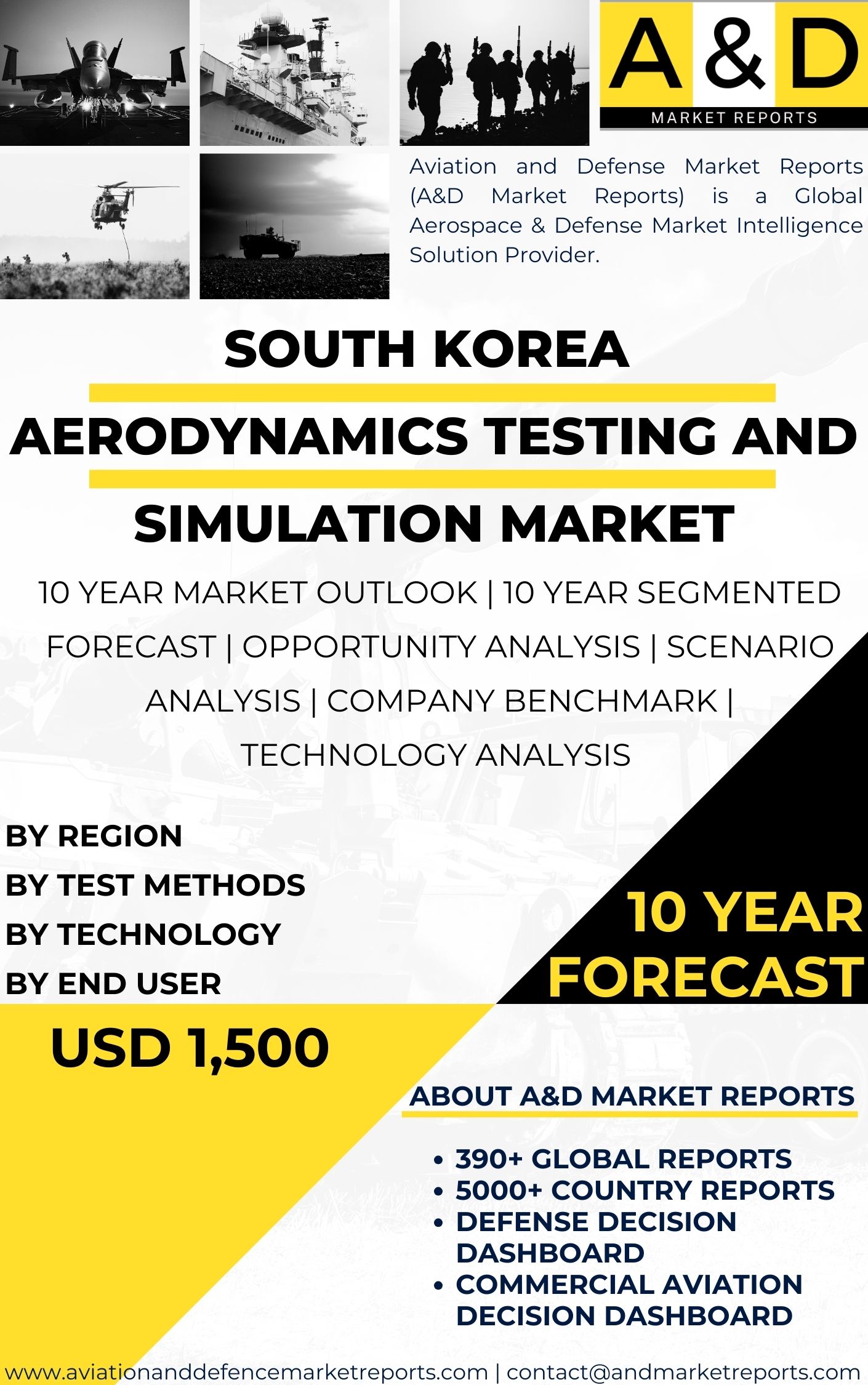
South Korea Aerodynamics Testing and Simulation

$1,500.00

Enquire Now

Aerodynamics Testing Market in South Korea is valued at approximately USD 320 million in 2025 and is projected to grow at a CAGR of 6.1% to reach around USD 496 million by 2033. This market growth is primarily driven by South Korea’s focus on advanced aerospace manufacturing, automotive industries, and increased investments in research and development within these sectors.

Go To Global Report Page Track this market real time on DDD

Description

Aerodynamics Testing Market in South Korea Overview

The Aerodynamics Testing and Simulation  in South Korea is growing steadily due to rising demand from aerospace and automotive industries. In 2025, the market is valued at about USD 320 million. It is expected to reach nearly USD 496 million by 2033.

Strong investment in research and development supports this growth. Advanced manufacturing also increases the need for testing services.

Aerodynamics Testing Market in South Korea Growth Drivers

The Aerodynamics Testing Market in South Korea benefits from rapid aerospace development. The country invests heavily in aircraft, UAVs, and space systems. These programs require precise aerodynamic validation.

Automotive innovation also drives demand. Electric and fuel-efficient vehicles rely on improved airflow design.

Role of Aerospace Programs

Aerospace projects strongly support the Aerodynamics Testing Market in South Korea. Indigenous programs like the KF-21 fighter require extensive testing. Wind tunnel and simulation tools improve safety and performance.

UAVs and launch vehicles also depend on accurate aerodynamic analysis. Testing helps reduce risk during development.

Automotive Industry Demand

The automotive sector increases demand for aerodynamic testing. Manufacturers aim to reduce drag and improve energy efficiency. This is critical for electric vehicle range.

Testing improves vehicle stability and noise reduction. These factors enhance overall performance.

Key Companies and Market Participants

Several firms lead the Aerodynamics Testing Market in South Korea. Major players include Hanwha Aerospace and Korea Aerospace Industries. Hyundai Rotem and LIG Nex1 also contribute.

These companies operate wind tunnels and simulation platforms. They invest in advanced testing tools.

Testing Technologies and Tools

Wind tunnel testing remains essential for physical validation. It supports aircraft, vehicles, and energy systems. Computational fluid dynamics also plays a major role.

CFD tools reduce development time and cost. They allow fast design changes and analysis.

Renewable Energy Applications

Aerodynamics testing supports wind energy projects. Blade design depends on airflow optimization. Testing improves efficiency and durability.

This application expands the market beyond defense and transport. Renewable energy remains a growing focus.

Government and Research Support

Government agencies support aerodynamics research. Organizations like KARI fund testing facilities. Public-private partnerships strengthen innovation.

Universities also contribute to skill development. Research programs support long-term growth.

Technology Trends and Innovation

AI-based modeling improves testing accuracy. Predictive tools speed up design decisions. These technologies enhance simulation efficiency.

Continuous upgrades remain necessary. Advanced systems help meet new design challenges.

Aerodynamics Testing Market in South Korea Outlook

The Aerodynamics Testing Market in South Korea shows strong long-term potential. Aerospace and automotive demand will remain high. Government support ensures steady investment.

Overall, aerodynamics testing remains vital to innovation. The market will continue to grow through technology and collaboration.
Table of content

Table Of Contents

1 Market Introduction

1.1 Market Introduction
1.2 Market Definition
1.3 Market Segmentation
1.4 10 Year Market Outlook

2 Market Technologies

3 Global Market Forecast

3.1 Global Market Forecast
3.2 By Test Methods
3.3 By Technology

4 APAC Market Trends & Forecast

4.1 Drivers, Restraints And Challenges
4.2 PEST
4.3 Market Forecast
4.3.1 Market Forecast By Test Methods
4.3.2 Market Forecast By Technology
4.4 Scenario Analysis
4.5 Key Companies& Profiling

5 South Korea Analysis

5.1 Current Levels Of Technology Maturation In This Market
5.2 Market Forecast
5.2.1 Market Forecast By Test Methods
5.2.2 Market Forecast By Technology
5.3 Scenario Analysis
5.4 Country Defense Budget (Historical and 10- year forecast)
5.5 Defense Budget Category Spending- 10- year forecast
5.6 Procurement Analysis
5.7 EXIM Data
5.8 Patents

6 Opportunity Matrix

6.1 By Test Methods
6.2 By Technology

7 Scenario Analysis

7.1 Scenario 1

7.1.1 By Test Methods (Scenario-1)
7.1.2 By Technology (Scenario-1)

7.2 Scenario 2

7.2.1 By Test Methods (Scenario-2)
7.2.2 By Technology (Scenario-2)

8 Company Benchmark

9 Strategic Conclusions

10 About Aviation And Defense Market Reports

Segments

By Test Methods
By Technology

List of Tables

Table1: Global Market Forecast, Aerodynamics Testing and Simulation
Table2: APAC Market Forecast, Aerodynamics Testing and Simulation
Table3: APAC Market Forecast, By Test Methods
Table4: APAC Market Forecast, By Technology
Table5: APAC, Scenario Analysis
Table6: South Korea Market Forecast, Aerodynamics Testing and Simulation
Table7: South Korea Market Forecast, By Test Methods
Table8: South Korea Market Forecast, By Technology
Table9: South Korea, Scenario Analysis
Table 10: South Korea Defense Budget 10 Year Forecast
Table 11: South Korea, Defense Budget Category Spending- 10- year forecast
Table 12: South Korea, Procurement Analysis
Table 13: South Korea, EXIM Data Analysis
Table 14: South Korea, Opportunity Analysis, By Test Methods
Table 15: South Korea, Opportunity Analysis, By Technology
Table 16: South Korea, Scenario Analysis, By Test Methods
Table 17: South Korea, Scenario Analysis, By Technology

List of Figures

Figure 1: Market Segmentation, South Korea Aerodynamics Testing and Simulation
Figure 2: Key Technology Analysis, Aerodynamics Testing and Simulation
Figure 3: Global Market Forecast, Aerodynamics Testing and Simulation
Figure 4: APAC, Market Forecast, Aerodynamics Testing and Simulation
Figure 5: APAC, Market Forecast, By Test Methods
Figure 6: APAC, Market Forecast, By Technology
Figure 7: APAC, Scenario Analysis
Figure 8: South Korea, Market Forecast, Aerodynamics Testing and Simulation
Figure 9: South Korea, Market Forecast, By Test Methods
Figure 10: South Korea, Market Forecast, By Technology
Figure 11: South Korea, Scenario Analysis
Figure 12: South Korea, Defense Budget 10 Year Forecast
Figure 13: South Korea, Defense Budget Category Spending- 10- year forecast
Figure 14: South Korea, Procurement Analysis
Figure 15: South Korea, EXIM Data Analysis
Figure 16: South Korea, Opportunity Analysis, By Test Methods
Figure 17: South Korea, Opportunity Analysis, By Technology
Figure 18: South Korea, Scenario Analysis, By Test Methods
Figure 19: South Korea, Scenario Analysis, By Technology
Figure 20: Company Benchmark

Aviation and Defense Market Reports


TPA | TIA | Consulting | Market Reports | Defense Decision Dashboard


Our Defense Report - Our Team Has Worked on More Than 250+ Individual Products / Markets