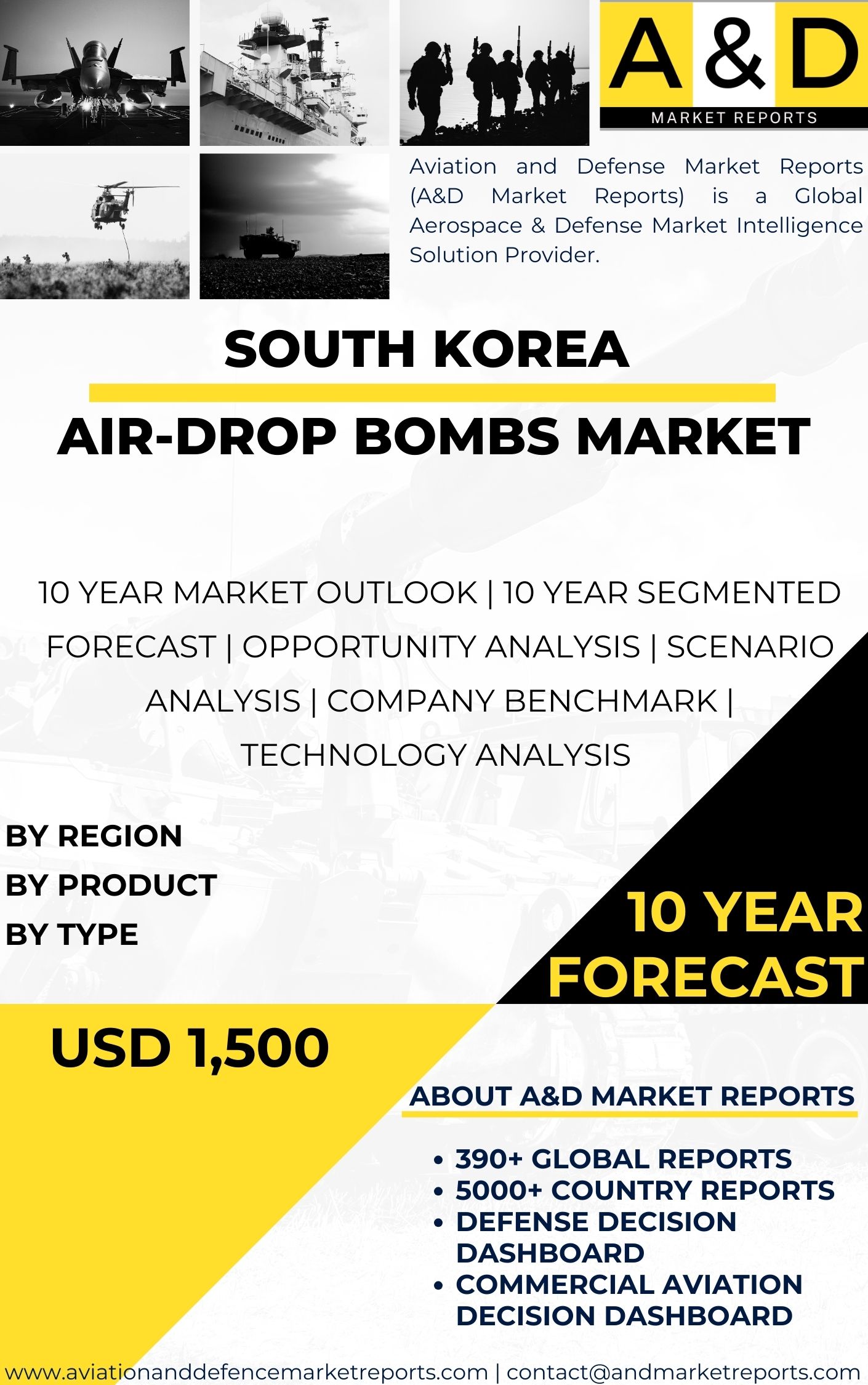
South Korea Air-Drop Bombs Market

$1,500.00

Enquire Now
Category: Tags: , Report ID: ANDCKR0236

Air-Drop Bombs Market in South Korea has been experiencing steady growth as the country continues to strengthen its defense and deterrence capabilities in response to regional security challenges. South Korea?s proximity to North Korea, along with rising tensions in the broader Asia-Pacific region, has heightened the demand for advanced aerial munitions, including precision-guided and unguided air-drop bombs. The South Korean government has been actively investing in modernizing its air force and ensuring that its fleet of fighter aircraft, including F-35s and F-15Ks, are equipped with cutting-edge weapon systems. This trend has translated into significant opportunities for both domestic defense manufacturers and international players that collaborate with local industries through joint ventures, licensing, and technology transfer.

Go To Global Report Page Track this market real time on DDD

Description

Air-Drop Bombs Market in South Korea Overview

The Air-Drop Bombs Market in South Korea is growing steadily due to rising defense needs. Regional security risks continue to shape military planning. The country invests heavily in aerial strike capabilities to strengthen deterrence.

Air-drop bombs support both precision and conventional strike missions. They remain essential for modern air force operations.

Air-Drop Bombs Market in South Korea Growth Drivers

The Air-Drop Bombs Market in South Korea is driven by tensions on the Korean Peninsula. Proximity to North Korea increases the need for reliable strike weapons. Wider security concerns in East Asia also influence procurement plans.

South Korea continues to modernize its air force. Fighter aircraft such as the F-35 and F-15K require advanced bomb systems.

Role of Precision-Guided Air-Drop Bombs

Precision-guided weapons dominate growth in the Air-Drop Bombs Market in South Korea. These bombs improve accuracy and mission success. They also reduce collateral damage.

Guidance systems include GPS, laser, and electro-optical technologies. These features support strikes in complex environments.

Continued Use of Unguided Air-Drop Bombs

Unguided bombs remain relevant in specific scenarios. They offer cost-effective solutions for certain missions. High-volume strike capability remains important.

These weapons support training and area-target missions. Their lower cost supports balanced force planning.

Influence of Strategic Alliances

Alliances strongly shape the Air-Drop Bombs Market in South Korea. The United States remains a key supplier and partner. Interoperability between allied air forces is a major priority.

Munition systems compatible with allied aircraft support joint operations. Long-term defense agreements reinforce this demand.

Indigenous Manufacturing and Self-Reliance

South Korea prioritizes domestic production of air-drop bombs. This supports its defense self-reliance goals. Government agencies guide development and procurement.

Companies such as Hanwha Aerospace and LIG Nex1 expand local capabilities. Their focus includes precision guidance and system integration.

Research, Development, and Innovation

Defense research funding supports advanced bomb technologies. The Air-Drop Bombs Market in South Korea benefits from this investment. Key areas include guidance accuracy and standoff delivery.

Improved warheads and control systems enhance effectiveness. Testing programs accelerate deployment timelines.

Integration with Modern Aircraft Platforms

Air-drop bombs are designed for multiple aircraft types. Compatibility with legacy and next-generation fighters is essential. This supports flexible mission planning.

Networked warfare systems improve targeting and command coordination. These upgrades strengthen strike performance.

Export Potential and Industry Expansion

South Korea is expanding its defense export portfolio. Advanced air-drop bombs may support this growth. Competitive pricing increases interest from partner nations.

Export controls guide market expansion. Regulatory reforms aim to balance growth and compliance.

Air-Drop Bombs Market in South Korea Outlook

The Air-Drop Bombs Market in South Korea shows positive long-term prospects. Defense spending remains stable. Modernization programs continue to drive demand.

Precision, flexibility, and system compatibility will shape future development. Overall, air-drop bombs remain central to South Korea’s air combat strategy.
Table of content

Table Of Contents

1 Market Introduction

1.1 Market Introduction
1.2 Market Definition
1.3 Market Segmentation
1.4 10 Year Market Outlook

2 Market Technologies

3 Global Market Forecast

3.1 Global Market Forecast
3.2 By Type
3.3 By Product

4 APAC Market Trends & Forecast

4.1 Drivers, Restraints And Challenges
4.2 PEST
4.3 Market Forecast
4.3.1 Market Forecast By Type
4.3.2 Market Forecast By Product
4.4 Scenario Analysis
4.5 Key Companies& Profiling

5 South Korea Analysis

5.1 Current Levels Of Technology Maturation In This Market
5.2 Market Forecast
5.2.1 Market Forecast By Type
5.2.2 Market Forecast By Product
5.3 Scenario Analysis
5.4 Country Defense Budget (Historical and 10- year forecast)
5.5 Defense Budget Category Spending- 10- year forecast
5.6 Procurement Analysis
5.7 EXIM Data
5.8 Patents

6 Opportunity Matrix

6.1 By Type
6.2 By Product

7 Scenario Analysis

7.1 Scenario 1

7.1.1 By Type (Scenario-1)
7.1.2 By Product (Scenario-1)

7.2 Scenario 2

7.2.1 By Type (Scenario-2)
7.2.2 By Product (Scenario-2)

8 Company Benchmark

9 Strategic Conclusions

10 About Aviation And Defense Market Reports

Segments

By Type
By Product

List of Tables

Table1: Global Market Forecast, Air-Drop Bombs Market
Table2: APAC Market Forecast, Air-Drop Bombs Market
Table3: APAC Market Forecast, By Type
Table4: APAC Market Forecast, By Product
Table5: APAC, Scenario Analysis
Table6: South Korea Market Forecast, Air-Drop Bombs Market
Table7: South Korea Market Forecast, By Type
Table8: South Korea Market Forecast, By Product
Table9: South Korea, Scenario Analysis
Table 10: South Korea Defense Budget 10 Year Forecast
Table 11: South Korea, Defense Budget Category Spending- 10- year forecast
Table 12: South Korea, Procurement Analysis
Table 13: South Korea, EXIM Data Analysis
Table 14: South Korea, Opportunity Analysis, By Type
Table 15: South Korea, Opportunity Analysis, By Product
Table 16: South Korea, Scenario Analysis, By Type
Table 17: South Korea, Scenario Analysis, By Product

List of Figures

Figure 1: Market Segmentation, South Korea Air-Drop Bombs Market
Figure 2: Key Technology Analysis, Air-Drop Bombs Market
Figure 3: Global Market Forecast, Air-Drop Bombs Market
Figure 4: APAC, Market Forecast, Air-Drop Bombs Market
Figure 5: APAC, Market Forecast, By Type
Figure 6: APAC, Market Forecast, By Product
Figure 7: APAC, Scenario Analysis
Figure 8: South Korea, Market Forecast, Air-Drop Bombs Market
Figure 9: South Korea, Market Forecast, By Type
Figure 10: South Korea, Market Forecast, By Product
Figure 11: South Korea, Scenario Analysis
Figure 12: South Korea, Defense Budget 10 Year Forecast
Figure 13: South Korea, Defense Budget Category Spending- 10- year forecast
Figure 14: South Korea, Procurement Analysis
Figure 15: South Korea, EXIM Data Analysis
Figure 16: South Korea, Opportunity Analysis, By Type
Figure 17: South Korea, Opportunity Analysis, By Product
Figure 18: South Korea, Scenario Analysis, By Type
Figure 19: South Korea, Scenario Analysis, By Product
Figure 20: Company Benchmark