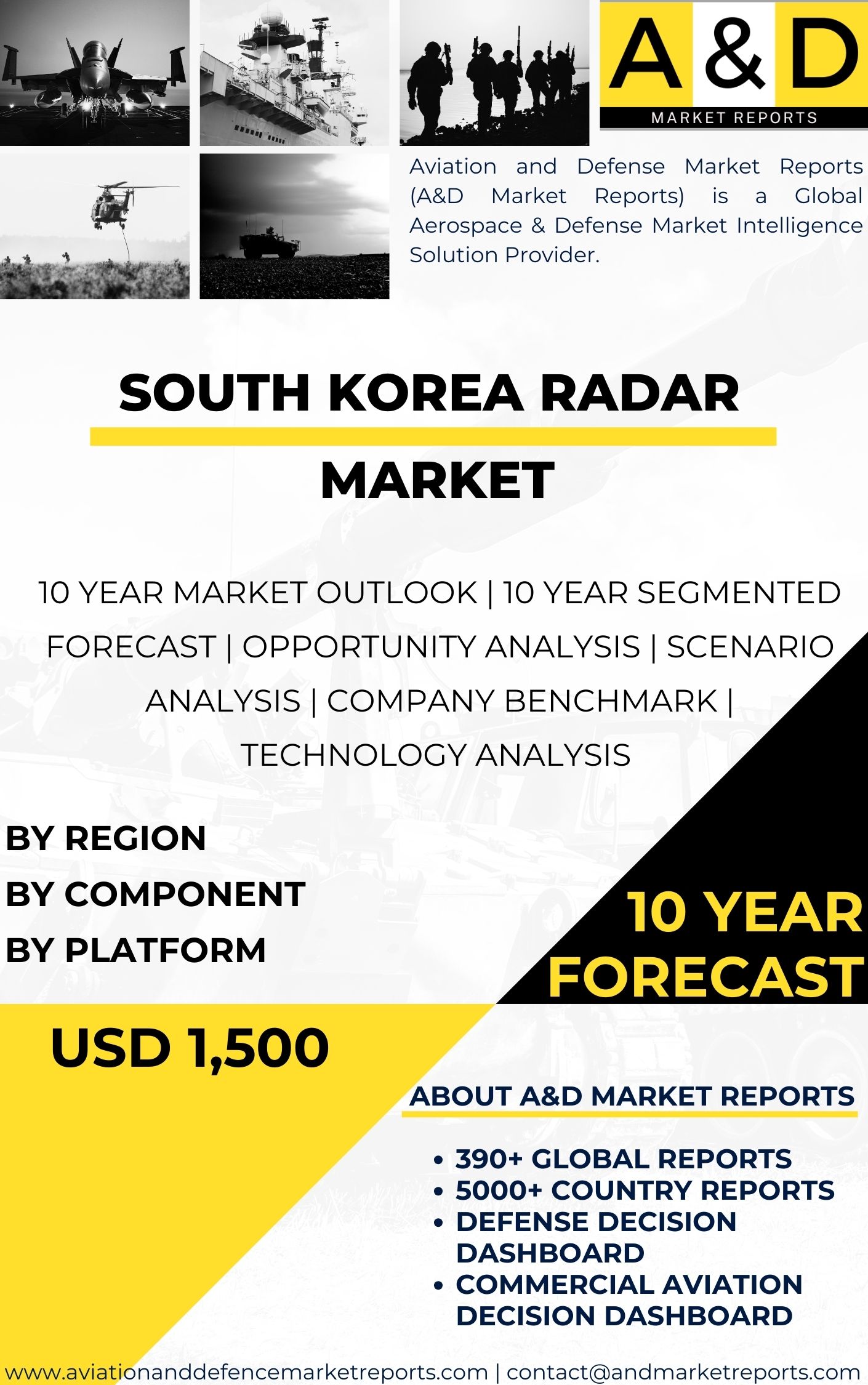
South Korea Radar Market

$1,500.00

Enquire Now

The South Korea radar market is a crucial segment of the country’s defense industry, providing advanced radar systems that enable comprehensive surveillance, detection, and tracking capabilities. Radars are vital tools for national security, enhancing situational awareness, and safeguarding South Korea’s airspace and territorial waters. The country’s focus on indigenous development, strategic partnerships, and technological innovation has positioned it as a major player in the global radar market.

Go To Global Report Page Track this market real time on DDD

Description

South Korea Radar Market Overview

The South Korea radar market is an important part of the country’s defense and security sector. Radar systems support surveillance, detection, and tracking across air, land, and sea. These systems help protect national airspace and territorial waters.

South Korea focuses on domestic development, advanced technology, and system reliability. This strategy strengthens national security and supports steady market growth.

Role of Radar Systems in Defense and Civil Use

Radar systems play a key role in modern defense operations. They use radio waves to detect objects and track movement. Radars provide data on location, speed, and direction.

This information supports air defense, naval monitoring, and battlefield awareness. Radar technology is also essential for air traffic control, weather tracking, and maritime safety.

Indigenous Development in the South Korea Radar Market

Indigenous development is central to the South Korea radar market. Domestic defense companies design systems to meet local military needs. This approach reduces reliance on external suppliers.

Companies such as LIG Nex1 and Hanwha Systems lead radar innovation. They develop solutions for surveillance, targeting, and threat detection.

K30 Biho Radar System Capabilities

The K30 Biho is a key radar-based air defense system in South Korea. It is a self-propelled platform with radar-guided twin 30mm cannons and missiles.

Its radar detects and tracks multiple aerial threats at once. This capability makes the K30 Biho a valuable asset for short-range air defense.

Strategic Partnerships and Technology Integration

South Korea works with international defense and technology firms to improve radar systems. These partnerships support joint research and system integration.

Technology collaboration enhances detection range, accuracy, and system performance. It also supports long-term innovation in radar design.

Research and Development in Radar Technology

Research and development drive progress in the South Korea radar market. Investment focuses on improving range, resolution, and target recognition.

Developers work to reduce system size and power use. Digital signal processing improves data analysis and response speed.

Radar Exports and Market Expansion

South Korea exports radar systems and related technologies to partner nations. These exports generate revenue and strengthen defense cooperation.

Export success highlights system reliability and operational performance. It also supports the growth of the domestic defense industry.

Civilian Applications of Radar Systems

Radar technology supports many civilian sectors. Airports use radar for air traffic control. Meteorological agencies rely on radar for weather monitoring.

Maritime authorities use radar to track vessels and improve safety. The market serves both defense and civilian needs.

Training and Cybersecurity Measures

South Korea invests in operator training for radar systems. Programs cover operation, maintenance, and system management.

Cybersecurity is also a priority. Radar systems include digital components that require protection. Strong security measures help safeguard operations.

Conclusion

The South Korea radar market supports both national defense and civilian infrastructure. Indigenous development, innovation, and partnerships drive advanced system design. Radar technology improves surveillance, air defense, and safety across multiple domains.

As security and technology demands evolve, continued investment in radar systems will remain essential for South Korea’s long-term readiness and resilience.
Table of content

Table Of Contents

1 Market Introduction

1.1 Market Introduction
1.2 Market Definition
1.3 Market Segmentation
1.4 10 Year Market Outlook

2 Market Technologies

3 Global Market Forecast

3.1 Global Market Forecast
3.2 By Component
3.3 By Platform

4 APAC Market Trends & Forecast

4.1 Drivers, Restraints And Challenges
4.2 PEST
4.3 Market Forecast
4.3.1 Market Forecast By Component
4.3.2 Market Forecast By Platform
4.4 Scenario Analysis
4.5 Key Companies& Profiling

5 South Korea Analysis

5.1 Current Levels Of Technology Maturation In This Market
5.2 Market Forecast
5.2.1 Market Forecast By Component
5.2.2 Market Forecast By Platform
5.3 Scenario Analysis
5.4 Country Defense Budget (Historical and 10- year forecast)
5.5 Defense Budget Category Spending- 10- year forecast
5.6 Procurement Analysis
5.7 EXIM Data
5.8 Patents

6 Opportunity Matrix

6.1 By Component
6.2 By Platform

7 Scenario Analysis

7.1 Scenario 1

7.1.1 By Component (Scenario-1)
7.1.2 By Platform (Scenario-1)

7.2 Scenario 2

7.2.1 By Component (Scenario-2)
7.2.2 By Platform (Scenario-2)

8 Company Benchmark

9 Strategic Conclusions

10 About Aviation And Defense Market Reports

Segments

By Component
By Platform

List of Tables

Table1: Global Market Forecast, South Korea Radar Market
Table2: APAC Market Forecast, South Korea Radar Market
Table3: APAC Market Forecast, By Component
Table4: APAC Market Forecast, By Platform
Table5: APAC, Scenario Analysis
Table6: South Korea Market Forecast, South Korea Radar Market
Table7: South Korea Market Forecast, By Component
Table8: South Korea Market Forecast, By Platform
Table9: South Korea, Scenario Analysis
Table 10: South Korea Defense Budget 10 Year Forecast
Table 11: South Korea, Defense Budget Category Spending- 10- year forecast
Table 12: South Korea, Procurement Analysis
Table 13: South Korea, EXIM Data Analysis
Table 14: South Korea, Opportunity Analysis, By Component
Table 15: South Korea, Opportunity Analysis, By Platform
Table 16: South Korea, Scenario Analysis, By Component
Table 17: South Korea, Scenario Analysis, By Platform

List of Figures

Figure 1: Market Segmentation, South Korea Radar Market
Figure 2: Key Technology Analysis, South Korea Radar Market
Figure 3: Global Market Forecast, South Korea Radar Market
Figure 4: APAC, Market Forecast, South Korea Radar Market
Figure 5: APAC, Market Forecast, By Component
Figure 6: APAC, Market Forecast, By Platform
Figure 7: APAC, Scenario Analysis
Figure 8: South Korea, Market Forecast, South Korea Radar Market
Figure 9: South Korea, Market Forecast, By Component
Figure 10: South Korea, Market Forecast, By Platform
Figure 11: South Korea, Scenario Analysis
Figure 12: South Korea, Defense Budget 10 Year Forecast
Figure 13: South Korea, Defense Budget Category Spending- 10- year forecast
Figure 14: South Korea, Procurement Analysis
Figure 15: South Korea, EXIM Data Analysis
Figure 16: South Korea, Opportunity Analysis, By Component
Figure 17: South Korea, Opportunity Analysis, By Platform
Figure 18: South Korea, Scenario Analysis, By Component
Figure 19: South Korea, Scenario Analysis, By Platform
Figure 20: Company Benchmark

Aviation and Defense Market Reports


TPA | TIA | Consulting | Market Reports | Defense Decision Dashboard


Our Defense Report - Our Team Has Worked on More Than 250+ Individual Products / Markets