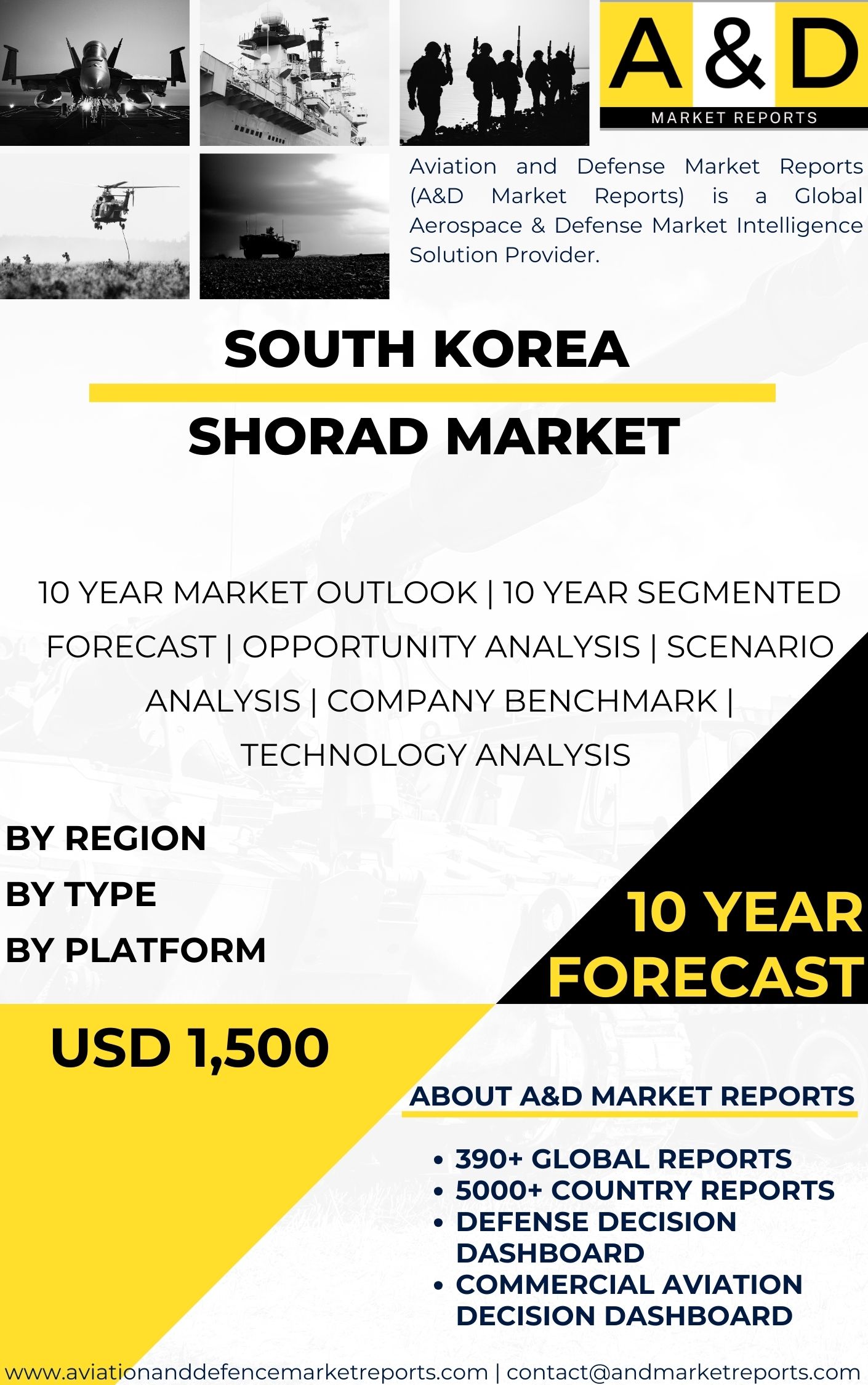
South Korea SHORAD Market

$1,500.00

Enquire Now

The short-range air defense (SHORAD) market in South Korea is rapidly evolving as a critical facet of the nation’s defense strategy, primarily driven by the imperative to counter increasingly sophisticated aerial threats. This market concentrates on the development, production, and deployment of mobile and adaptable defense systems designed to protect military assets from hostile aircraft, drones, missiles, and other airborne threats. As South Korea navigates a tense geopolitical environment with persistent regional security challenges, the demand for robust SHORAD solutions continues to grow. These systems are vital for safeguarding critical infrastructure and military forces against evolving aerial attacks, especially with the rising prominence of unmanned aerial vehicles and precision-guided munitions in modern warfare.

Go To Global Report Page Track this market real time on DDD

Description

South Korea SHORAD Market Overview

The South Korea SHORAD market is a critical part of the country’s air defense strategy. It focuses on protecting military assets and infrastructure from low-altitude threats. These threats include aircraft, drones, cruise missiles, and precision-guided weapons. Rising regional tensions continue to increase demand for reliable short-range air defense systems.

Role of SHORAD Systems in National Defense

The South Korea SHORAD market supports fast and flexible air defense operations.

Protection Against Modern Aerial Threats

SHORAD systems defend against drones and low-flying missiles. These threats are now common in modern warfare. Quick response and accuracy are essential for effective interception.

Safeguarding Critical Assets

These systems protect military bases, command centers, and key infrastructure. They reduce vulnerability during sudden aerial attacks.

Technology Advancements in the South Korea SHORAD Market

Technology plays a major role in improving system performance.

Radar and Sensor Integration

Modern SHORAD platforms use advanced radar and tracking sensors. These tools detect and track multiple threats at short ranges. They improve engagement speed and accuracy.

Artificial Intelligence Applications

AI supports real-time threat analysis and decision-making. It helps prioritize targets and improve interception success. Predictive maintenance also increases system reliability.

Mobility and Deployment Flexibility

Mobility is a defining feature of the South Korea SHORAD market.

Mobile SHORAD Platforms

Mobile systems operate in urban and rugged terrain. This suits the varied geography of the Korean Peninsula. Rapid movement allows forces to respond to changing threats.

Layered Air Defense Integration

SHORAD systems work alongside medium- and long-range defenses. This layered structure improves overall airspace protection. Coordination strengthens national defense readiness.

Competitive Landscape and Industry Participation

Domestic defense companies drive market development.

Strong Domestic Defense Base

Local manufacturers invest heavily in research and development. They focus on improving detection, interception, and system durability. This strengthens national self-reliance.

Strategic Partnerships and Exports

Companies form partnerships with foreign firms and governments. Export initiatives expand market reach, especially across Asia. These efforts support industrial growth.

Investment Trends in the South Korea SHORAD Market

The South Korea SHORAD market presents strong investment potential.

Government Support and Modernization

Defense modernization programs drive long-term funding. Government backing accelerates innovation and deployment.

AI and Automation Opportunities

AI and machine learning attract investor interest. These technologies improve system efficiency and combat readiness. Collaboration with research institutions boosts innovation.

Key Challenges Facing the SHORAD Market

Despite strong growth, challenges remain.

High Development and Deployment Costs

Advanced systems require large investments. Costs may limit participation by smaller firms.

Rapidly Evolving Threats

Emerging risks include autonomous drones and hypersonic weapons. Continuous upgrades are necessary to stay effective.

Future Outlook of the South Korea SHORAD Market

The South Korea SHORAD market is set for steady growth. Mobile, AI-enabled, and precision-based systems will shape future development. Continued investment and innovation will strengthen national air defense capabilities. This market will remain essential to South Korea’s security strategy in the years ahead.
Table of content

Table Of Contents

1 Market Introduction

1.1 Market Introduction
1.2 Market Definition
1.3 Market Segmentation
1.4 10 Year Market Outlook

2 Market Technologies

3 Global Market Forecast

3.1 Global Market Forecast
3.2 By Platform
3.3 By Type

4 APAC Market Trends & Forecast

4.1 Drivers, Restraints And Challenges
4.2 PEST
4.3 Market Forecast
4.3.1 Market Forecast By Platform
4.3.2 Market Forecast By Type
4.4 Scenario Analysis
4.5 Key Companies& Profiling

5 South Korea Analysis

5.1 Current Levels Of Technology Maturation In This Market
5.2 Market Forecast
5.2.1 Market Forecast By Type
5.2.2 Market Forecast By Platform
5.3 Scenario Analysis
5.4 Country Defense Budget (Historical and 10- year forecast)
5.5 Defense Budget Category Spending- 10- year forecast
5.6 Procurement Analysis
5.7 EXIM Data
5.8 Patents

6 Opportunity Matrix

6.1 By Platform
6.2 By Type

7 Scenario Analysis

7.1 Scenario 1

7.1.1 By Platform (Scenario-1)
7.1.2 By Type (Scenario-1)

7.2 Scenario 2

7.2.1 By Platform (Scenario-2)
7.2.2 By Type (Scenario-2)

8 Company Benchmark

9 Strategic Conclusions

10 About Aviation And Defense Market Reports

Segments

By Type
By Platform

List of Tables

Table1: Global Market Forecast, SHORAD Market
Table2: APAC Market Forecast, SHORAD Market
Table3: APAC Market Forecast, By Type
Table4: APAC Market Forecast, By Platform
Table5: APAC, Scenario Analysis
Table6: South Korea Market Forecast, SHORAD Market
Table7: South Korea Market Forecast, By Type
Table8: South Korea Market Forecast, By Platform
Table9: South Korea, Scenario Analysis
Table 10: South Korea Defense Budget 10 Year Forecast
Table 11: South Korea, Defense Budget Category Spending- 10- year forecast
Table 12: South Korea, Procurement Analysis
Table 13: South Korea, EXIM Data Analysis
Table 14: South Korea, Opportunity Analysis, By Type
Table 15: South Korea, Opportunity Analysis, By Platform
Table 16: South Korea, Scenario Analysis, By Type
Table 17: South Korea, Scenario Analysis, By Platform

List of Figures

Figure 1: Market Segmentation, South Korea SHORAD Market
Figure 2: Key Technology Analysis, SHORAD Market
Figure 3: Global Market Forecast, SHORAD Market
Figure 4: APAC, Market Forecast, SHORAD Market
Figure 5: APAC, Market Forecast, By Type
Figure 6: APAC, Market Forecast, By Platform
Figure 7: APAC, Scenario Analysis
Figure 8: South Korea, Market Forecast, SHORAD Market
Figure 9: South Korea, Market Forecast, By Type
Figure 10: South Korea, Market Forecast, By Platform
Figure 11: South Korea, Scenario Analysis
Figure 12: South Korea, Defense Budget 10 Year Forecast
Figure 13: South Korea, Defense Budget Category Spending- 10- year forecast
Figure 14: South Korea, Procurement Analysis
Figure 15: South Korea, EXIM Data Analysis
Figure 16: South Korea, Opportunity Analysis, By Type
Figure 17: South Korea, Opportunity Analysis, By Platform
Figure 18: South Korea, Scenario Analysis, By Type
Figure 19: South Korea, Scenario Analysis, By Platform
Figure 20: Company Benchmark