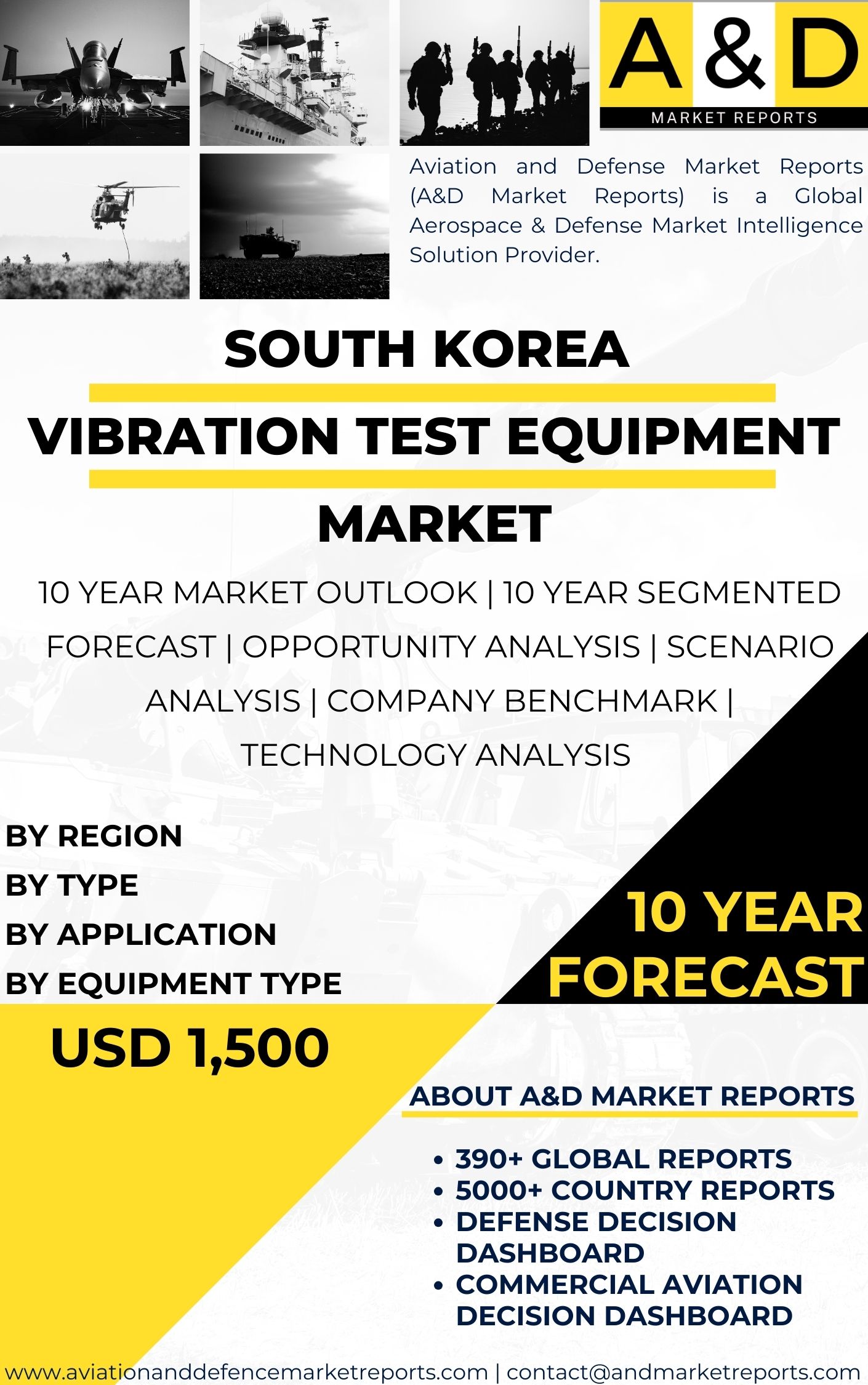
South Korea Vibration Test Equipment

$1,500.00

Enquire Now
Category: Tag: Report ID: ANDCKR0215

The vibration test equipment market in South Korea has emerged as a critical and rapidly expanding sector supporting the aerospace and defense industries? requirements for ensuring product reliability, structural integrity, and operational resilience of mission-critical systems subjected to harsh operational environments. Valued at approximately USD 0.94 billion in 2025, the South Korean segment mirrors the broader global trend where the market is expected to grow robustly with a CAGR of about 7.38% through 2034, reaching USD 1.78 billion in size. The nation?s aerospace and defense sectors, characterized by advanced manufacturing disciplines and stringent quality standards, serve as a key driver behind this growth.

Go To Global Report Page Track this market real time on DDD

Description

Vibration Test Equipment Market in South Korea Overview

The Vibration Test Equipment Market in South Korea is growing steadily. It plays a vital role in the aerospace and defense industries. These sectors rely on vibration testing to ensure safety, durability, and system reliability.

In 2025, the market is valued at about USD 0.94 billion. It is expected to reach nearly USD 1.78 billion by 2034. Strong defense manufacturing and strict quality standards support this growth.

Importance of Vibration Test Equipment in South Korea

Vibration test equipment simulates real operating conditions. It measures the effect of vibration, shock, and mechanical stress on systems. These tests help identify failures before deployment.

Defense programs depend on vibration testing to certify mission-critical components.

Defense Applications of Vibration Test Equipment

Aerospace and Avionics Testing

The Vibration Test Equipment Market in South Korea supports avionics and aircraft system testing. Equipment validates electronics used in fighter jets, helicopters, and unmanned platforms.

Programs such as the KF-21 require precise vibration validation to ensure flight safety.

Missile and Naval System Testing

Missile subsystems undergo vibration testing to confirm structural strength. Naval electronics also require testing to withstand harsh sea conditions.

Electrodynamic shakers and multi-axis systems are commonly used.

Types of Vibration Test Equipment Used

Electrodynamic and Hydraulic Shakers

Electrodynamic shakers support high-frequency testing. Hydraulic systems handle heavy loads and low-frequency vibration.

Both systems help simulate operational stress conditions accurately.

Multi-Axis and Shock Testing Systems

Multi-axis systems replicate real motion profiles. Shock testing validates resistance to sudden impacts during launch or transport.

These systems support sinusoidal, random, and shock testing.

Regulatory Standards Driving Market Demand

South Korea enforces strict defense testing standards. Common requirements include MIL-STD-810 and NATO STANAG compliance.

These standards increase demand for high-precision vibration test equipment.

Technology Trends in Vibration Test Equipment

Digital Data and Smart Testing

Modern systems use digital data acquisition tools. Real-time monitoring improves fault detection and test accuracy.

Integration with digital twins enhances product validation.

AI and Remote Testing Capabilities

Manufacturers adopt AI-driven testing methods. These tools optimize test cycles and reduce downtime.

Remote testing features improve efficiency and safety.

Role of Government and Industry Support

Defense modernization programs support market growth. Government agencies fund advanced testing infrastructure.

Collaboration between research institutes and defense firms strengthens innovation.

Challenges in the Vibration Test Equipment Market

High setup costs remain a key challenge. Skilled engineers are required to analyze complex data.

Shorter development timelines add pressure on testing schedules.

Future Outlook of the Vibration Test Equipment Market in South Korea

The Vibration Test Equipment Market in South Korea is set for stable growth. Aerospace and defense programs will continue to drive demand.

Energy-efficient designs and portable systems will shape future developments. The market will remain essential to South Korea’s defense readiness and manufacturing strength.
Table of content

Table Of Contents

1 Market Introduction

1.1 Market Introduction
1.2 Market Definition
1.3 Market Segmentation
1.4 10 Year Market Outlook

2 Market Technologies

3 Global Market Forecast

3.1 Global Market Forecast
3.2 By Type
3.3 By Application

4 APAC Market Trends & Forecast

4.1 Drivers, Restraints And Challenges
4.2 PEST
4.3 Market Forecast
4.3.1 Market Forecast By Type
4.3.2 Market Forecast By Application
4.4 Scenario Analysis
4.5 Key Companies& Profiling

5 South Korea Analysis

5.1 Current Levels Of Technology Maturation In This Market
5.2 Market Forecast
5.2.1 Market Forecast By Type
5.2.2 Market Forecast By Application
5.3 Scenario Analysis
5.4 Country Defense Budget (Historical and 10- year forecast)
5.5 Defense Budget Category Spending- 10- year forecast
5.6 Procurement Analysis
5.7 EXIM Data
5.8 Patents

6 Opportunity Matrix

6.1 By Type
6.2 By Application

7 Scenario Analysis

7.1 Scenario 1

7.1.1 By Type (Scenario-1)
7.1.2 By Application (Scenario-1)

7.2 Scenario 2

7.2.1 By Type (Scenario-2)
7.2.2 By Application (Scenario-2)

8 Company Benchmark

9 Strategic Conclusions

10 About Aviation And Defense Market Reports

Segments

By Type
By Application

List of Tables

Table1: Global Market Forecast, Vibration Test Equipment
Table2: APAC Market Forecast, Vibration Test Equipment
Table3: APAC Market Forecast, By Type
Table4: APAC Market Forecast, By Application
Table5: APAC, Scenario Analysis
Table6: South Korea Market Forecast, Vibration Test Equipment
Table7: South Korea Market Forecast, By Type
Table8: South Korea Market Forecast, By Application
Table9: South Korea, Scenario Analysis
Table 10: South Korea Defense Budget 10 Year Forecast
Table 11: South Korea, Defense Budget Category Spending- 10- year forecast
Table 12: South Korea, Procurement Analysis
Table 13: South Korea, EXIM Data Analysis
Table 14: South Korea, Opportunity Analysis, By Type
Table 15: South Korea, Opportunity Analysis, By Application
Table 16: South Korea, Scenario Analysis, By Type
Table 17: South Korea, Scenario Analysis, By Application

List of Figures

Figure 1: Market Segmentation, South Korea Vibration Test Equipment
Figure 2: Key Technology Analysis, Vibration Test Equipment
Figure 3: Global Market Forecast, Vibration Test Equipment
Figure 4: APAC, Market Forecast, Vibration Test Equipment
Figure 5: APAC, Market Forecast, By Type
Figure 6: APAC, Market Forecast, By Application
Figure 7: APAC, Scenario Analysis
Figure 8: South Korea, Market Forecast, Vibration Test Equipment
Figure 9: South Korea, Market Forecast, By Type
Figure 10: South Korea, Market Forecast, By Application
Figure 11: South Korea, Scenario Analysis
Figure 12: South Korea, Defense Budget 10 Year Forecast
Figure 13: South Korea, Defense Budget Category Spending- 10- year forecast
Figure 14: South Korea, Procurement Analysis
Figure 15: South Korea, EXIM Data Analysis
Figure 16: South Korea, Opportunity Analysis, By Type
Figure 17: South Korea, Opportunity Analysis, By Application
Figure 18: South Korea, Scenario Analysis, By Type
Figure 19: South Korea, Scenario Analysis, By Application
Figure 20: Company Benchmark