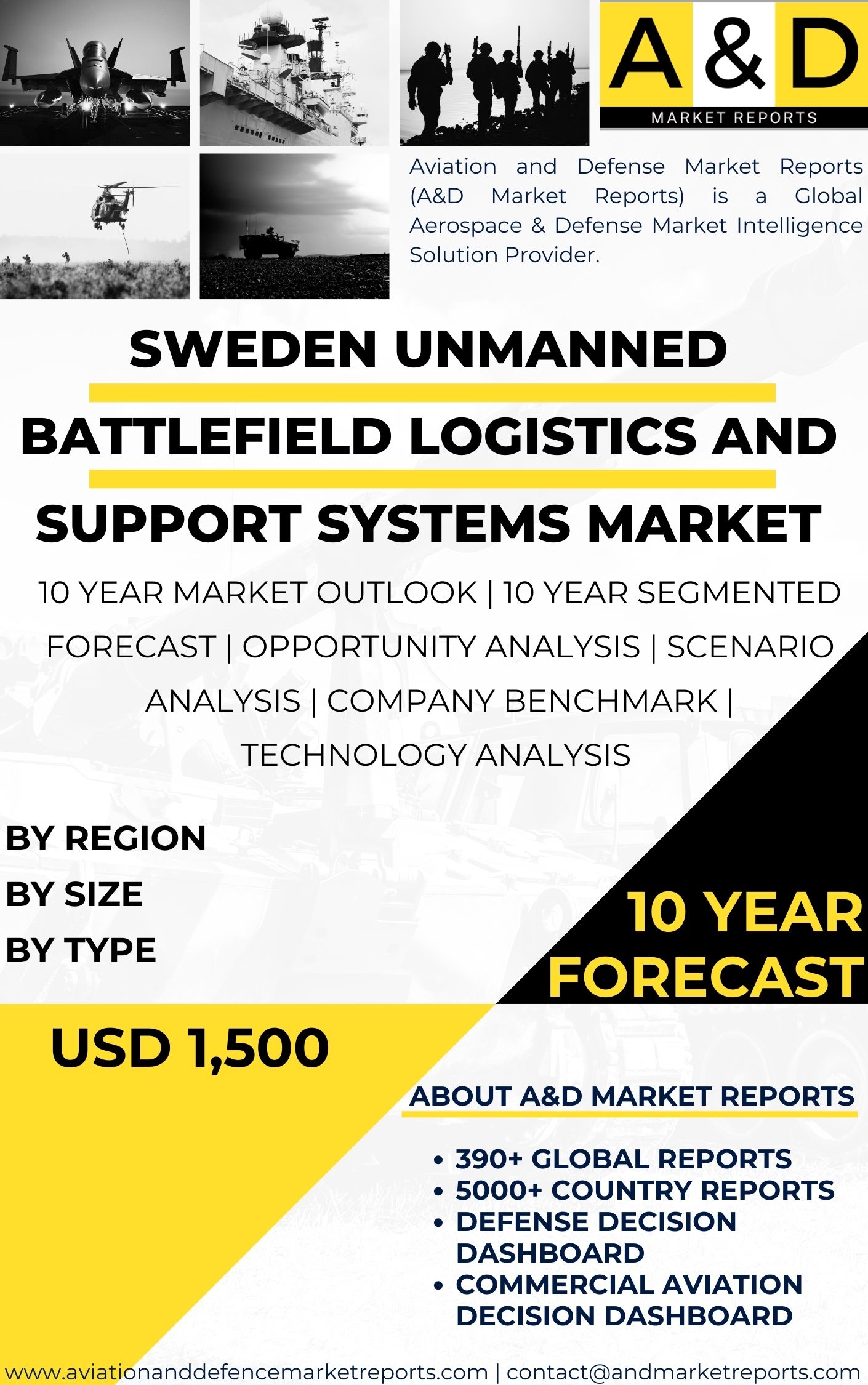
Sweden Unmanned battlefield logistics and support systems Market

$1,500.00

Enquire Now

The Sweden Unmanned Battlefield Logistics and Support Systems Market plays a pivotal role in revolutionizing modern warfare by providing innovative and efficient solutions for the transportation, resupply, and support of troops and equipment on the battlefield. Unmanned battlefield logistics and support systems encompass a wide range of unmanned ground vehicles (UGVs), unmanned aerial vehicles (UAVs), and autonomous systems designed to carry out logistics and support tasks, freeing up human resources, and enhancing the effectiveness and agility of Sweden’s armed forces. These sophisticated systems are crucial in enhancing Sweden’s defense capabilities, improving operational efficiency, and reducing the risks faced by military personnel in hostile and challenging environments. Sweden’s commitment to innovation, technological expertise, and defense modernization has positioned it as a key player in the global Unmanned Battlefield Logistics and Support Systems Market.

Go To Global Report Page Track this market real time on DDD

Description

Sweden Unmanned Battlefield Logistics and Support Systems Market Overview

The Sweden Unmanned Battlefield Logistics and Support Systems Market plays a transformative role in modern warfare by providing autonomous solutions for transporting, resupplying, and supporting troops and equipment. These systems, including unmanned ground vehicles (UGVs), unmanned aerial vehicles (UAVs), and other autonomous platforms, enhance operational efficiency, free up human resources, and reduce risks to personnel. Sweden’s focus on innovation, technological expertise, and defense modernization positions it as a key global player in this sector.

Sweden Unmanned Battlefield Logistics and Support Systems Market Applications

The market supports a wide range of defense applications. UGVs and UAVs with cargo capabilities enable resupply missions to troops in remote or high-risk areas, delivering ammunition, food, and medical supplies without exposing personnel to danger. Unmanned systems also enhance force protection by minimizing the need for manned convoys and supply runs, reducing the risk of ambushes.

Additionally, unmanned systems play a critical role in troop support and medical evacuation (medevac). Vehicles equipped for battlefield casualty transport can move injured soldiers quickly to field hospitals, improving medical response times and potentially saving lives.

Sweden Unmanned Battlefield Logistics and Support Systems Market Technology Integration

Emerging technologies have strengthened the capabilities of Sweden’s unmanned battlefield systems. Artificial intelligence, autonomous navigation, and advanced sensors allow these systems to operate in dynamic and complex environments, adapt to changing battlefield conditions, and execute logistics tasks efficiently with minimal human intervention.

Sweden Unmanned Battlefield Logistics and Support Systems Market Export Potential

Swedish unmanned logistics and support systems have gained international recognition for their reliability and effectiveness. The market’s export-oriented approach ensures adherence to strict arms export regulations, with robust end-user controls and compliance with international arms transfer agreements.

Sweden Unmanned Battlefield Logistics and Support Systems Market R&D and Collaboration

Research and development are central to market growth. Collaboration among Sweden’s defense industry, research institutions, and the Swedish Armed Forces drives innovation and technological advancement. These efforts ensure unmanned systems integrate advanced autonomy, sensor technology, and communication networks tailored to meet military requirements.

Sweden Unmanned Battlefield Logistics and Support Systems Market Industry Expertise

The market leverages Sweden’s expertise in robotics, automation, and artificial intelligence. Swedish companies lead the development of state-of-the-art unmanned systems, tackling challenges related to autonomous navigation, mission planning, and battlefield logistics coordination.

Market Challenges

Key challenges include ensuring interoperability with existing military infrastructure and command networks, as well as mitigating cybersecurity risks. Secure communication and protection against cyberattacks are critical to maintaining operational integrity and safeguarding sensitive battlefield data.

Market Future Outlook

The Sweden Unmanned Battlefield Logistics and Support Systems Market has a promising future, driven by continuous R&D, international collaboration, and growing demand for efficient, autonomous logistics solutions. Sweden’s dedication to innovation ensures its unmanned systems remain at the forefront of modern military capabilities, enhancing defense readiness, improving operational efficiency, and contributing to global security.
Table of content

Table Of Contents

1 Market Introduction

1.1 Market Introduction
1.2 Market Definition
1.3 Market Segmentation
1.4 10 Year Market Outlook

2 Market Technologies

3 Global Market Forecast

3.1 Global Market Forecast
3.2 By Size
3.3 By Type

4 EuropeMarket Trends & Forecast

4.1 Drivers, Restraints And Challenges
4.2 PEST
4.3 Market ForecastScenario Analysis
4.3.1 Market Forecast By Size
4.3.2 Market Forecast By Type
4.4 Scenario Analysis
4.5 Key Companies& Profiling

5 Sweden Analysis

5.1 Current Levels Of Technology Maturation In This Market
5.2 Market ForecastScenario Analysis
5.2.1 Market Forecast By Size
5.2.2 Market Forecast By Type
5.3 Scenario Analysis
5.4 Country Defense Budget (Historical and 10- year forecast)
5.5 Defense Budget Category Spending- 10- year forecast
5.6 Procurement Analysis
5.7 EXIM Data
5.8 Patents

6 Opportunity Matrix

6.1 By Size
6.2 By Type

7 Scenario Analysis

7.1 Scenario 1

7.1.1 By Size (Scenario-1)
7.1.2 By Type (Scenario-1)

7.2 Scenario 2

7.2.1 By Size (Scenario-2)
7.2.2 By Type (Scenario-2)

8 Company Benchmark

9 Strategic Conclusions

10 About Aviation And Defense Market Reports

Segments

By Size
By Type

List of Tables

Table1: Global Market Forecast, Sweden Unmanned battlefield logistics and support systems Market
Table2: Europe Market Forecast, Sweden Unmanned battlefield logistics and support systems Market
Table3: Europe Market Forecast, By Size
Table4: Europe Market Forecast, By Type
Table5: Europe, Scenario Analysis
Table6: Sweden Market Forecast, Sweden Unmanned battlefield logistics and support systems Market
Table7: Sweden Market Forecast, By Size
Table8: Sweden Market Forecast, By Type
Table9: Sweden, Scenario Analysis
Table 10: Sweden Defense Budget 10 Year Forecast
Table 11: Sweden, Defense Budget Category Spending- 10- year forecast
Table 12: Sweden, Procurement Analysis
Table 13: Sweden, EXIM Data Analysis
Table 14: Sweden, Opportunity Analysis, By Size
Table 15: Sweden, Opportunity Analysis, By Type
Table 16: Sweden, Scenario Analysis, By Size
Table 17: Sweden, Scenario Analysis, By Type

List of Figures

Figure 1: Market Segmentation, Sweden Unmanned battlefield logistics and support systems Market
Figure 2: Key Technology Analysis, Sweden Unmanned battlefield logistics and support systems Market
Figure 3: Global Market Forecast, Sweden Unmanned battlefield logistics and support systems Market
Figure 4: Europe, Market Forecast, Sweden Unmanned battlefield logistics and support systems Market
Figure 5: Europe, Market Forecast, By Size
Figure 6: Europe, Market Forecast, By Type
Figure 7: Europe, Scenario Analysis
Figure 8: Sweden, Market Forecast, Sweden Unmanned battlefield logistics and support systems Market
Figure 9: Sweden, Market Forecast, By Size
Figure 10: Sweden, Market Forecast, By Type
Figure 11: Sweden, Scenario Analysis
Figure 12: Sweden, Defense Budget 10 Year Forecast
Figure 13: Sweden, Defense Budget Category Spending- 10- year forecast
Figure 14: Sweden, Procurement Analysis
Figure 15: Sweden, EXIM Data Analysis
Figure 16: Sweden, Opportunity Analysis, By Size
Figure 17: Sweden, Opportunity Analysis, By Type
Figure 18: Sweden, Scenario Analysis, By Size
Figure 19: Sweden, Scenario Analysis, By Type
Figure 20: Company Benchmark