
Description
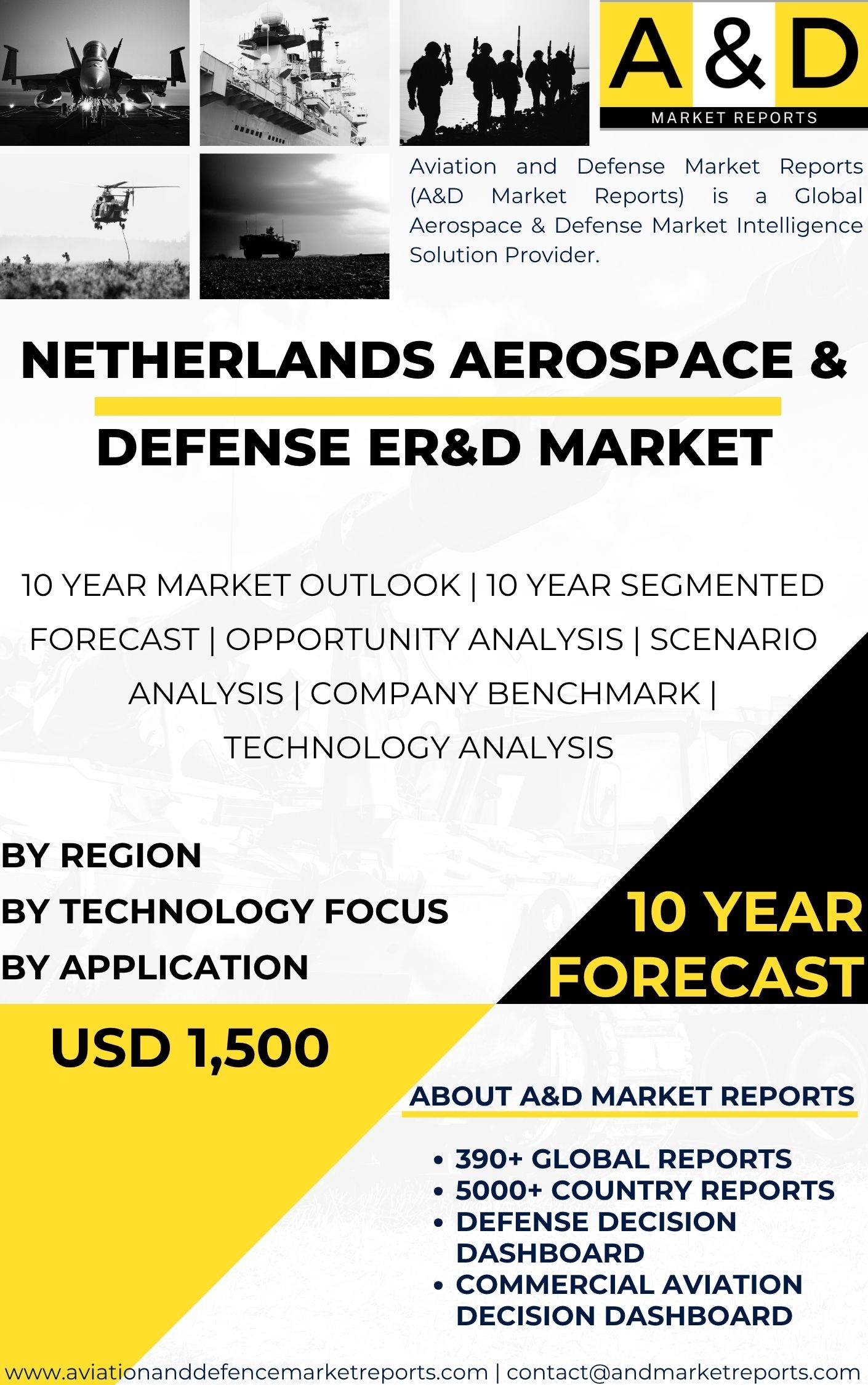
The Netherlands aerospace and defense engineering research and development (ER&D) market plays a pivotal role in driving innovation and supporting the modernization of defense and aerospace platforms. ER&D services encompass the design, development, testing, and optimization of advanced systems and subsystems, ensuring that equipment meets the stringent performance, safety, and reliability standards required for operational readiness. The Netherlands, as a key NATO member and participant in European defense collaborations, relies heavily on its ER&D sector to maintain technological competitiveness and support national security objectives.
ER&D activities cover a wide spectrum, including avionics system design, propulsion engineering, structural analysis, software development, systems integration, and digital modeling. In defense, ER&D focuses on fighter aircraft, helicopters, naval vessels, armored vehicles, and missile systems, while in aerospace, it addresses civil aircraft, UAVs, and space systems. Dutch ER&D firms work closely with manufacturers and end-users to ensure that systems are not only functional but optimized for efficiency, safety, and operational effectiveness.
The market growth is driven by several factors. Modern platforms are increasingly complex, integrating advanced sensors, electronics, autonomous systems, and digital communication networks. The Netherlands? defense forces require continuous innovation to upgrade legacy platforms, maintain interoperability with NATO allies, and address emerging threats in cyber and electronic warfare domains. Civil aerospace programs also benefit from ER&D investments, particularly in the development of lightweight materials, fuel-efficient propulsion systems, and enhanced avionics capabilities.
Technological advancements are central to the ER&D market. Digital twins, advanced simulation, AI-driven design optimization, and additive manufacturing are transforming how aerospace and defense systems are conceptualized, tested, and deployed. ER&D enables engineers to simulate performance under real-world conditions, reduce development cycles, and minimize risks associated with field deployment. In the Netherlands, ER&D centers are increasingly integrating these technologies to support both national defense programs and multinational projects.
Collaboration and partnerships are key features of the Dutch ER&D market. Companies and research institutions often collaborate with NATO, the European Union, and international defense contractors to co-develop solutions that are interoperable across multiple platforms and countries. This approach ensures that Dutch systems are compatible with allied equipment and meet global operational standards.
Cost efficiency and risk mitigation also contribute to market growth. By leveraging ER&D services, the Netherlands can identify potential failures early, reduce prototyping costs, and optimize system performance before deployment. This not only reduces lifecycle costs but also enhances operational reliability, which is critical for mission success.
Challenges include the high costs of advanced ER&D activities, the need to continuously update skills and infrastructure, and the rapid pace of technological change. Retaining skilled engineers and researchers is crucial, as is ensuring compliance with international regulations and export control laws. Additionally, balancing innovation with budgetary constraints remains an ongoing concern for both government and industry stakeholders.
Looking ahead, the Netherlands aerospace and defense ER&D market is expected to expand, driven by modernization initiatives, emerging technologies such as autonomous systems and hypersonics, and increased emphasis on sustainability and fuel efficiency. By investing in ER&D, the Netherlands ensures that its defense and aerospace sectors remain innovative, resilient, and fully capable of meeting both national and NATO operational requirements.