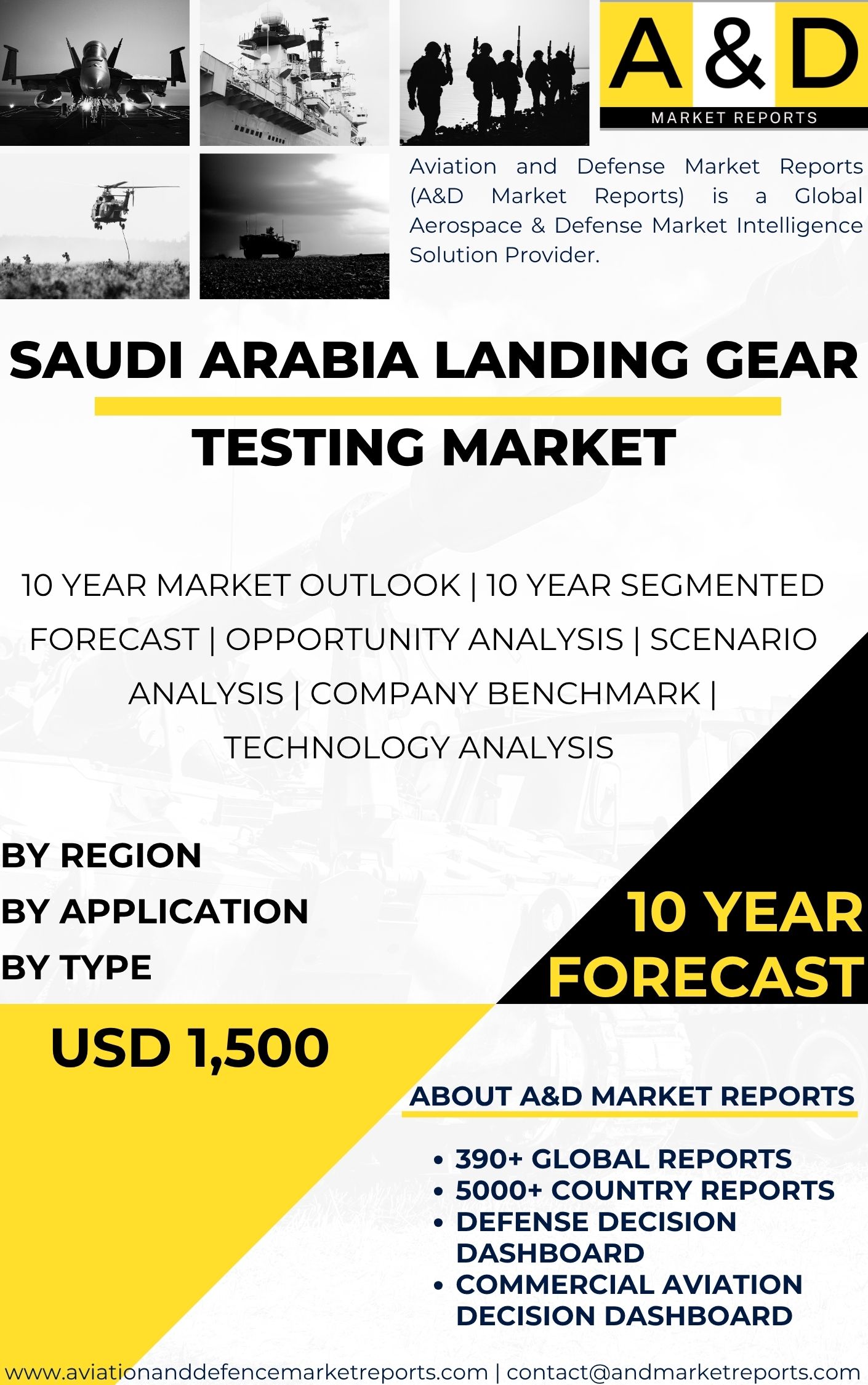
Saudi Arabia Landing gear testing

$1,500.00

Enquire Now
Category: Tag: Report ID: ANDCSA0220

Landing gear testing in aerospace is a critical process dedicated to validating the safety, reliability, and performance of aircraft landing gear systems under simulated real-world conditions. The landing gear assembly, which includes wheels, brakes, shock absorbers, struts, actuators, and retraction mechanisms, endures significant mechanical loads and environmental stresses during takeoff, landing, and taxiing. Rigorous testing ensures that the entire system can withstand these stresses without failure, thus safeguarding aircraft integrity and passenger safety.

Go To Global Report Page Track this market real time on DDD

Description

Landing gear testing in aerospace is a critical process dedicated to validating the safety, reliability, and performance of aircraft landing gear systems under simulated real-world conditions. The landing gear assembly, which includes wheels, brakes, shock absorbers, struts, actuators, and retraction mechanisms, endures significant mechanical loads and environmental stresses during takeoff, landing, and taxiing. Rigorous testing ensures that the entire system can withstand these stresses without failure, thus safeguarding aircraft integrity and passenger safety.

One fundamental aspect of landing gear testing is structural integrity assessment. Static load tests apply predetermined weights to the landing gear to verify its strength and deformation limits. These tests ensure the gear can support the maximum loads it will encounter during operation without permanent damage. Dynamic load tests simulate conditions such as impact shocks during landing and taxiing by applying cyclic and sudden forces to evaluate the gear?s ability to absorb energy and maintain structural integrity over numerous load cycles. Fatigue testing involves repeatedly applying stress to detect potential failure points due to material weakening or structural wear over the gear?s operational lifespan.

Functionality tests of the hydraulic systems controlling the extension, retraction, and locking of the landing gear are equally important. These tests verify that gear deployment and retraction mechanisms operate smoothly, reliably, and within required timeframes. Brake system tests evaluate the effectiveness of stopping power, heat dissipation, and performance consistency under repeated braking scenarios. Specialized drop tests, where landing gear assemblies or aircraft are dropped onto platforms that simulate runway surfaces, simulate hard or emergency landings to observe gear response and resilience.

Environmental testing exposes landing gear components to extremes of temperature, corrosion-inducing atmospheres, humidity, and other operational stresses to assess long-term durability and reliability. These tests replicate specific conditions aircraft face during varied climates and operational environments worldwide.

Advanced instrumentation such as strain gauges, load cells, accelerometers, and data acquisition systems record forces, displacements, stresses, and vibrations during tests, providing precise and comprehensive data for analysis. Regulatory compliance is ensured by adhering to standards defined by the Federal Aviation Administration (FAA), European Union Aviation Safety Agency (EASA), and military specifications such as MIL-STD, which stipulate testing protocols, performance criteria, and documentation requirements.

In addition to ground-based testing, flight test programs validate landing gear performance under actual operational conditions, complementing lab results while exposing gear systems to unpredictable factors such as runway irregularities and pilot inputs.

Economically, thorough landing gear testing reduces the risk of in-service failures, costly repairs, and aircraft downtime, contributing to enhanced safety and operational readiness. Manufacturers continuously innovate testing methods and equipment, incorporating digital control, automation, and simulation technologies to enhance test accuracy, efficiency, and predictive maintenance capabilities.

In conclusion, landing gear testing in aerospace is a comprehensive discipline that ensures the mechanical robustness, functional reliability, and environmental resilience of aircraft landing gear systems. It combines structural, dynamic, functional, and environmental evaluations guided by stringent regulatory standards, playing an essential role in aircraft safety and operational performance.

Table of content

Table Of Contents

1 Market Introduction

1.1 Market Introduction
1.2 Market Definition
1.3 Market Segmentation
1.4 10 Year Market Outlook

2 Market Technologies

3 Global Market Forecast

3.1 Global Market Forecast
3.2 By Type
3.3 By Application

4 Middle East Market Trends & Forecast

4.1 Drivers, Restraints And Challenges
4.2 PEST
4.3 Market Forecast
4.3.1 Market Forecast By Type
4.3.2 Market Forecast By Application
4.4 Scenario Analysis
4.5 Key Companies& Profiling

5Saudi Arbia Analysis

5.1 Current Levels Of Technology Maturation In This Market
5.2 Market Forecast
5.2.1 Market Forecast By Type
5.2.2 Market Forecast By Application
5.3 Scenario Analysis
5.4 Country Defense Budget (Historical and 10- year forecast)
5.5 Defense Budget Category Spending- 10- year forecast
5.6 Procurement Analysis
5.7 EXIM Data
5.8 Patents

6 Opportunity Matrix

6.1 By Type
6.2 By Application

7 Scenario Analysis

7.1 Scenario 1

7.1.1 By Type (Scenario-1)
7.1.2 By Application (Scenario-1)

7.2 Scenario 2

7.2.1 By Type (Scenario-2)
7.2.2 By Application (Scenario-2)

8 Company Benchmark

9 Strategic Conclusions

10 About Aviation And Defense Market Reports

Segments

By Application
By Type

List of Tables

Table1: Global Market Forecast, Landing gear testing
Table2: Middle East Market Forecast, Landing gear testing
Table3: Middle East Market Forecast, By Application
Table4: Middle East Market Forecast, By Type
Table5: Middle East, Scenario Analysis
Table6: Saudi Arabia Market Forecast, Landing gear testing
Table7: Saudi Arabia Market Forecast, By Application
Table8: Saudi Arabia Market Forecast, By Type
Table9: Saudi Arabia, Scenario Analysis
Table 10: Saudi Arabia Defense Budget 10 Year Forecast
Table 11: Saudi Arabia, Defense Budget Category Spending- 10- year forecast
Table 12: Saudi Arabia, Procurement Analysis
Table 13: Saudi Arabia, EXIM Data Analysis
Table 14: Saudi Arabia, Opportunity Analysis, By Application
Table 15: Saudi Arabia, Opportunity Analysis, By Type
Table 16: Saudi Arabia, Scenario Analysis, By Application
Table 17: Saudi Arabia, Scenario Analysis, By Type

List of Figures

Figure 1: Market Segmentation, Saudi Arbia Landing gear testing
Figure 2: Key Technology Analysis, Landing gear testing
Figure 3: Global Market Forecast, Landing gear testing
Figure 4: Middle East, Market Forecast, Landing gear testing
Figure 5: Middle East, Market Forecast, By Application
Figure 6: Middle East, Market Forecast, By Type
Figure 7: Middle East, Scenario Analysis
Figure 8: Saudi Arabia, Market Forecast, Landing gear testing
Figure 9: Saudi Arabia, Market Forecast, By Application
Figure 10: Saudi Arabia, Market Forecast, By Type
Figure 11: Saudi Arabia, Scenario Analysis
Figure 12: Saudi Arabia, Defense Budget 10 Year Forecast
Figure 13: Saudi Arabia, Defense Budget Category Spending- 10- year forecast
Figure 14: Saudi Arabia, Procurement Analysis
Figure 15: Saudi Arabia, EXIM Data Analysis
Figure 16: Saudi Arabia, Opportunity Analysis, By Application
Figure 17: Saudi Arabia, Opportunity Analysis, By Type
Figure 18: Saudi Arabia, Scenario Analysis, By Application
Figure 19: Saudi Arabia, Scenario Analysis, By Type
Figure 20: Company Benchmark