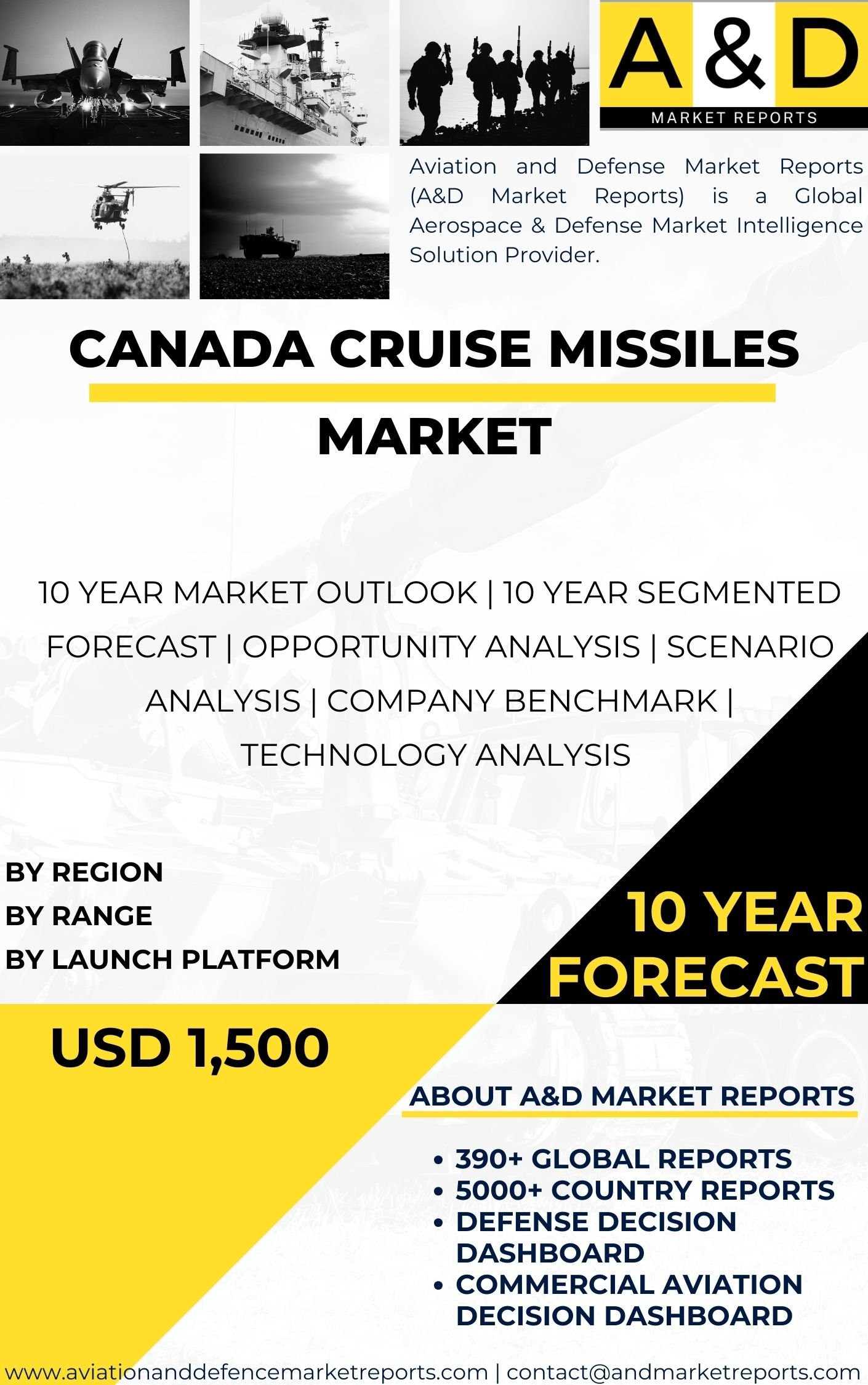
Canada Cruise Missiles Market

$1,500.00

Enquire Now

Cruise Missiles Market in the Canada is both dynamic and multifaceted, occupying a prominent position in the nation?s strategic arsenal and defense industrial base. This sector consists of established defense primes, innovative midsize firms, and specialized subcontractors engaged in developing advanced propulsion systems, warhead payloads, guidance electronics, composite containers, and system integration platforms. Cruise missiles serve as a versatile and precise element of modern military doctrine, frequently selected for their capacity to deliver controlled effects at stand-off ranges and to navigate complex defense environments using stealth, low-altitude flight profiles, and sophisticated terrain-mapping algorithms. Core market characteristics revolve around adaptability for integration with diverse launch platforms, including surface ships, submarines, land vehicles, and aircraft, ensuring that the missiles satisfy a range of mission types and operational requirements.

Go To Global Report Page Track this market real time on DDD

Description

Market Overview and Strategic Position

The Canada Cruise Missiles Market   is dynamic, multifaceted, and strategically embedded within the nation’s defense industrial base. Cruise missiles represent a precision-guided strike capability designed to engage high-value targets at significant stand-off distances. Because modern defense doctrine emphasizes speed, precision, and minimized collateral impact, these systems are central to deterrence and power projection. Their ability to operate in contested airspace using low-altitude flight paths and terrain-following navigation enhances survivability. In addition, cruise missiles provide flexible response options across conventional and strategic scenarios. Therefore, this market remains integral to Canada’s evolving security architecture.

Industry Structure and Key Participants

The sector includes established defense primes, midsize innovators, and highly specialized subcontractors. Major global contractors such as Raytheon Technologies and Lockheed Martin contribute expertise in propulsion, guidance, and systems integration. These firms collaborate with advanced electronics suppliers and composite material manufacturers. Furthermore, niche companies focus on warhead payload engineering and embedded sensor development. This layered industrial ecosystem supports research, production, and lifecycle sustainment. As a result, the market benefits from both technological depth and manufacturing scalability.

Technology Capabilities and Platform Integration

Cruise missiles combine high-efficiency propulsion systems, advanced guidance electronics, and precision warhead configurations. Terrain-mapping algorithms and satellite navigation enable accurate long-range targeting. Artificial intelligence-based targeting systems enhance adaptability and mission planning efficiency. Additionally, stealth shaping and radar-absorbing materials reduce detectability in hostile environments. A defining characteristic is compatibility with multiple launch platforms, including naval surface ships, submarines, land vehicles, and aircraft. Consequently, adaptability across domains strengthens operational flexibility.

Demand Drivers and Modernization Priorities

Demand is driven by evolving threat landscapes and competitive global arms development. National security strategies emphasize rapid response, stand-off engagement, and multi-domain integration. Modernization initiatives prioritize replenishing and upgrading stockpiles to address emerging air defense challenges. Because adversaries invest in sophisticated countermeasures, cruise missile systems must continually evolve. Research and development investments focus on miniaturized electronics, improved propulsion efficiency, and extended operational range. Therefore, sustained funding supports long-term strategic readiness.

Regulatory Framework, Supply Chain, and Lifecycle Support

Regulatory oversight involves strict export controls, safety certifications, and compliance protocols. In Canada, procurement and oversight are coordinated through the Department of National Defence to ensure responsible stewardship of sensitive technologies. The supply chain integrates advanced materials science, precision engineering, and automated production systems. Manufacturers address challenges related to environmental resilience, interoperability, and quality assurance. Continuous advancement in stealth features, embedded sensors, and digital fire control systems increases technical complexity. Customers require upgrade assurance, after-sales service, and rigorous performance validation throughout the missile’s lifespan. Ultimately, the interplay of innovation, policy direction, and operational necessity ensures the cruise missile market remains central to Canada’s defense capabilities while adapting to technological change and global uncertainty.
Table of content

Table Of Contents

1 Market Introduction

1.1 Market Introduction
1.2 Market Definition
1.3 Market Segmentation
1.4 10 Year Market Outlook

2 Market Technologies

3 Global Market Forecast

3.1 Global Market Forecast
3.2 By Launch Platform
3.3 By Range

4 North America Market Trends & Forecast

4.1 Drivers, Restraints And Challenges
4.2 PEST
4.3 Market Forecast
4.3.1 Market Forecast By Launch Platform
4.3.2 Market Forecast By Fitment
4.4 Scenario Analysis
4.5 Key Companies& Profiling

5 Canada Analysis

5.1 Current Levels Of Technology Maturation In This Market
5.2 Market Forecast
5.2.1 Market Forecast By Launch Platform
5.2.2 Market Forecast By Fitment
5.3 Scenario Analysis
5.4 Country Defense Budget (Historical and 10- year forecast)
5.5 Defense Budget Category Spending- 10- year forecast
5.6 Procurement Analysis
5.7 EXIM Data
5.8 Patents

6 Opportunity Matrix

6.1 By Launch Platform
6.2 By Range

7 Scenario Analysis

7.1 Scenario 1

7.1.1 By Launch Platform (Scenario-1)
7.1.2 By Range (Scenario-1)

7.2 Scenario 2

7.2.1 By Launch Platform (Scenario-2)
7.2.2 By Range (Scenario-2)

8 Company Benchmark

9 Strategic Conclusions

10 About Aviation And Defense Market Reports

Segments

By Launch Platform
By Range

List of Tables

Table1: Global Market Forecast, Cruise Missiles Market
Table2: Market Forecast, Cruise Missiles Market
Table3: Market Forecast, By Launch Platform
Table4: Market Forecast, By Range
Table5: , Scenario Analysis
Table6: Market Forecast, Cruise Missiles Market
Table7: Market Forecast, By Launch Platform
Table8: Market Forecast, By Range
Table9: , Scenario Analysis
Table 10: Defense Budget 10 Year Forecast
Table 11: , Defense Budget Category Spending- 10- year forecast
Table 12: , Procurement Analysis
Table 13: , EXIM Data Analysis
Table 14: , Opportunity Analysis, By Launch Platform
Table 15: , Opportunity Analysis, By Range
Table 16: , Scenario Analysis, By Launch Platform
Table 17: , Scenario Analysis, By Range

List of Figures

Figure 1: Market Segmentation, Canada Cruise Missiles Market
Figure 2: Key Technology Analysis, Cruise Missiles Market
Figure 3: Global Market Forecast, Cruise Missiles Market
Figure 4: North America, Market Forecast, Cruise Missiles Market
Figure 5: North America, Market Forecast, By Launch Platform
Figure 6: North America, Market Forecast, By Range
Figure 7: North America, Scenario Analysis
Figure 8: Canada, Market Forecast, Cruise Missiles Market
Figure 9: Canada, Market Forecast, By Launch Platform
Figure 10: Canada, Market Forecast, By Range
Figure 11: Canada, Scenario Analysis
Figure 12: Canada, Defense Budget 10 Year Forecast
Figure 13: Canada, Defense Budget Category Spending- 10- year forecast
Figure 14: Canada, Procurement Analysis
Figure 15: Canada, EXIM Data Analysis
Figure 16: Canada, Opportunity Analysis, By Launch Platform
Figure 17: Canada, Opportunity Analysis, By Range
Figure 18: Canada, Scenario Analysis, By Launch Platform
Figure 19: Canada, Scenario Analysis, By Range
Figure 20: Company Benchmark