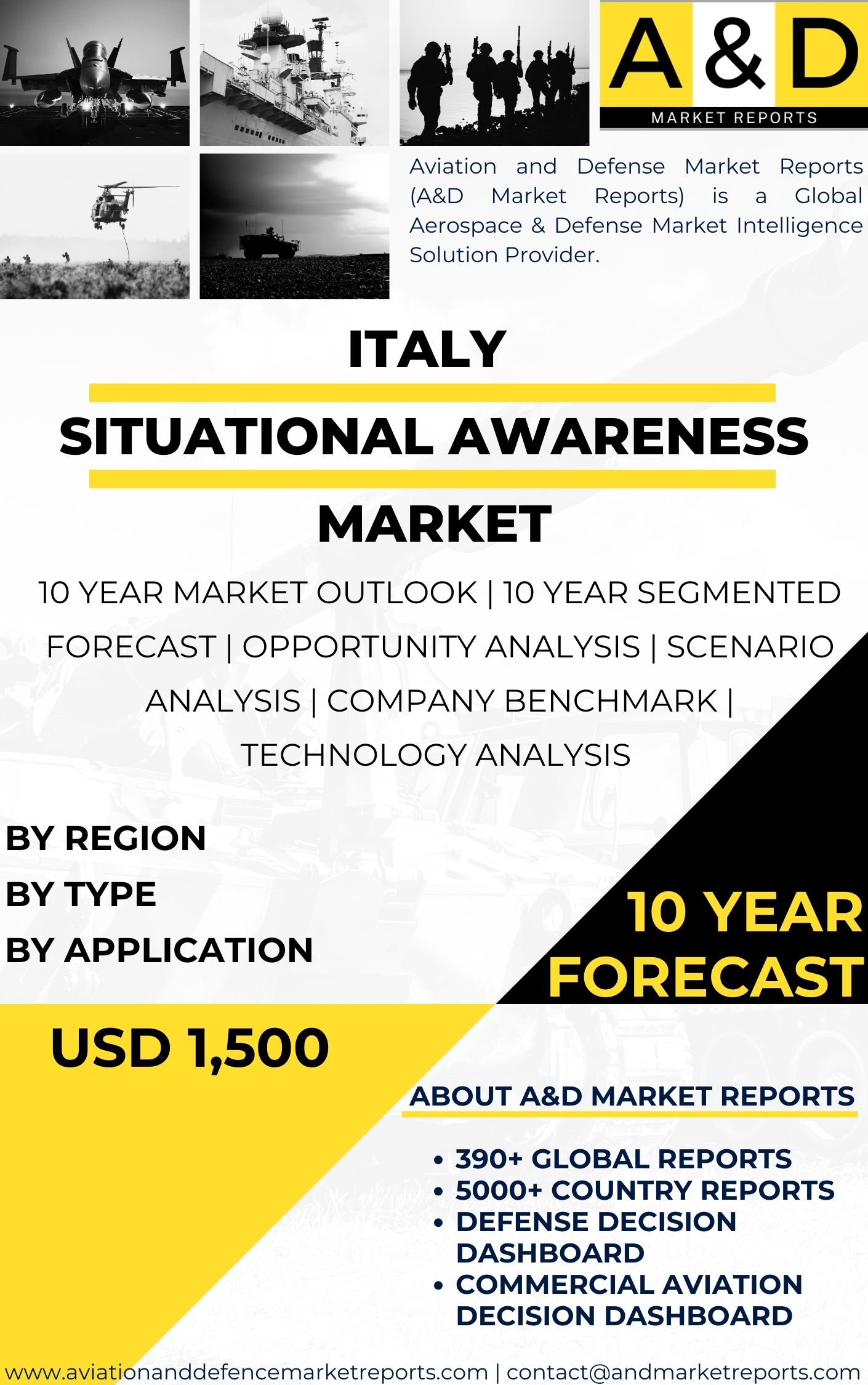
Italy Situational Awareness Market

$1,500.00

Enquire Now

Italy?s situational awareness market has evolved into a multi-layered ecosystem that combines sensors, data fusion, command-and-control systems, communications, and human-machine interfaces to provide decision makers with a coherent, timely picture of operational environments across land, sea, air and cyber domains. Demand is driven by the country?s strategic priorities?homeland security, NATO interoperability, expeditionary deployments, maritime domain awareness in the Mediterranean and Arctic-adjacent waters, counter-terrorism and protection of critical infrastructure?each requiring rapid, accurate understanding of threats and opportunities. At the core of situational awareness capabilities are sensor suites: airborne electro-optical/infrared systems, maritime radars, coastal surveillance radars, acoustic arrays, ground surveillance radars, unmanned aerial systems, space-based imagery and a growing array of cyber and signals-intelligence sensors. Italy?s market reflects a mix of mature, platform-integrated systems on naval and air platforms and an expanding base of distributed, networked sensors for persistent monitoring. The value proposition is no longer limited to raw detection; modern investments emphasize multisensor fusion, automated target classification, predictive analytics and end-to-end decision support that compress the observe-orient-decide-act loop. This shift is driven by technological advances such as higher-resolution sensors, improved data links, secure software-defined radios, edge computing, machine learning for pattern recognition and automated cueing, and resilient distributed architectures that mitigate single-point failures. Integration is central: situational awareness systems must ingest heterogeneous streams?radar tracks, imagery, AIS, electronic support measures, human reports?and present synthesized, geolocated intelligence to commanders as a single common operational picture. Italy?s defense and security customers therefore place high value on systems engineering, middleware, standards-based interoperability and rigorous testing to ensure that disparate subsystems produce reliable, actionable outputs under stress. The civil-military interface is also a growth area. Capabilities developed for defense?maritime surveillance, border monitoring, emergency response coordination?are increasingly adapted to civilian uses such as search-and-rescue, environmental monitoring, port security and disaster response. The dual-use nature of situational awareness technologies creates additional commercial opportunities for Italian suppliers while complicating export control and data-governance considerations. Resilience and cyber-hardened design are critical market drivers in Italy: situational awareness must remain operational in contested electromagnetic environments, under cyber-attack, or when GPS signals are degraded. That concern has accelerated investment into alternative navigation and timing sources, anti-jam communications, encrypted data links and secure cloud-edge architectures that preserve data integrity and sovereignty. NATO and EU interoperability requirements shape procurement and R&D, pushing Italian providers to comply with coalition standards and to ensure common data models and exchange protocols. This need has fostered international partnerships and participation in multinational programs where Italian firms supply sensors, C2 systems or integration services. From an industrial perspective, the situational awareness market in Italy is characterized by a blend of well-established systems integrators, specialized SMEs in optics, radar, EW and AI, and research institutions that support sensor R&D and algorithm development. The market opportunity favors firms that can offer turnkey solutions?sensor packages plus resilient networks and analytic layers?because end users prioritize deployability, sustainability and lifecycle support. Training and human factors engineering remain important: decision-support systems must present complex data in intuitive formats that prevent information overload, and the market increasingly stresses simulation-based training and synthetic environments to validate tactics and workflows before deployment. Logistics and sustainment are long-term considerations: distributed sensor networks and deployed platforms require robust supply chains for spare parts, secure software updates, and local maintenance capability to minimize downtime. Environmental factors?operation in Mediterranean maritime climates, extreme cold for Arctic operations, and urban complexities?drive ruggedization and platform-specific customization. Looking ahead, the Italian situational awareness market will expand its focus on AI-enabled analytics, maritime-domain persistent sensing, autonomous sensor platforms (surface, subsurface, aerial), secure multi-domain data fabrics and greater civilian-military integration. The strategic prize for successful providers is substantial: governments want systems that reduce decision latency, lower operational risk, and provide a scalable response to hybrid threats, while private-sector actors can translate defense-grade capabilities into commercial products for ports, critical infrastructure and emergency services. Success will depend on technological excellence, interoperability, supply-chain resilience and the ability to demonstrate mission effectiveness in real-world operations.

Go To Global Report Page Track this market real time on DDD

Description

Market Overview and Strategic Importance

The Italy Situational Awareness Market has evolved into a highly integrated ecosystem combining sensors, data fusion, command-and-control systems, and communication networks. These systems provide decision-makers with a real-time and coherent understanding of operational environments across land, sea, air, and cyber domains. Demand is driven by national priorities such as homeland security, protection of critical infrastructure, and participation in NATO operations. Italy’s geographic position, particularly in the Mediterranean region, further increases the need for advanced monitoring and surveillance capabilities. As a result, situational awareness has become a cornerstone of both defense and security strategies.

Sensor Ecosystem and Data Collection

At the core of Italy’s situational awareness capabilities lies a diverse and advanced sensor ecosystem. This includes electro-optical and infrared systems, maritime and coastal radars, acoustic sensors, unmanned aerial systems, and space-based imaging technologies. These sensors operate across multiple domains to provide continuous monitoring and intelligence gathering. The market reflects a mix of traditional platform-based systems and modern distributed sensor networks. Increasingly, emphasis is placed on persistent surveillance and wide-area coverage. This ensures that threats can be detected early and tracked accurately across complex environments.

Data Fusion and Decision Support Systems

Modern situational awareness systems in Italy go beyond simple detection by focusing on data fusion and decision support. Multiple data streams are integrated into a unified operational picture, enabling faster and more informed decision-making. Advanced technologies such as machine learning and predictive analytics are used to classify targets and anticipate potential threats. This reduces the time required for analysis and improves operational efficiency. Commanders benefit from a clear and actionable view of the situation, which enhances response capabilities in both military and civilian operations.

Technological Advancements and Innovation

Technological innovation plays a key role in shaping the Italian situational awareness market. Improvements in sensor resolution, communication networks, and computing power have significantly enhanced system performance. Secure software-defined radios and edge computing enable faster data processing closer to the source. In addition, artificial intelligence is increasingly used for pattern recognition and automated threat detection. These advancements allow systems to operate effectively even in complex and dynamic environments. As a result, Italy continues to invest in cutting-edge technologies to maintain its competitive edge.

Integration and Interoperability

Integration is a critical requirement for situational awareness systems. Different sensors and platforms must work together seamlessly to provide a unified operational picture. Italy places strong emphasis on interoperability, particularly within NATO frameworks. Systems must be capable of sharing data with allied forces using standardized protocols. This ensures coordinated operations during joint missions. Effective integration also reduces redundancy and improves overall system efficiency. Therefore, system engineering and testing are key priorities in the market.

Civil-Military Applications and Dual-Use Potential

The situational awareness market in Italy has significant dual-use applications. Technologies developed for defense are increasingly adapted for civilian purposes. These include search-and-rescue operations, environmental monitoring, port security, and disaster response. This creates additional commercial opportunities for Italian companies. However, it also introduces challenges related to data governance and export controls. Balancing security requirements with commercial potential is an ongoing consideration in the market.

Cybersecurity and System Resilience

Resilience and cybersecurity are major priorities in Italy’s situational awareness systems. These systems must remain operational even in contested environments or during cyber-attacks. Investments are being made in secure communication networks, encrypted data links, and anti-jamming technologies. Alternative navigation systems are also being developed to reduce dependence on GPS. These measures ensure that situational awareness capabilities remain reliable under all conditions. As threats evolve, cybersecurity will continue to be a critical focus area.

Industrial Landscape and Market Structure

Italy’s situational awareness market is supported by a diverse industrial base. It includes large system integrators, specialized small and medium enterprises, and research institutions. These organizations collaborate to develop advanced sensors, software, and integration solutions. The market favors companies that can provide complete solutions, including hardware, software, and support services. Lifecycle management, including maintenance and upgrades, is also an important factor. This ensures long-term system performance and customer satisfaction.

Training, Human Factors, and Operational Efficiency

Human factors play a crucial role in situational awareness systems. Operators must be able to interpret complex data quickly and accurately. Therefore, user-friendly interfaces and intuitive displays are essential. Training programs and simulation tools are widely used to prepare personnel for real-world scenarios. These tools help reduce errors and improve decision-making under pressure. As systems become more advanced, the importance of effective training continues to grow.

Future Outlook and Market Growth

The future of Italy’s situational awareness market is driven by continued technological advancement and evolving security needs. AI-driven analytics, autonomous sensor platforms, and secure data-sharing networks will shape the next generation of systems. Increased integration between military and civilian applications will expand market opportunities. At the same time, interoperability with NATO and European partners will remain a key requirement. Overall, the market is expected to grow steadily, supported by innovation, strategic investments, and the need for enhanced security and operational awareness.
Table of content

Table Of Contents

1 Market Introduction

1.1 Market Introduction
1.2 Market Definition
1.3 Market Segmentation
1.4 10 Year Market Outlook

2 Market Technologies

3 Global Market Forecast

3.1 Global Market Forecast
3.2 By Type
3.3 By Application

4 Europe Market Trends & Forecast

4.1 Drivers, Restraints And Challenges
4.2 PEST
4.3 Market Forecast
4.3.1 Market Forecast By Type
4.3.2 Market Forecast By Application
4.4 Scenario Analysis
4.5 Key Companies& Profiling

5 Italy Analysis

5.1 Current Levels Of Technology Maturation In This Market
5.2 Market Forecast
5.2.1 Market Forecast By Type
5.2.2 Market Forecast By Application
5.3 Scenario Analysis
5.4 Country Defense Budget (Historical and 10- year forecast)
5.5 Defense Budget Category Spending- 10- year forecast
5.6 Procurement Analysis
5.7 EXIM Data
5.8 Patents

6 Opportunity Matrix

6.1 By Type
6.2 By Application

7 Scenario Analysis

7.1 Scenario 1

7.1.1 By Type (Scenario-1)
7.1.2 By Application (Scenario-1)

7.2 Scenario 2

7.2.1 By Type (Scenario-2)
7.2.2 By Application (Scenario-2)

8 Company Benchmark

9 Strategic Conclusions

10 About Aviation And Defense Market Reports

Segments

By Type
By Application

List of Tables

Table1: Global Market Forecast, Situational Awareness Market
Table2: Europe Market Forecast, Situational Awareness Market
Table3: Europe Market Forecast, By Type
Table4: Europe Market Forecast, By Application
Table5: Europe, Scenario Analysis
Table6: Italy Market Forecast, Situational Awareness Market
Table7: Italy Market Forecast, By Type
Table8: Italy Market Forecast, By Application
Table9: Italy, Scenario Analysis
Table 10: Italy Defense Budget 10 Year Forecast
Table 11: Italy, Defense Budget Category Spending- 10- year forecast
Table 12: Italy, Procurement Analysis
Table 13: Italy, EXIM Data Analysis
Table 14: Italy, Opportunity Analysis, By Type
Table 15: Italy, Opportunity Analysis, By Application
Table 16: Italy, Scenario Analysis, By Type
Table 17: Italy, Scenario Analysis, By Application

List of Figures

Figure 1: Market Segmentation, Italy Situational Awareness Market
Figure 2: Key Technology Analysis, Situational Awareness Market
Figure 3: Global Market Forecast, Situational Awareness Market
Figure 4: Europe, Market Forecast, Situational Awareness Market
Figure 5: Europe, Market Forecast, By Type
Figure 6: Europe, Market Forecast, By Application
Figure 7: Europe, Scenario Analysis
Figure 8: Italy, Market Forecast, Situational Awareness Market
Figure 9: Italy, Market Forecast, By Type
Figure 10: Italy, Market Forecast, By Application
Figure 11: Italy, Scenario Analysis
Figure 12: Italy, Defense Budget 10 Year Forecast
Figure 13: Italy, Defense Budget Category Spending- 10- year forecast
Figure 14: Italy, Procurement Analysis
Figure 15: Italy, EXIM Data Analysis
Figure 16: Italy, Opportunity Analysis, By Type
Figure 17: Italy, Opportunity Analysis, By Application
Figure 18: Italy, Scenario Analysis, By Type
Figure 19: Italy, Scenario Analysis, By Application
Figure 20: Company Benchmark

Aviation and Defense Market Reports


TPA | TIA | Consulting | Market Reports | Defense Decision Dashboard


Our Defense Report - Our Team Has Worked on More Than 250+ Individual Products / Markets