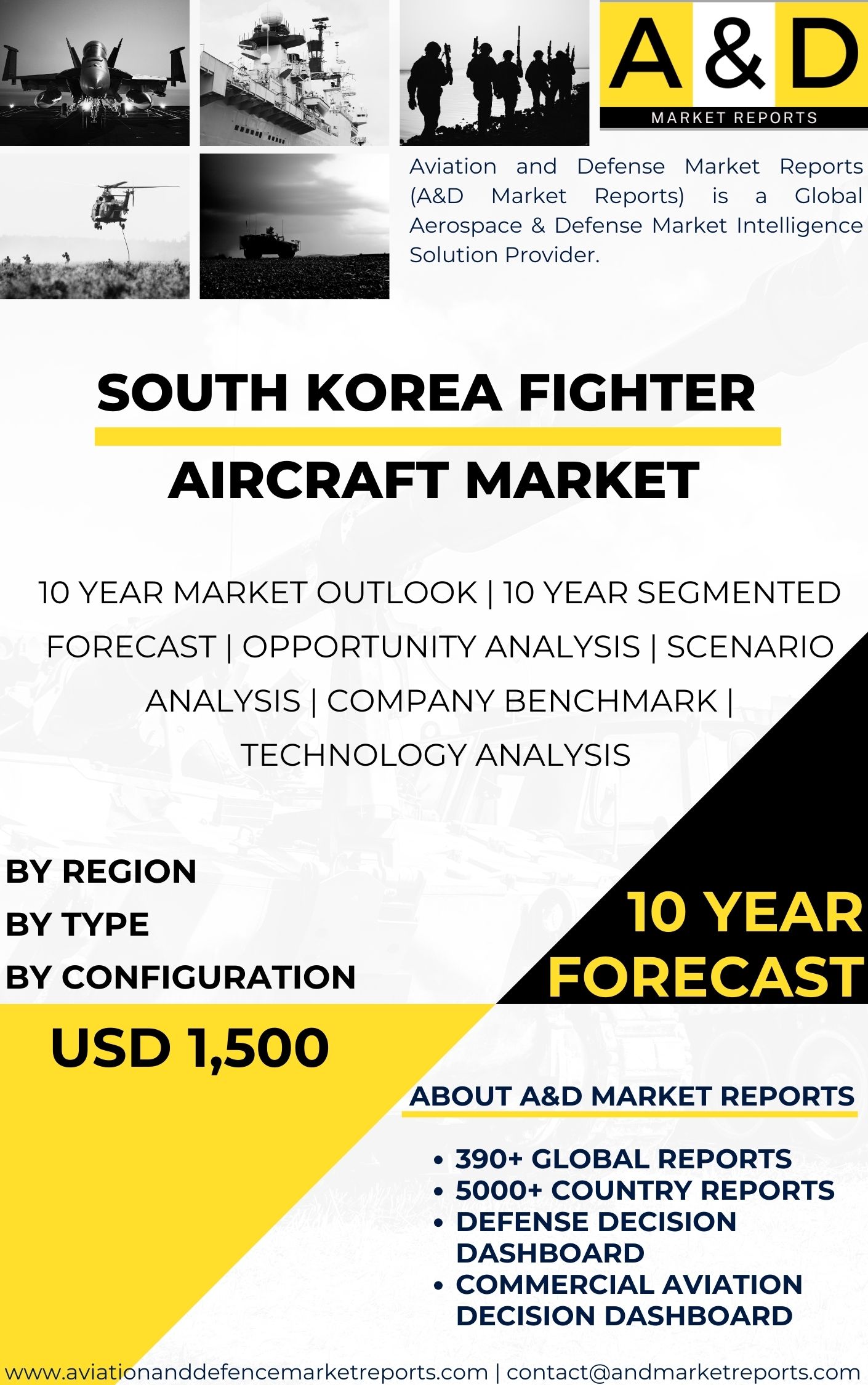
South Korea Fighter Aircraft Market

$1,500.00

Enquire Now

The Republic of Korea (South Korea) has a long-standing commitment to maintaining a robust and modern fighter aircraft fleet to safeguard its national security and territorial integrity. The South Korea fighter aircraft market is a critical component of the country’s defense strategy, driven by regional security dynamics and the need to counter potential threats from neighboring countries like North Korea.

Go To Global Report Page Track this market real time on DDD

Description

South Korea Fighter Aircraft Market Overview

The South Korea fighter aircraft market is a core part of the country’s defense strategy. Fighter aircraft protect airspace and support national security. Regional threats, especially from North Korea, drive steady investment in this market. South Korea focuses on readiness, technology, and fleet modernization.

Early Development of the South Korea Fighter Aircraft Market

After the Korean War, South Korea relied on foreign fighter jets. The air force initially used surplus aircraft from the United States. Later, it inducted advanced platforms such as the F-4 Phantom II and F-5 Freedom Fighter. These aircraft helped build early air combat capability.

Shift Toward Indigenous Fighter Aircraft Programs

Economic growth strengthened South Korea’s defense industry. The country aimed to reduce dependence on external suppliers. This shift led to the development of the KAI T-50 Golden Eagle. The platform later evolved into the FA-50 light combat aircraft.

Role of the FA-50 in the South Korea Fighter Aircraft Market

The FA-50 features modern avionics and weapon systems. It supports air defense and training roles. The aircraft became a key asset for fleet expansion. It also supported domestic industry growth.

KF-X Program and Advanced Fighter Development

To replace aging aircraft, South Korea launched the KF-X fighter program. The aircraft, now known as the KF-21 Boramae, is a fifth-generation multirole fighter. It strengthens air superiority and strike capability.

International Cooperation in the KF-X Program

Indonesia joined the KF-X project as a partner. This cooperation helped share costs and risks. It also expanded future export opportunities in Asia.

Foreign Acquisitions in the South Korea Fighter Aircraft Market

While building local platforms, South Korea also acquired advanced foreign aircraft. The F-35 Lightning II joined the fleet to meet immediate defense needs. The F-35 offers stealth and network-centric warfare capability. It added a strong technological edge.

Strategic Role of the United States Partnership

The defense partnership with the United States remains vital. The Mutual Defense Treaty supports interoperability. Joint exercises improve coordination and readiness. This partnership strengthens the South Korea fighter aircraft market.

Growing Role of UAVs and Air Combat Systems

South Korea is expanding the use of unmanned aerial vehicles. UAVs support surveillance and combat missions. They reduce risk and operational cost. Investment in this area continues to rise.

Pilot Training and Operational Readiness

Pilot skill is critical to air combat success. South Korea runs rigorous training programs. Regular drills improve combat readiness. These efforts ensure effective aircraft use.

Technology Integration in the South Korea Fighter Aircraft Market

Advanced technologies support future growth. Artificial intelligence improves mission planning. Data analytics enhances aircraft performance. Continuous research keeps the fleet modern.

Conclusion

The South Korea fighter aircraft market plays a vital role in national defense. The country moved from foreign reliance to strong indigenous development. Programs like the FA-50 and KF-21 highlight this progress. Strategic partnerships and advanced acquisitions strengthen air power. As threats evolve, South Korea remains focused on building a modern and capable fighter aircraft fleet.
Table of content

Table Of Contents

1 Market Introduction

1.1 Market Introduction
1.2 Market Definition
1.3 Market Segmentation
1.4 10 Year Market Outlook

2 Market Technologies

3 Global Market Forecast

3.1 Global Market Forecast
3.2 By Configuration
3.3 By Type

4 APAC Market Trends & Forecast

4.1 Drivers, Restraints And Challenges
4.2 PEST
4.3 Market Forecast
4.3.1 Market Forecast By Configuration
4.3.2 Market Forecast By Type
4.4 Scenario Analysis
4.5 Key Companies& Profiling

5 South Korea Analysis

5.1 Current Levels Of Technology Maturation In This Market
5.2 Market Forecast
5.2.1 Market Forecast By Configuration
5.2.2 Market Forecast By Type
5.3 Scenario Analysis
5.4 Country Defense Budget (Historical and 10- year forecast)
5.5 Defense Budget Category Spending- 10- year forecast
5.6 Procurement Analysis
5.7 EXIM Data
5.8 Patents

6 Opportunity Matrix

6.1 By Configuration
6.2 By Type

7 Scenario Analysis

7.1 Scenario 1

7.1.1 By Configuration (Scenario-1)
7.1.2 By Type(Scenario-1)

7.2 Scenario 2

7.2.1 By Configuration (Scenario-2)
7.2.2 By Type(Scenario-2)

8 Company Benchmark

9 Strategic Conclusions

10 About Aviation And Defense Market Reports

Segments

By Configuration
By Type

List of Tables

Table1: Global Market Forecast, South Korea Fighter Aircraft Market
Table2: APAC Market Forecast, South Korea Fighter Aircraft Market
Table3: APAC Market Forecast, By Configuration
Table4: APAC Market Forecast, By Type
Table5: APAC, Scenario Analysis
Table6: South Korea Market Forecast, South Korea Fighter Aircraft Market
Table7: South Korea Market Forecast, By Configuration
Table8: South Korea Market Forecast, By Type
Table9: South Korea, Scenario Analysis
Table 10: South Korea Defense Budget 10 Year Forecast
Table 11: South Korea, Defense Budget Category Spending- 10- year forecast
Table 12: South Korea, Procurement Analysis
Table 13: South Korea, EXIM Data Analysis
Table 14: South Korea, Opportunity Analysis, By Configuration
Table 15: South Korea, Opportunity Analysis, By Type
Table 16: South Korea, Scenario Analysis, By Configuration
Table 17: South Korea, Scenario Analysis, By Type

List of Figures

Figure 1: Market Segmentation, South Korea Fighter Aircraft Market
Figure 2: Key Technology Analysis, South Korea Fighter Aircraft Market
Figure 3: Global Market Forecast, South Korea Fighter Aircraft Market
Figure 4: APAC, Market Forecast, South Korea Fighter Aircraft Market
Figure 5: APAC, Market Forecast, By Configuration
Figure 6: APAC, Market Forecast, By Type
Figure 7: APAC, Scenario Analysis
Figure 8: South Korea, Market Forecast, South Korea Fighter Aircraft Market
Figure 9: South Korea, Market Forecast, By Configuration
Figure 10: South Korea, Market Forecast, By Type
Figure 11: South Korea, Scenario Analysis
Figure 12: South Korea, Defense Budget 10 Year Forecast
Figure 13: South Korea, Defense Budget Category Spending- 10- year forecast
Figure 14: South Korea, Procurement Analysis
Figure 15: South Korea, EXIM Data Analysis
Figure 16: South Korea, Opportunity Analysis, By Configuration
Figure 17: South Korea, Opportunity Analysis, By Type
Figure 18: South Korea, Scenario Analysis, By Configuration
Figure 19: South Korea, Scenario Analysis, By Type
Figure 20: Company Benchmark

Aviation and Defense Market Reports


TPA | TIA | Consulting | Market Reports | Defense Decision Dashboard


Our Defense Report - Our Team Has Worked on More Than 250+ Individual Products / Markets