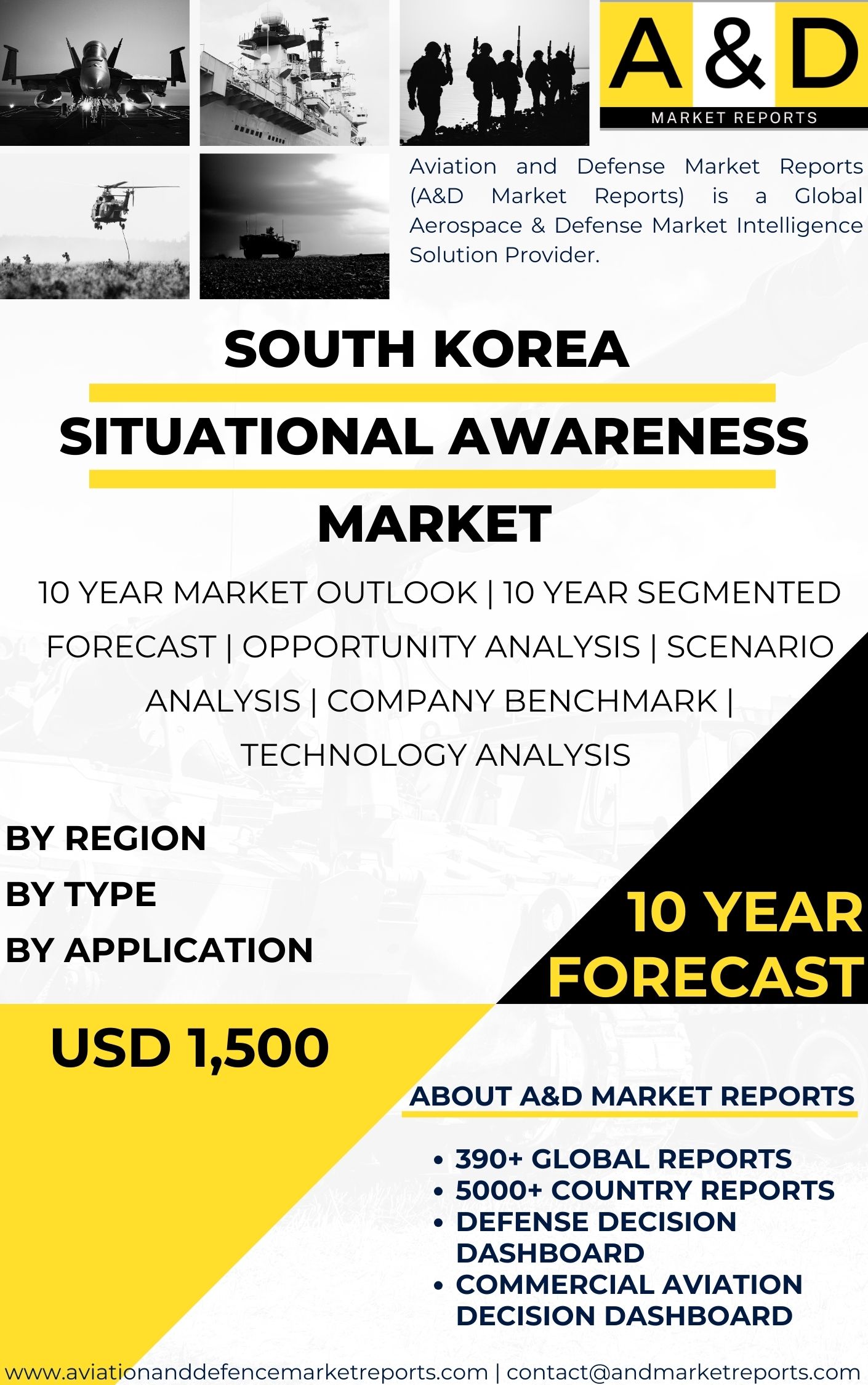
South Korea Situational Awareness Market

$1,500.00

Enquire Now

The situational awareness market in South Korea is experiencing significant growth, fueled by advancements in technology and increasing demands from various sectors such as defense, public safety, transportation, and smart city infrastructure. As the country focuses on modernizing its defense capabilities and improving security protocols, situational awareness solutions have become pivotal for enhancing operational effectiveness. These systems encompass a broad range of components including sensors, cameras, GPS, networked devices, and software platforms that aggregate and analyze real-time data to provide comprehensive environmental understanding and decision support.

Go To Global Report Page Track this market real time on DDD

Description

Situational Awareness Market in South Korea: Overview

The situational awareness market in South Korea is growing steadily due to rising demand across defense, public safety, transportation, and smart city projects. The country is investing heavily in modern security systems to improve real-time monitoring and decision-making. Situational awareness solutions combine sensors, cameras, GPS, networked devices, and software to deliver clear and timely operational insights.

Defense Sector Driving the Situational Awareness Market in South Korea

The defense sector is a primary growth driver for the situational awareness market in South Korea.

Role of C4ISR Systems

South Korea relies on advanced C4ISR systems to address regional security concerns. These systems depend on situational awareness tools to support fast threat detection and response. Accurate data improves command efficiency and battlefield coordination.

Use of AI and Sensor Fusion

Artificial intelligence enhances threat recognition and mission planning. Sensor fusion improves visibility across land, air, and naval platforms. These capabilities strengthen operational readiness and situational clarity.

Public Safety and Smart City Applications

Public safety agencies increasingly adopt situational awareness systems.

Emergency Response and Urban Monitoring

Cities use these solutions to manage traffic, monitor crowds, and respond to emergencies. Real-time data helps authorities deploy resources more effectively during critical events.

Smart Infrastructure Management

Situational awareness tools support energy management, environmental monitoring, and transport systems. These technologies align with South Korea’s focus on smart and efficient urban development.

Commercial Adoption Across Industries

The commercial sector expands the situational awareness market in South Korea.

Industrial and Logistics Use Cases

Factories and logistics hubs use sensors and analytics to track equipment and workflows. Predictive monitoring reduces downtime and improves productivity.

Automotive and Autonomous Systems

Connected and autonomous vehicles rely on situational awareness for navigation and obstacle detection. These systems improve safety and driving accuracy.

Cybersecurity Integration in Situational Awareness Systems

Cybersecurity plays a critical role in situational awareness frameworks.

Real-Time Threat Monitoring

Organizations integrate cyber monitoring with physical awareness systems. This approach protects infrastructure and sensitive data from digital threats.

Cloud-Based Platforms

Cloud solutions enable secure data sharing and scalability. They improve collaboration between agencies and support faster decision-making.

Challenges in the Situational Awareness Market in South Korea

Despite strong growth, challenges remain.

High Costs and System Complexity

Deployment costs can be high, especially for smaller organizations. Integrating multiple technologies also increases system complexity.

Data Privacy and Compliance

Protecting sensitive data requires strict regulatory compliance. Security requirements can slow adoption and deployment.

Future Outlook of the Situational Awareness Market in South Korea

The situational awareness market in South Korea is expected to grow at a steady pace. Demand will continue from defense modernization, smart city projects, public safety needs, and industrial automation. Strong adoption of AI, IoT, and cloud technologies will support innovation. As security and efficiency remain national priorities, the market will advance in both scale and sophistication.
Table of content

Table Of Contents

1 Market Introduction

1.1 Market Introduction
1.2 Market Definition
1.3 Market Segmentation
1.4 10 Year Market Outlook

2 Market Technologies

3 Global Market Forecast

3.1 Global Market Forecast
3.2 By Type
3.3 By Application

4 APAC Market Trends & Forecast

4.1 Drivers, Restraints And Challenges
4.2 PEST
4.3 Market Forecast
4.3.1 Market Forecast By Type
4.3.2 Market Forecast By Application
4.4 Scenario Analysis
4.5 Key Companies& Profiling

5 South Korea Analysis

5.1 Current Levels Of Technology Maturation In This Market
5.2 Market Forecast
5.2.1 Market Forecast By Type
5.2.2 Market Forecast By Application
5.3 Scenario Analysis
5.4 Country Defense Budget (Historical and 10- year forecast)
5.5 Defense Budget Category Spending- 10- year forecast
5.6 Procurement Analysis
5.7 EXIM Data
5.8 Patents

6 Opportunity Matrix

6.1 By Type
6.2 By Application

7 Scenario Analysis

7.1 Scenario 1

7.1.1 By Type (Scenario-1)
7.1.2 By Application (Scenario-1)

7.2 Scenario 2

7.2.1 By Type (Scenario-2)
7.2.2 By Application (Scenario-2)

8 Company Benchmark

9 Strategic Conclusions

10 About Aviation And Defense Market Reports

Segments

By Type
By Application

List of Tables

Table1: Global Market Forecast, Situational Awareness Market
Table2: APAC Market Forecast, Situational Awareness Market
Table3: APAC Market Forecast, By Type
Table4: APAC Market Forecast, By Application
Table5: APAC, Scenario Analysis
Table6: South Korea Market Forecast, Situational Awareness Market
Table7: South Korea Market Forecast, By Type
Table8: South Korea Market Forecast, By Application
Table9: South Korea, Scenario Analysis
Table 10: South Korea Defense Budget 10 Year Forecast
Table 11: South Korea, Defense Budget Category Spending- 10- year forecast
Table 12: South Korea, Procurement Analysis
Table 13: South Korea, EXIM Data Analysis
Table 14: South Korea, Opportunity Analysis, By Type
Table 15: South Korea, Opportunity Analysis, By Application
Table 16: South Korea, Scenario Analysis, By Type
Table 17: South Korea, Scenario Analysis, By Application

List of Figures

Figure 1: Market Segmentation, South Korea Situational Awareness Market
Figure 2: Key Technology Analysis, Situational Awareness Market
Figure 3: Global Market Forecast, Situational Awareness Market
Figure 4: APAC, Market Forecast, Situational Awareness Market
Figure 5: APAC, Market Forecast, By Type
Figure 6: APAC, Market Forecast, By Application
Figure 7: APAC, Scenario Analysis
Figure 8: South Korea, Market Forecast, Situational Awareness Market
Figure 9: South Korea, Market Forecast, By Type
Figure 10: South Korea, Market Forecast, By Application
Figure 11: South Korea, Scenario Analysis
Figure 12: South Korea, Defense Budget 10 Year Forecast
Figure 13: South Korea, Defense Budget Category Spending- 10- year forecast
Figure 14: South Korea, Procurement Analysis
Figure 15: South Korea, EXIM Data Analysis
Figure 16: South Korea, Opportunity Analysis, By Type
Figure 17: South Korea, Opportunity Analysis, By Application
Figure 18: South Korea, Scenario Analysis, By Type
Figure 19: South Korea, Scenario Analysis, By Application
Figure 20: Company Benchmark