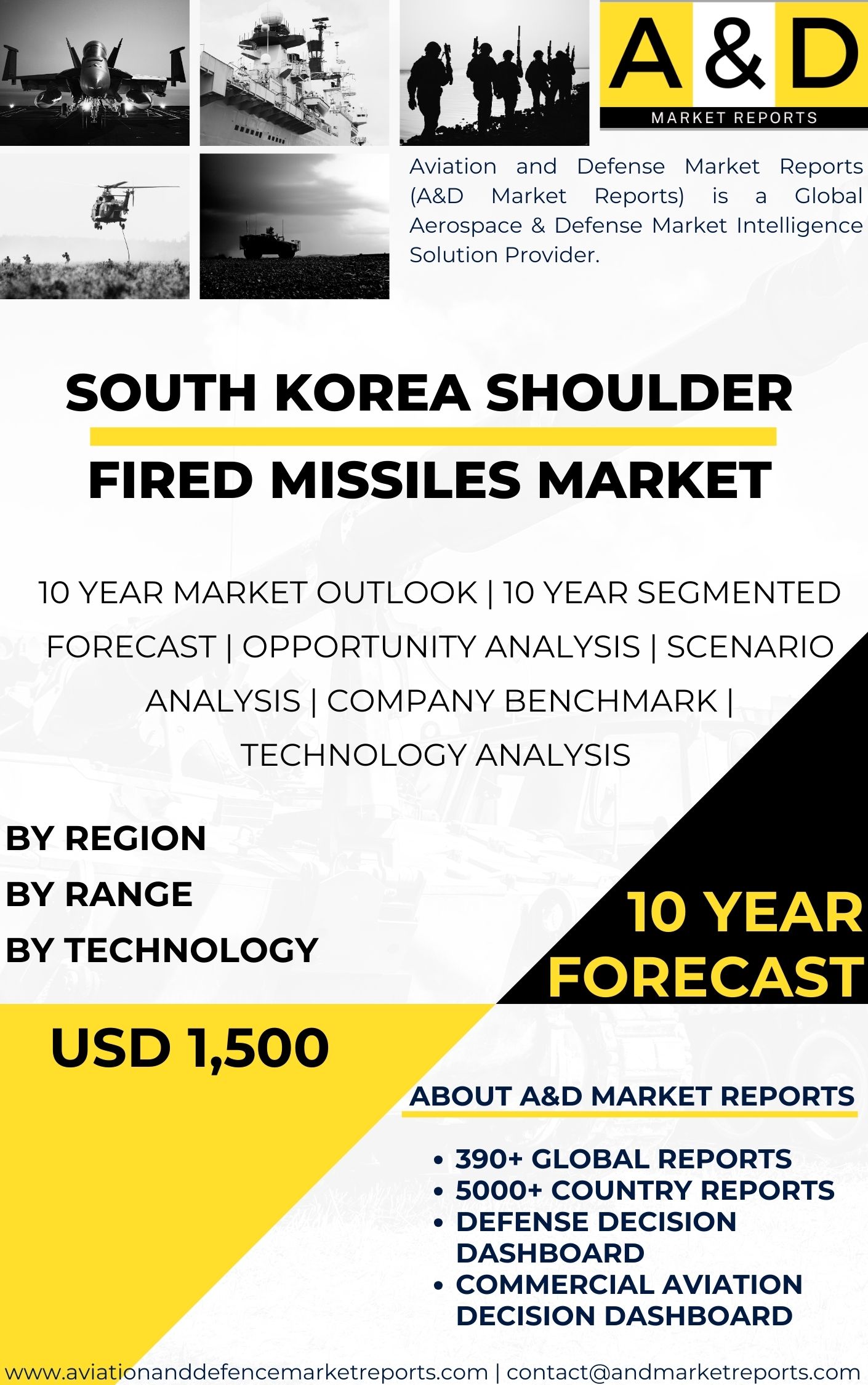
South Korea Shoulder Fired Missiles Market

$1,500.00

Enquire Now

The South Korea shoulder-fired missiles market is a significant segment of the country’s defense industry, providing advanced and portable anti-tank and anti-aircraft missile systems. Shoulder-fired missiles, also known as man-portable air-defense systems (MANPADS) or anti-tank guided missiles (ATGMs), are crucial assets for ground forces, providing them with the capability to engage armored vehicles, helicopters, and other aerial threats with precision and mobility. South Korea’s focus on indigenous development, strategic partnerships, and technological innovation has positioned it as a major player in the global shoulder-fired missiles market.

Go To Global Report Page Track this market real time on DDD

Description

South Korea Shoulder-Fired Missiles Market Overview

The Shoulder Fired Missiles Market is an important part of the country’s defense industry. It supplies portable missile systems used by ground forces in combat situations.

These systems include man-portable air-defense systems and anti-tank guided missiles. They help soldiers counter armored vehicles and low-flying aircraft with speed and accuracy.

Role of Shoulder-Fired Missiles in Modern Warfare

Tactical Importance on the Battlefield

Shoulder-fired missiles play a key role in modern military operations. They allow infantry units to engage threats from safe distances.

These systems are light and easy to carry. This makes them ideal for fast-moving and asymmetric combat scenarios.

Mobility and Precision Advantages

Soldiers can deploy these missiles quickly in the field. Their precision improves mission success while reducing risk to friendly forces.

Indigenous Development in the South Korea Shoulder-Fired Missiles Market

Focus on Domestic Manufacturing

Indigenous development is central to the South Korea shoulder-fired missiles market. Local defense firms design systems to meet national military needs.

Companies such as LIG Nex1 and Hanwha Defense lead this effort. They develop advanced missile systems for local deployment.

Strengthening Defense Capabilities

Domestic production improves system reliability and long-term support. It also enhances military self-reliance.

Key Shoulder-Fired Missile Systems in South Korea

Chungung Missile System

One notable system in South Korea’s inventory is the Chungung missile. It is designed to counter low-flying aircraft and helicopters.

The system is mobile and easy to deploy. Infantry units can use it in many operational environments.

Strategic Partnerships and Technology Cooperation

South Korea builds partnerships with international defense companies. These collaborations support technology transfer and joint development.

They also help integrate advanced components into local missile platforms. This improves system performance and effectiveness.

Research and Development Advancements

Improving Range and Accuracy

Investment in research and development drives progress in missile technology. Programs focus on better range and targeting accuracy.

Advanced guidance systems and modern seekers improve threat detection.

Fire-and-Forget Capabilities

Newer systems include fire-and-forget features. These allow operators to move immediately after launch.

Export Potential of the South Korea Shoulder-Fired Missiles Market

The South Korea shoulder-fired missiles market extends beyond domestic demand. The country exports missile systems and related technologies.

Successful exports highlight system reliability and performance. They also support growth in the defense industry.

Training and Operational Readiness

South Korea emphasizes training for missile operators. Programs cover handling, targeting, and engagement procedures.

Realistic training improves effectiveness during combat missions.

Safety and Reliability Standards

Safety remains a top priority in missile deployment. Strict regulations govern missile handling and maintenance.

These standards reduce risks to soldiers and civilians. They also ensure system reliability in the field.

Future Outlook of the South Korea Shoulder-Fired Missiles Market

The South Korea shoulder-fired missiles market continues to grow with defense modernization efforts. Indigenous development and innovation remain key drivers.

Advanced missile systems strengthen infantry capabilities and military readiness. Continued investment will support long-term national security objectives.

Table of content

Table Of Contents

1 Market Introduction

1.1 Market Introduction
1.2 Market Definition
1.3 Market Segmentation
1.4 10 Year Market Outlook

2 Market Technologies

3 Global Market Forecast

3.1 Global Market Forecast
3.2 By Range
3.3 By Technology

4 APAC Market Trends & Forecast

4.1 Drivers, Restraints And Challenges
4.2 PEST
4.3 Market Forecast
4.3.1 Market Forecast By Range
4.3.2 Market Forecast By Technology
4.4 Scenario Analysis
4.5 Key Companies& Profiling

5 South Korea Analysis

5.1 Current Levels Of Technology Maturation In This Market
5.2 Market Forecast
5.2.1 Market Forecast By Range
5.2.2 Market Forecast By Technology
5.3 Scenario Analysis
5.4 Country Defense Budget (Historical and 10- year forecast)
5.5 Defense Budget Category Spending- 10- year forecast
5.6 Procurement Analysis
5.7 EXIM Data
5.8 Patents

6 Opportunity Matrix

6.1 By Range
6.2 By Technology

7 Scenario Analysis

7.1 Scenario 1

7.1.1 By Range (Scenario-1)
7.1.2 By Technology (Scenario-1)

7.2 Scenario 2

7.2.1 By Range (Scenario-2)
7.2.2 By Technology (Scenario-2)

8 Company Benchmark

9 Strategic Conclusions

10 About Aviation And Defense Market Reports

Segments

By Range
By Technology

List of Tables

Table1: Global Market Forecast, South Korea Shoulder Fired Missiles Market
Table2: APAC Market Forecast, South Korea Shoulder Fired Missiles Market
Table3: APAC Market Forecast, By Range
Table4: APAC Market Forecast, By Technology
Table5: APAC, Scenario Analysis
Table6: South Korea Market Forecast, South Korea Shoulder Fired Missiles Market
Table7: South Korea Market Forecast, By Range
Table8: South Korea Market Forecast, By Technology
Table9: South Korea, Scenario Analysis
Table 10: South Korea Defense Budget 10 Year Forecast
Table 11: South Korea, Defense Budget Category Spending- 10- year forecast
Table 12: South Korea, Procurement Analysis
Table 13: South Korea, EXIM Data Analysis
Table 14: South Korea, Opportunity Analysis, By Range
Table 15: South Korea, Opportunity Analysis, By Technology
Table 16: South Korea, Scenario Analysis, By Range
Table 17: South Korea, Scenario Analysis, By Technology

List of Figures

Figure 1: Market Segmentation, South Korea Shoulder Fired Missiles Market
Figure 2: Key Technology Analysis, South Korea Shoulder Fired Missiles Market
Figure 3: Global Market Forecast, South Korea Shoulder Fired Missiles Market
Figure 4: APAC, Market Forecast, South Korea Shoulder Fired Missiles Market
Figure 5: APAC, Market Forecast, By Range
Figure 6: APAC, Market Forecast, By Technology
Figure 7: APAC, Scenario Analysis
Figure 8: South Korea, Market Forecast, South Korea Shoulder Fired Missiles Market
Figure 9: South Korea, Market Forecast, By Range
Figure 10: South Korea, Market Forecast, By Technology
Figure 11: South Korea, Scenario Analysis
Figure 12: South Korea, Defense Budget 10 Year Forecast
Figure 13: South Korea, Defense Budget Category Spending- 10- year forecast
Figure 14: South Korea, Procurement Analysis
Figure 15: South Korea, EXIM Data Analysis
Figure 16: South Korea, Opportunity Analysis, By Range
Figure 17: South Korea, Opportunity Analysis, By Technology
Figure 18: South Korea, Scenario Analysis, By Range
Figure 19: South Korea, Scenario Analysis, By Technology
Figure 20: Company Benchmark

Aviation and Defense Market Reports


TPA | TIA | Consulting | Market Reports | Defense Decision Dashboard


Our Defense Report - Our Team Has Worked on More Than 250+ Individual Products / Markets